A practical guide to coquina shell around tree trunks
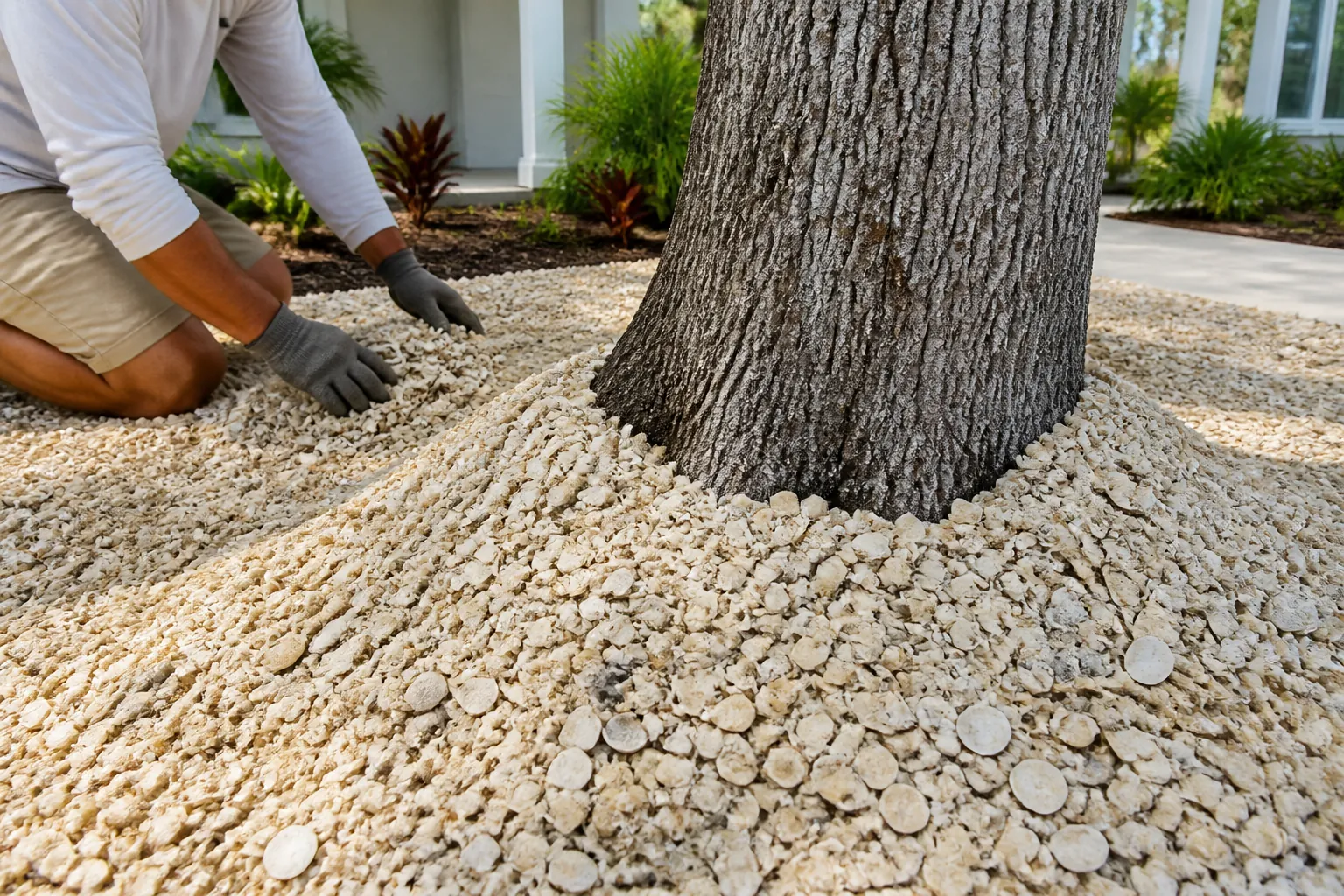
Coquina shell can give a Florida yard a light, coastal appearance, but using it near a tree takes more thought than covering an empty patch of ground. Tree trunks, surface roots, irrigation and soil conditions all influence whether shell is a sensible choice. The goal is to create a useful ground covering without burying the tree’s base or making its growing conditions harder to manage.
This guide focuses on choosing, ordering and placing coquina shell around tree trunks yourself. Tropical Yards supplies coquina shell and tropical plants, with dump trailer delivery from St. Augustine to Daytona Beach. Placement, planting and ongoing care remain the buyer’s responsibility.
Is Coquina Shell A Good Choice Around Your Tree?
Start with the tree rather than the material. A healthy, established tree in a well-drained location may tolerate a carefully positioned shell-covered area. A newly planted tree, a tree with exposed roots or a tree already showing stress needs a more cautious approach.
Coquina shell is not interchangeable with organic mulch. Wood-based mulch gradually decomposes and contributes organic matter. Shell persists longer and creates a different surface environment. Its pale appearance can also reflect light toward nearby trunks and plants.
Shell contains calcium carbonate. Depending on the material, soil conditions and exposure to water, it can contribute to changes in soil alkalinity over time. That matters when the tree or surrounding plants prefer acidic growing conditions. Do not assume that every Florida tree or planting bed will respond the same way.
- Identify the tree and check its soil and moisture preferences before choosing shell for its root area.
- Look for declining foliage, soft ground, standing water or trunk damage before adding any ground covering.
- Use a soil test if soil pH is unknown, especially near plants that prefer acidic soil.
- Consider keeping organic mulch closer to the tree and using shell farther outward where conditions allow.
If the tree is valuable, visibly stressed or difficult to identify, ask a qualified arborist or your local UF/IFAS Extension office about its specific needs. A decorative material should not be used to disguise a drainage problem or an unhealthy tree base.
Keep The Trunk And Root Flare Uncovered
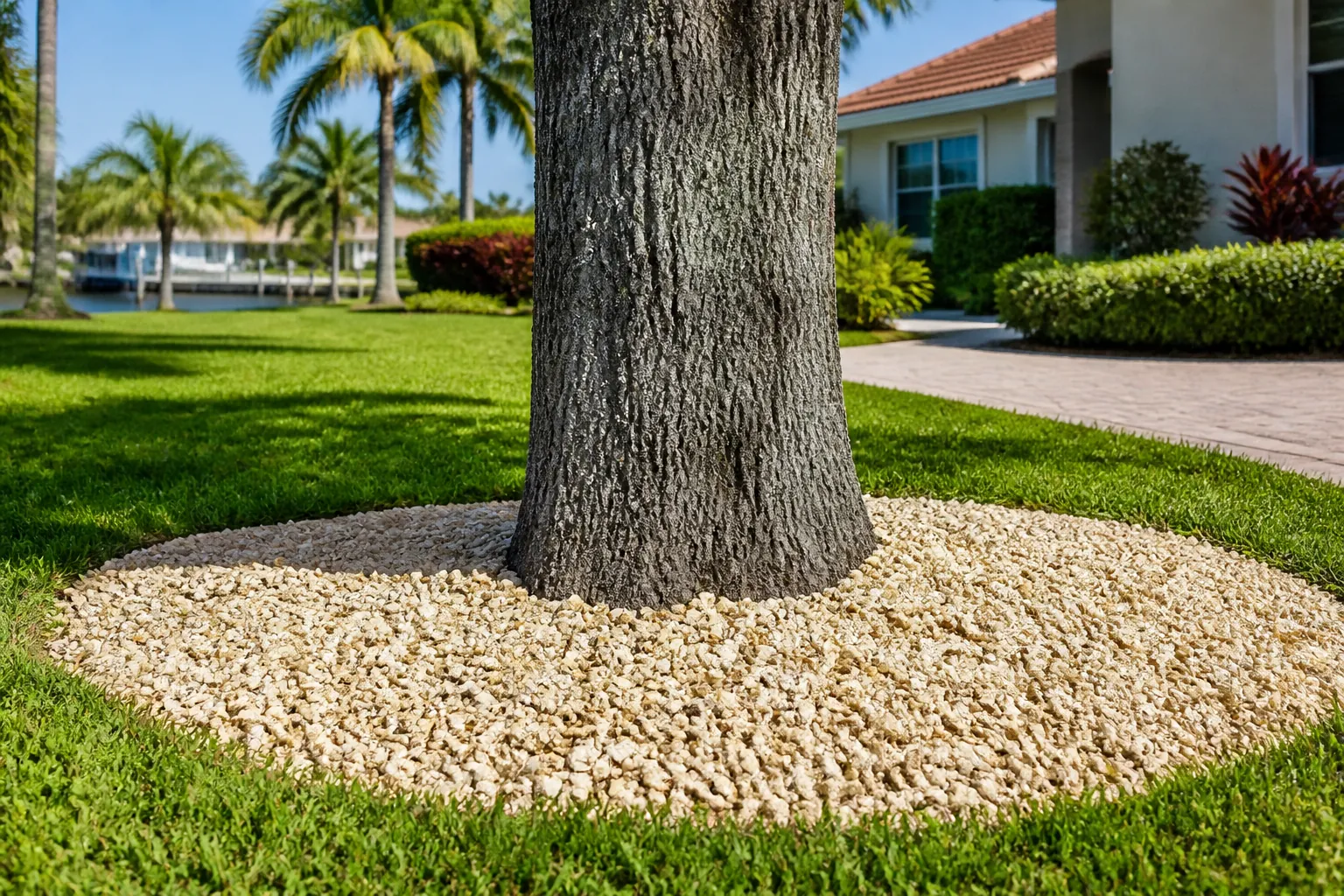
The most important rule for coquina shell around tree trunks is straightforward: do not pile shell against bark. The root flare is the widening area where a tree’s trunk transitions into its main roots. It should remain visible rather than disappearing beneath shell, soil or another covering.
Material piled against the trunk can hold moisture against bark, obscure damage and interfere with routine inspection. A raised mound can also encourage roots to grow into the covering instead of remaining in the underlying soil. Shell should form a shallow surrounding surface, not a volcano around the trunk.
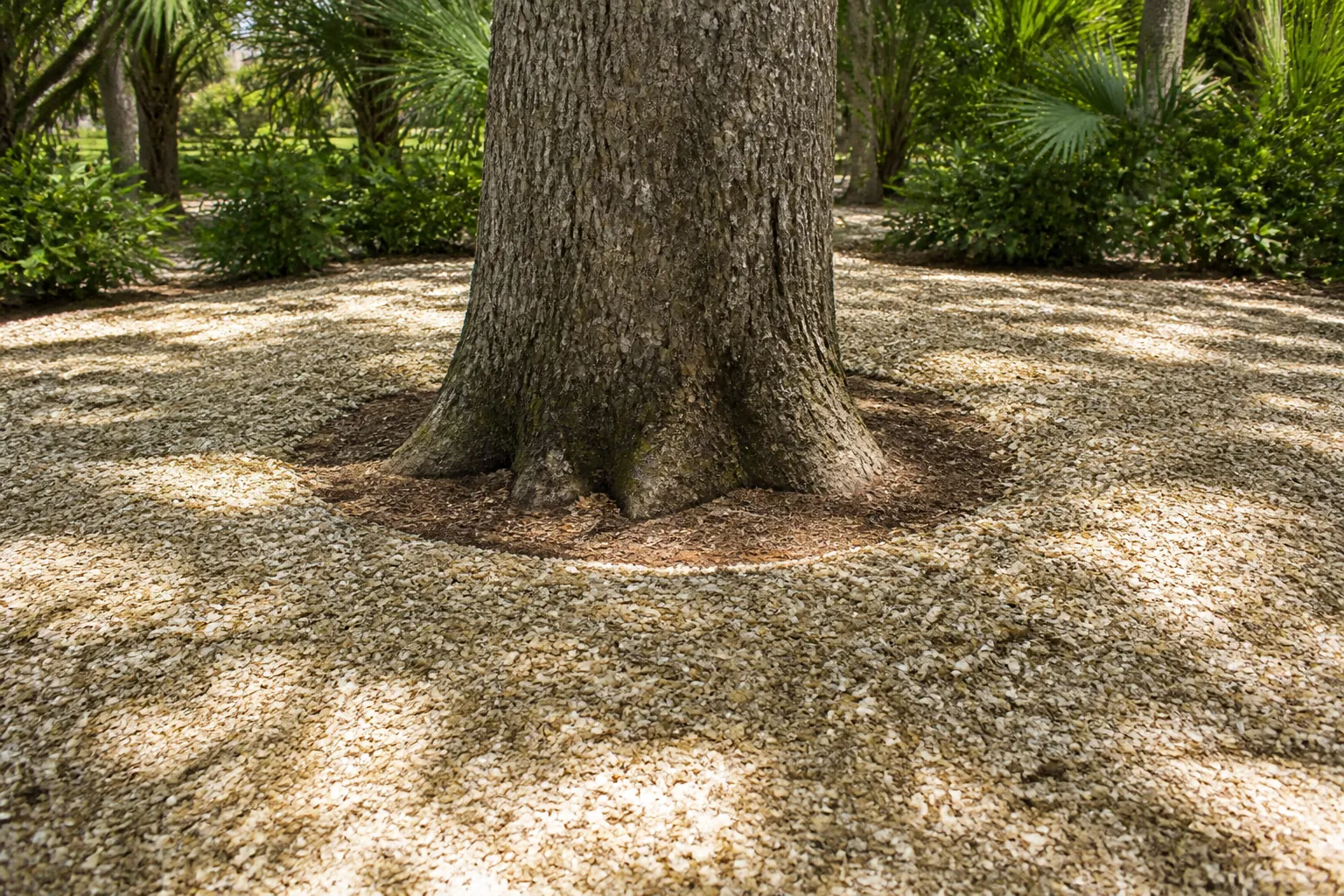
Leave a visible open space around the trunk, and extend that clearance wherever necessary to keep the entire root flare exposed. The appropriate opening depends on the tree’s size and existing root structure. A small, uniform circle is not sufficient if a broad flare extends beyond it.
- Locate the root flare before measuring the shell-covered area.
- Keep shell away from the trunk and off the exposed flare.
- Allow extra clearance for trunk growth and easy visual inspection.
- Avoid raising the surrounding ground level to make the surface look evenly covered.
If the trunk enters the ground like a straight pole and no flare is visible, it may already be buried too deeply. Do not excavate aggressively or cut roots while trying to expose it. Get tree-specific advice before changing the grade around an established tree.
Respect Surface Roots And Existing Soil Levels
Many Florida trees develop roots close to the soil surface. These roots are not simply obstacles to hide. They help support the tree and take up water and nutrients, and they can extend well beyond the canopy.
Do not shave, chop or remove roots to create a flat shell ring. Avoid digging a continuous edging trench through the root zone. Even shallow work can damage roots, especially when several cuts occur around the same tree.
Adding a deep layer of material can also change how air and water move through the root area. For that reason, shell should not be treated as fill for low spots around a trunk. If the surface is uneven because of roots, accept some unevenness or relocate the shell feature.
When planning a border, choose a position and method that minimize digging. Surface-positioned edging may be more practical than a deeply buried border, provided it can remain stable without damaging roots. Keep the border from restricting the trunk or trapping water against the tree.
Use hand tools carefully near visible roots. Do not run heavy equipment over the root zone or repeatedly move loaded wheelbarrows across the same soft ground. A temporary route outside the immediate tree area can reduce traffic while you move shell from the delivery pile.
Check Drainage, Irrigation And Nearby Plants
Shell does not repair poorly drained soil. Water movement depends on the soil beneath it, the slope of the site and any compaction or existing drainage restrictions. A shell surface can look dry while the ground underneath remains saturated.
Observe the area after rainfall and during an irrigation cycle before ordering. Look for water collecting near the trunk, runoff entering the bed and sprinklers repeatedly wetting the bark. Correcting irrigation placement or seeking drainage advice may be more important than changing the surface covering.
Avoid building a raised shell ring that acts like a basin around the tree. Likewise, do not redirect runoff toward a neighbor’s property or a building simply to keep the decorative area tidy. The surrounding grade should continue to function as intended.
- Check whether irrigation reaches the soil beneath the planned shell area rather than only wetting the surface.
- Keep sprinkler spray from repeatedly striking the trunk.
- Confirm that drip tubing remains accessible for inspection and repair.
- Leave room to observe soil moisture without disturbing roots.
Nearby plants deserve the same attention. Ferns, hibiscus, bougainvillea and palms do not all share identical moisture, light or soil requirements. Choose plants for the actual site rather than grouping them together solely because they look tropical.
Tropical Yards supplies palm trees, hibiscus, bougainvillea, ferns and other tropical plants. If you are purchasing plants for a nearby bed, identify the specific varieties and review their mature size and growing requirements before planting them yourself.
Choose Shell Based On Function, Not Appearance Alone
Before buying, ask what the available coquina shell looks like and how it is supplied. Particle size, the amount of finer material and the mix of shell fragments can affect the finished surface, handling and movement after rainfall.
Natural material can vary in color and texture. Evaluate it as a ground covering rather than expecting every piece to match. If visual consistency matters, ask about the current material before deciding on the quantity.
Think about how people will use the area. Shell fragments may be uncomfortable under bare feet and can move into adjacent lawn or walking areas. A decorative space beneath a tree has different requirements from a frequently used path.
- Ask about the available shell’s size and texture before ordering.
- Consider whether children, pets or barefoot traffic will cross the area.
- Plan a boundary where shell meets lawn, pavement or another ground covering.
- Choose a layout that leaves the trunk, major roots and irrigation components easy to inspect.
For broader material-selection guidance, visit the coquina shell page. Keep this tree-specific project focused on root protection and clearances rather than turning it into a general driveway or pathway project.
Measure The Area Before Ordering Coquina Shell
Measure only the ground you intend to cover. Exclude the open area around the trunk, exposed roots that will remain uncovered and any planting pockets. Ordering from the outside dimensions alone can overstate the amount needed.
For a circular ring, calculate the outer circle’s area and subtract the inner circle’s area. In feet, the calculation is 3.14 multiplied by the outer radius squared, minus 3.14 multiplied by the inner radius squared. A radius is half the diameter.
For example, a planned area measuring 12 feet across has an outer radius of 6 feet. If the uncovered center measures 4 feet across, its radius is 2 feet. Subtracting the inner area from the outer area gives approximately 100 square feet of coverage. These dimensions illustrate the math, not a recommended clearance for every tree.
Next, convert your intended layer depth from inches to feet and multiply it by the coverage area. Divide the resulting cubic feet by 27 to estimate cubic yards. At a hypothetical depth of 1 inch, 100 square feet would require about 8.3 cubic feet, or approximately 0.31 cubic yard before allowances.
The example depth is for calculation only. Confirm a suitable shallow application for your site rather than automatically copying a depth used on a path or another project. Ask how the supplier measures and sells the material so your estimate matches the ordering unit.
Irregular shapes can be divided into smaller rectangles and circles. Record the measurements, photograph the area and explain any roots or openings that reduce coverage. Discuss measurement uncertainty before ordering instead of assuming unused shell can be piled deeper around the tree.
Plan A Dump Trailer Delivery Without Blocking The Project
Tropical Yards offers dump trailer delivery of plants and coquina shell from St. Augustine to Daytona Beach. Before scheduling, describe the property access and your intended unloading location. Delivery is separate from spreading shell or planting trees and other plants.
Choose a drop location outside the tree’s root zone whenever practical. A concentrated pile of shell is heavy, and moving it later does not undo every effect of loading or traffic on soft soil. Keep the unloading area away from trunks, exposed roots and delicate planting beds.
Dump trailer access requires more than an open gate. The approach, turning room, surface condition and overhead clearance all matter. Provide accurate details and let the supplier confirm whether the proposed location is suitable.
- Describe narrow driveways, gates, slopes and tight turns when discussing delivery.
- Identify overhead branches, wires and other obstructions near the unloading area.
- Point out irrigation equipment, septic components and other sensitive areas.
- Keep parked vehicles and movable obstacles clear of the agreed access route.
- Plan your own labor, tools and time for moving shell after delivery.
If access is uncertain, discuss an alternative drop location before the delivery date. Do not assume a trailer can cross a lawn safely or place material directly beside a tree. Review the coquina shell delivery page for delivery-focused information, then confirm the details for your property.
Place The Shell Carefully As A DIY Project
Once the material arrives, work in manageable amounts. Gloves, closed-toe shoes and eye protection are sensible when handling shell and using tools. Avoid creating unnecessary dust, and follow any handling guidance provided for the material.
Begin by marking the trunk clearance and the outer boundary. If weeds are present, choose a removal method that will not disturb roots or damage the tree. Do not strip away soil or use a digging tool indiscriminately beneath an established canopy.
Landscape fabric is not automatically necessary. It can complicate future planting, interact with surface roots and become exposed as shell shifts. Plastic sheeting is particularly unsuitable where it restricts normal water and air movement. Consider whether a barrier is appropriate for the specific site rather than installing one by default.
- Move shell along a route that avoids repeated traffic over exposed roots.
- Spread small amounts gradually so you can monitor the developing layer.
- Keep the root flare and marked trunk opening clear throughout the work.
- Use gentle hand-tool movements near roots rather than forceful scraping.
- Stop if achieving the desired appearance would require burying roots or raising the grade.
Check the finished area from several angles. Make sure shell has not rolled into the trunk opening or covered irrigation emitters. Keep leftover material in an appropriate location away from the tree rather than adding it to the ring simply to empty the pile.
Watch The Tree After Adding Shell
A shell-covered area still needs observation. After rain, check for migration toward the trunk, pooling water and shell washing into lawn or drainage routes. Restore the open trunk area by hand if fragments move inward.
Assess soil moisture below the surface before changing irrigation. A light-colored surface is not evidence that the root zone needs more water. Likewise, shell that appears damp does not necessarily mean the soil has adequate moisture throughout the relevant rooting depth.
Watch for changes in leaf color, canopy density or growth. Those symptoms can have several causes, so do not automatically attribute them to shell or attempt to correct them with fertilizer. Seek tree-specific advice if changes persist.
Avoid repeatedly adding material as the surface settles or shifts. First determine where the shell went and whether more is actually needed. Preserving the original soil level and visible root flare remains more important than maintaining a perfectly uniform appearance.
Order With The Tree’s Needs In Mind
The best coquina shell project begins with a suitable tree and site, a clear trunk opening and a realistic delivery plan. Measure the actual coverage area, ask about the available material and prepare to move and spread it yourself without disturbing roots.
For coquina shell sales, tropical plant sales and dump trailer delivery from St. Augustine to Daytona Beach, call Tropical Yards at 772-267-1611. Have your measurements, access details and intended drop location ready so you can discuss your purchase and delivery needs.
Tropical Yards supplies the materials and delivers them. You remain responsible for placement, planting and care, with arborist or Extension guidance when the tree’s condition calls for it.
Call 772-267-1611 to talk through next steps.