The Complete Guide to Coquina Shell in Northeast Florida — Pricing, Delivery & Applications
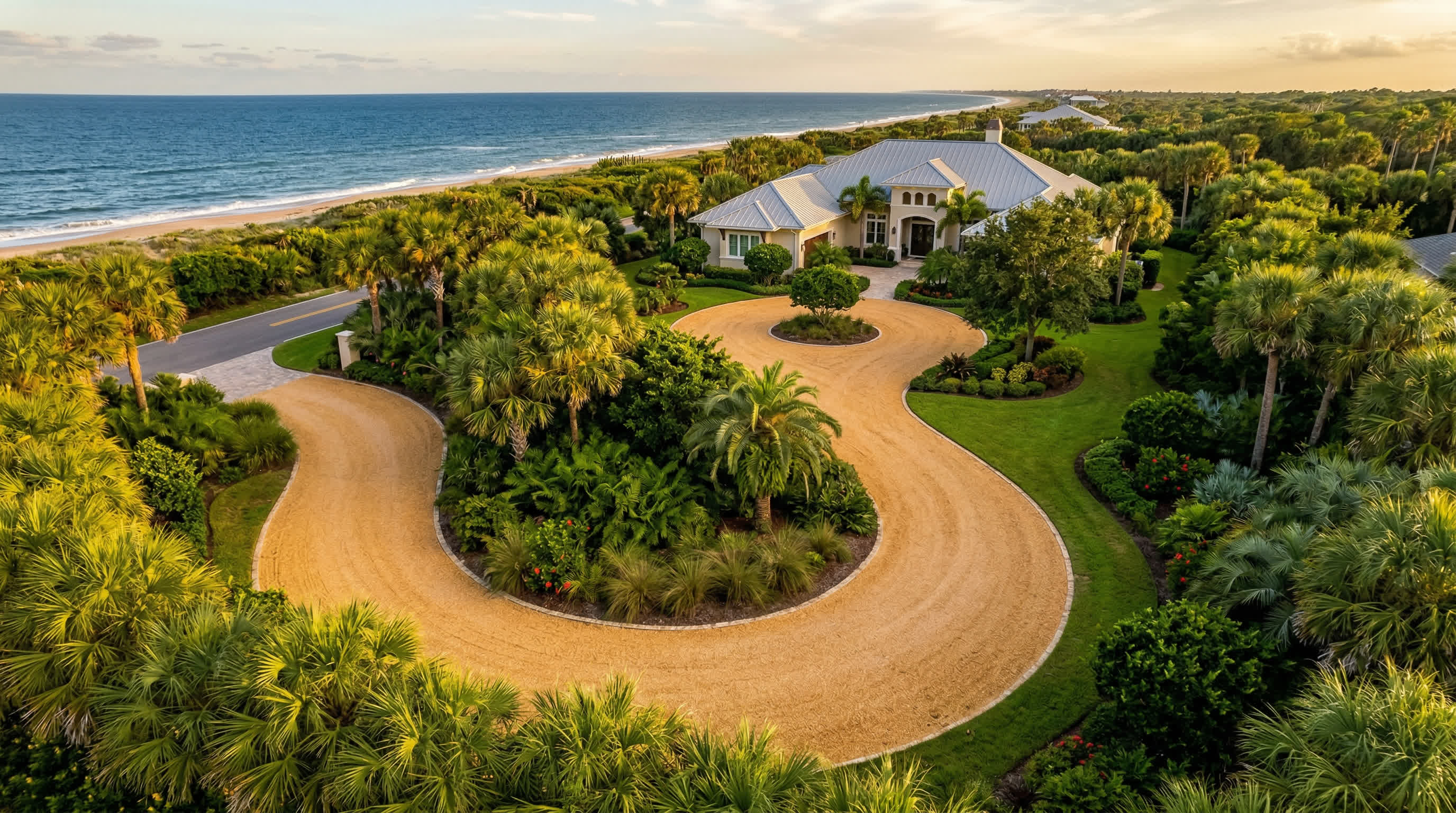
Short answer: Coquina shell is a naturally occurring Florida material made of compressed fragments of small bivalve shells and shell particles. It is the top choice for driveways, garden beds, pool decks, and walkways across Northeast Florida because it drains instantly, stays cool underfoot, looks native to the coastal landscape, and never breaks down or needs annual replacement the way bark mulch does. Coquina shell from Tropical Yards is priced at $145 per cubic yard, delivered by dump trailer throughout Northeast Florida from St. Augustine to Daytona Beach.
Key Takeaways
- Coquina shell is priced at $145 per cubic yard from Tropical Yards, with dump trailer delivery to St. Augustine ($250), Ponte Vedra ($275), Palm Coast ($300), Flagler Beach ($300), Ormond Beach ($350), and Daytona Beach ($375).
- Northeast Florida's sandy, fast-draining soil and humid coastal climate make coquina shell an ideal year-round ground cover — it does not mold, float in rain, or attract termites the way organic bark mulch does.
- For driveways, install coquina shell at a minimum depth of 4 inches over a compacted base; for garden beds and walkways, 2 to 3 inches is sufficient for weed suppression and moisture regulation.
- A standard cubic yard of coquina shell covers approximately 100 square feet at a 3-inch depth — use this benchmark to calculate how many yards your project requires before ordering.
- Coquina shell is significantly more cost-effective over a 5-year horizon than bark mulch (which needs annual replacement), pea gravel (which sinks and requires topping off), or crushed concrete (which compacts poorly and stains).
- Around palm trees and pool decks, coquina shell eliminates standing water, reduces heat absorption, and creates the coastal resort aesthetic that makes Northeast Florida yards stand out.
- Coquina shell requires almost no maintenance — occasional raking to redistribute material and periodic topping-off every 2 to 3 years are the only tasks required after initial installation.
In This Article
- What is coquina shell and why is it perfect for Northeast Florida?
- Coquina shell price per yard — what does it cost in NE Florida?
- Coquina shell delivery zones and pricing across Northeast Florida
- Coquina shell for driveways — depth, installation, pros and cons
- Coquina shell for garden beds, walkways, and pathways
- Coquina shell around palm trees and pool decks
- Coquina shell for drainage solutions in Northeast Florida yards
- How much coquina shell do you need? Coverage calculator
- Coquina shell vs. alternatives — pea gravel, mulch, crushed concrete, shell rock
- Coquina shell maintenance and longevity
- Frequently Asked Questions
What is coquina shell and why is it perfect for Northeast Florida?
Coquina shell is a naturally occurring sedimentary material composed of millions of tiny bivalve mollusk shells — predominantly from the coquina clam (Donax variabilis), a small surf-zone clam endemic to Florida's Atlantic coast. Over thousands of years, wave action and tidal deposits have accumulated these shell fragments along Florida's coastal dunes and beaches, creating the distinctive cream-to-tan shell aggregate that Northeast Florida homeowners and contractors use as a ground cover, driveway base, and landscaping mulch. Unlike quarried limestone gravel or manufactured aggregate, coquina shell is a genuinely local material — it comes from the same coastal environment where it will be used, and it carries an inherently Florida aesthetic that no imported stone can replicate.
The reason coquina shell performs so well in Northeast Florida specifically comes down to climate and geology. The region's sandy, fast-draining soils — formed by ancient coastal dune systems and marine terrace deposits — share the same mineral composition as coquina shell itself. When you install coquina shell in a garden bed or driveway in St. Augustine, Ponte Vedra, or Palm Coast, you are effectively returning a native material to its native environment. This means coquina shell integrates naturally with the existing soil chemistry rather than fighting it. There is no pH mismatch, no leaching of foreign minerals, and no visual clash with the sandy soil visible at bed edges.
From a practical standpoint, coquina shell solves every major landscaping challenge that Northeast Florida's coastal climate creates. First, drainage: Northeast Florida receives an average of 50 to 54 inches of rainfall per year, much of it concentrated in intense summer afternoon thunderstorms that can drop two inches of rain in 45 minutes. Bark mulch floats, migrates, and clogs drainage during these events. Coquina shell drains immediately — water passes through the shell layer within seconds and continues into the sandy substrate below, eliminating standing water in planting beds and alongside driveways within minutes of the heaviest rainfall. Second, humidity and mold: bark mulch in Northeast Florida's summer humidity creates ideal conditions for mold, fungus, and the soil-borne pathogens that cause root rot in palm trees and tropical plants. Coquina shell is inorganic and does not support mold or fungal growth under any humidity condition. Third, pest resistance: organic mulches attract termites, fire ants, and fungus gnats. Coquina shell is an inorganic mineral material that offers no food or habitat for any common landscape pest.
Aesthetically, coquina shell captures the coastal character of Northeast Florida better than any alternative material. Its creamy off-white color coordinates naturally with the sandy soil, the bleached wood of coastal hardscape, and the gray-green foliage of native and tropical plants alike. It reflects rather than absorbs heat — an important quality in a region where summer soil temperatures under dark bark mulch can reach 140°F and damage shallow root systems. And unlike pea gravel or crushed concrete, coquina shell has a regional identity: it is the material used to build the Castillo de San Marcos in St. Augustine, one of the oldest masonry structures in North America. When you choose coquina shell for your Northeast Florida yard, you are not just selecting the most practical ground cover — you are choosing a material that belongs here.
- Coquina shell ground cover for sale in St. Augustine and Northeast Florida — native coastal material
- What is coquina shell used for in Ponte Vedra Beach and St. Johns County Florida landscaping
- Coquina shell vs bark mulch for humid coastal yards in Palm Coast and Flagler Beach FL
- Best ground cover for sandy soil driveways and garden beds in Northeast Florida coastal communities
- Native shell material for driveways, walkways, and garden beds in Daytona Beach and Ormond Beach FL
Is coquina shell the same as shell rock or crushed shell?
No — these are distinct materials. Coquina shell is specifically composed of fragmented Donax clam shells and similar small bivalve shell particles native to Florida's Atlantic coast. Shell rock (also called coquina rock or Florida coquina) is a quarried sedimentary limestone formed when coquina deposits have been compressed and cemented over geologic time — it is much harder and is used as a construction aggregate. Crushed shell is a broader category that can include oyster shell, clam shell, or mixed shell products from various sources. When Tropical Yards refers to coquina shell, we mean the natural, loose shell aggregate at $145 per yard — not shell rock or generic crushed shell blends.
Coquina shell price per yard — what does it cost in Northeast Florida?
Coquina shell from Tropical Yards is priced at $145 per cubic yard, delivered to your property by dump trailer throughout Northeast Florida. This is the delivered price — there are no hidden fees, no material markup, and no per-bag retail premium. The $145 per yard figure is for the material itself; delivery is a separate flat fee that varies by distance from our St. Augustine base of operations (see the delivery zone table in the next section).
To put the $145 per yard price in context: retail bagged coquina shell or shell products at big-box home improvement stores typically run $6 to $9 per 0.5 cubic foot bag, which translates to $324 to $486 per cubic yard equivalent — more than three times our bulk delivery price. Even specialty landscape supply yards that sell loose shell by the yard typically charge $180 to $220 per yard before delivery. Tropical Yards' $145 per yard price reflects direct sourcing from Florida coastal shell suppliers and the efficiencies of dump trailer bulk delivery, where a single trip can carry 5 to 8 yards of material to your property at once.
For budget planning purposes, a typical residential project in Northeast Florida involves the following approximate material costs at $145 per yard: a single-car driveway (approximately 400 square feet at 4 inches deep) requires about 5 yards, or $725 in material. A two-car driveway (approximately 700 square feet) requires 9 yards, or $1,305 in material. A complete garden bed refresh for an average St. Augustine or Ponte Vedra home (1,200 square feet of planting beds at 3 inches deep) requires about 11 yards, or $1,595 in material. Pool deck surrounds and walkways typically add 2 to 4 additional yards. Most full-property coquina shell projects in Northeast Florida run between 8 and 20 yards of material, placing the total material cost between $1,160 and $2,900 before delivery.
There is no minimum order quantity for coquina shell from Tropical Yards, but because the delivery fee is a flat rate regardless of how many yards are on the load, larger orders are more cost-efficient per yard when the delivery fee is amortized across the total volume. Ordering 10 yards with a $250 delivery fee to St. Augustine adds $25 per yard to your effective cost; ordering 3 yards with the same delivery fee adds $83 per yard. For maximum cost efficiency, plan your project thoroughly before ordering and aim to cover your entire property's needs in a single delivery load.
- Coquina shell price per yard in St. Augustine and Northeast Florida — $145 per yard delivered
- How much does coquina shell cost in Ponte Vedra Beach, Nocatee, and St. Johns County FL
- Bulk coquina shell cost per cubic yard vs bagged shell at Home Depot in Northeast Florida
- Coquina shell delivery price per yard for driveways and garden beds in Palm Coast Flagler County FL
- Wholesale coquina shell pricing for contractors and homeowners in Ormond Beach and Daytona Beach FL
Does the $145 per yard price include delivery?
No — $145 per yard is the material price only. Delivery is a separate flat fee that varies by your location: St. Augustine is $250, Ponte Vedra is $275, Palm Coast and Flagler Beach are $300 each, Ormond Beach is $350, and Daytona Beach is $375. The delivery fee covers the entire load regardless of how many yards are on the trailer, so larger orders spread the delivery cost over more material. Call or text 772-267-1611 to confirm pricing and availability for your specific address.
Coquina shell delivery zones and pricing across Northeast Florida
Tropical Yards delivers coquina shell by dump trailer throughout Northeast Florida, from St. Johns County in the north to Volusia County in the south. Our delivery model uses a flat fee per trip — not a per-yard delivery charge — which means you pay the same delivery fee whether your load carries 3 yards or 10 yards of coquina shell. This structure rewards larger orders and makes it practical to fill your entire project in a single delivery rather than making multiple smaller purchases.
All deliveries are made by dump trailer, which means the material is delivered directly to your driveway or the edge of your property in bulk. This is the most efficient and lowest-cost way to receive large quantities of coquina shell. Our trailer can access most standard residential driveways and side yards. If your access is restricted — narrow gates, low-clearance entries, or HOA-restricted delivery zones — let us know when you order so we can plan the most effective drop location.
| Delivery Zone | Areas Served | Delivery Fee |
|---|---|---|
| St. Augustine | St. Augustine, St. Augustine Beach, Anastasia Island, World Golf Village, Vilano Beach | $250 |
| Ponte Vedra | Ponte Vedra Beach, Nocatee, Palm Valley, Sawgrass, Marsh Landing, Jacksonville Beach | $275 |
| Palm Coast | Palm Coast, Hammock Beach, Grand Haven, Lehigh Woods | $300 |
| Flagler Beach | Flagler Beach, Bunnell, Beverly Beach, Marineland | $300 |
| Ormond Beach | Ormond Beach, Ormond-by-the-Sea, Tomoka Farms, Hunter's Ridge | $350 |
| Daytona Beach | Daytona Beach, Daytona Beach Shores, Port Orange, South Daytona, Holly Hill | $375 |
To illustrate the total cost of a typical order: a homeowner in Ponte Vedra ordering 8 yards of coquina shell would pay $1,160 in material (8 × $145) plus $275 in delivery, for a total of $1,435. A homeowner in Palm Coast ordering 6 yards would pay $870 in material plus $300 in delivery, totaling $1,170. Because coquina shell from Tropical Yards is priced significantly below retail alternatives, even the longer-distance delivery fees in the Ormond Beach and Daytona Beach zones still result in a lower total cost than purchasing bagged shell at local retailers.
Coquina shell deliveries can be combined on the same load with palm trees, tropical plants, and other landscape materials. If you are planning a complete yard transformation — coquina shell for beds and driveway, palms for accent planting, shrubs for privacy screening — ordering everything on one delivery load maximizes the value of the flat delivery fee. Contact Tropical Yards to confirm availability and schedule your delivery date.
- Coquina shell delivery to St. Augustine FL — $250 flat fee for dump trailer delivery to St. Johns County
- Coquina shell delivered to Ponte Vedra Beach, Nocatee, and Palm Valley FL — $275 per dump trailer load
- Bulk coquina shell dump trailer delivery to Palm Coast and Flagler Beach FL — $300 flat delivery fee
- Coquina shell delivery to Ormond Beach and Daytona Beach Florida with dump trailer — $350 to $375
- Same-load coquina shell and palm tree delivery across Northeast Florida — one flat delivery fee
Can coquina shell be delivered to gated communities in Northeast Florida?
Yes — Tropical Yards delivers to gated communities throughout Northeast Florida, including Ponte Vedra's Sawgrass, Marsh Landing, and The Plantation communities, as well as gated neighborhoods in Palm Coast, Ormond Beach, and Daytona Beach. When ordering, let us know your community name and gate access requirements. For HOA communities with specific delivery time windows or access restrictions, we coordinate with the delivery schedule your community requires. The dump trailer can access most standard residential driveways; if your access has specific constraints (low-clearance entry gates, restricted delivery hours), mention them when you call or text 772-267-1611.
Ready to Order Coquina Shell for Your Northeast Florida Yard?
Coquina shell at $145/yard — delivered by dump trailer from St. Augustine to Daytona Beach. View all delivery zones.
Get a Free Quote Call 772-267-1611Coquina shell for driveways — depth, installation, pros and cons
Coquina shell driveways are one of the most popular applications in Northeast Florida, particularly in coastal communities from St. Augustine Beach to Flagler Beach and Ponte Vedra. A coquina shell driveway costs a fraction of poured concrete or asphalt, requires no curing time, and can be installed in a single afternoon with a dump trailer delivery and a few hours of raking and compacting. Done correctly, a coquina shell driveway in a Florida coastal environment will last 5 to 10 years before needing significant replenishment — far longer than most homeowners expect from a shell surface. For a comprehensive step-by-step installation walkthrough, see our coquina shell driveway installation guide.
Recommended depth: For a residential driveway in Northeast Florida's sandy soil, install coquina shell at a minimum of 4 inches of compacted depth. This translates to approximately 5 to 6 inches of loose shell before compaction, since shell compacts by roughly 20 to 25 percent under vehicle traffic and a plate compactor. For driveways that receive heavy vehicle loads (trucks, RVs, delivery vehicles), install at 5 to 6 inches of compacted depth. Do not install shell over an unprepared sandy base without first addressing any soft spots or depressions that could cause differential settling under vehicle weight.
Base preparation: Begin by defining the driveway perimeter with landscape edging, timber borders, or concrete curbing. Compact the existing sandy subgrade with a plate compactor (available from local equipment rental centers) to eliminate soft spots. Some installers lay a geotextile weed barrier fabric over the compacted subgrade before adding shell — this is optional but recommended if significant weed pressure exists along the driveway edges. Install the coquina shell in two layers: a base layer of 2 to 3 inches compacted first, then a finish layer of 2 to 3 inches on top. Compact lightly after the finish layer to close the surface but avoid over-compacting, which reduces the drainage performance of the shell layer.
Pros of coquina shell driveways in Northeast Florida: Coquina shell drains instantly and completely — no standing water, no flooding, and no surface runoff that would cause erosion along driveway edges. The light color reflects heat, keeping the surface cooler underfoot than dark asphalt on summer afternoons. Shell driveways are permeable, which means they comply with stormwater management requirements that some St. Johns and Flagler County communities require for large impervious surface areas. The material is locally sourced and has a natural, coastal aesthetic that complements nearly every architectural style from old Florida Cracker to contemporary coastal modern. Installation cost is dramatically lower than concrete ($8 to $12 per square foot installed) or asphalt ($4 to $8 per square foot installed) — a coquina shell driveway typically costs $1.50 to $3.00 per square foot installed including material and delivery.
Cons of coquina shell driveways: Shell driveways do require periodic replenishment — vehicle traffic gradually displaces shell toward the edges, requiring raking back toward the center every few months, and top-off material should be added every 2 to 4 years. Shell can be tracked into the garage and house on vehicle tires and shoe soles. The surface is not as smooth as concrete and can make foot travel in heels or bare feet uncomfortable. In high-traffic turning areas, shell can develop ruts that require periodic grading. For homeowners who prioritize zero maintenance, concrete or pavers may be a better fit; for those who value cost, drainage, and coastal aesthetics, coquina shell is consistently the right choice for Northeast Florida driveways.
- Coquina shell driveway installation in St. Augustine — depth, base preparation, and cost per square foot
- Coquina shell driveway pros and cons for Ponte Vedra Beach and Nocatee FL coastal homes
- How thick should coquina shell be on a driveway in Palm Coast and Flagler Beach Florida
- Coquina shell driveway vs concrete cost comparison in St. Johns County and Flagler County FL
- Permeable coquina shell driveway installation for Ormond Beach and Daytona Beach coastal properties
How many yards of coquina shell does a typical driveway need in Northeast Florida?
A standard single-car driveway (10 feet wide × 40 feet long = 400 square feet) installed at 4 inches deep requires approximately 5 cubic yards of coquina shell. A two-car driveway (20 feet wide × 40 feet long = 800 square feet) at the same depth requires approximately 9.9 cubic yards — round to 10 yards. Long driveways on rural or estate-sized Northeast Florida lots may require 15 to 25 yards or more. Use the coverage calculator in Section 8 of this guide to calculate your specific project volume precisely before ordering.
Coquina shell for garden beds, walkways, and pathways
Beyond driveways, coquina shell is the superior ground cover choice for garden planting beds, meandering walkways, and pathway connections throughout Northeast Florida residential landscapes. In these applications, the primary function of coquina shell shifts from structural (supporting vehicle loads) to horticultural and aesthetic — suppressing weeds, moderating soil moisture and temperature, and creating a finished, polished look in planted areas. The good news is that coquina shell excels in all three roles simultaneously, which is why it has become the mulch of choice for upscale landscapes in St. Augustine, Ponte Vedra, and the coastal communities of Flagler and Volusia counties.
Installation depth for garden beds: For planting beds, install coquina shell at 2 to 3 inches of depth. This is sufficient to suppress annual weeds, regulate soil moisture (by reducing evaporation from the soil surface), and insulate plant roots from summer heat extremes. Unlike bark mulch, which decomposes and needs to be topped off annually, coquina shell at a 3-inch installation depth will remain effective for 5 to 8 years before any significant topping-off is needed. Apply shell after watering the bed thoroughly, and keep the shell pulled 2 to 3 inches back from the base of plant stems to prevent moisture accumulation at the crown, which can contribute to crown rot in some tropical plant species.
Walkways and pathways: Coquina shell creates a naturally draining, comfortable walking surface for garden pathways, side-yard access routes, and pool-deck perimeter paths. For a stable pedestrian pathway, install at 3 to 4 inches of compacted depth over a geotextile weed barrier. Define the path edges with landscape edging, oyster-shell border material, or low timber or concrete curbing — without edge restraint, shell will gradually migrate off the path into adjacent planting areas. The off-white color of coquina shell provides natural wayfinding through a planted garden, creating visual contrast that helps define the pathway from surrounding planted areas even in low-light conditions at dusk.
One particularly popular application in Northeast Florida front yards is combining coquina shell planting beds with specimen palms and low-growing tropical groundcovers like Mondo Grass, Shore Juniper, or Liriope. This combination — shell mulch, palm trunks rising from the shell surface, and a carpet of low groundcover — creates the clean resort landscape look that has become characteristic of high-end coastal homes from Ponte Vedra Beach to Hammock Beach in Palm Coast. Coquina shell reflects the morning light along the Atlantic coast in a way that brown bark mulch simply cannot, giving front yard plantings a bright, open, airy quality that is distinctly Northeast Florida.
- Coquina shell garden bed mulch in St. Augustine — 2 to 3 inch installation depth for tropical plant beds
- Coquina shell pathway and walkway installation for Ponte Vedra Beach and Nocatee FL coastal yards
- How to install coquina shell in planting beds in Palm Coast and Flagler Beach Florida
- Coquina shell as mulch replacement for tropical plant beds in Ormond Beach and Daytona Beach FL
- Coquina shell garden path installation with palm trees and tropical groundcovers in NE Florida
Should I put landscape fabric under coquina shell in garden beds?
Landscape fabric under coquina shell in planting beds is a matter of preference, but the recommendation depends on bed type. For established beds where you are mulching around existing plants, landscape fabric is not recommended because it interferes with root expansion, blocks soil oxygen exchange, and eventually becomes tangled with roots and difficult to remove. For shell pathways or areas without plantings, a geotextile weed barrier fabric is helpful because it prevents shell from sinking into soft sandy soil over time and reduces weed emergence from below. If your planting bed has persistent weed pressure from rhizomatous weeds like Torpedo Grass, a barrier fabric can help — but it is not a permanent solution as weeds eventually root into the fabric itself.
Coquina shell around palm trees and pool decks
Palm trees and coquina shell are the two signature elements of a Northeast Florida coastal landscape, and they work together exceptionally well both aesthetically and horticulturally. Coquina shell is the ideal mulch material for the root zone of palm trees for several reasons that go beyond appearance. First, palm roots are surface-level and laterally spreading — they extend outward in the top 12 to 18 inches of soil and are extremely sensitive to soil compaction and temperature extremes. A 3-inch layer of coquina shell around a palm tree protects the root zone from compaction by foot traffic, moderates soil temperatures (preventing the extreme heat spikes that dark mulch or bare soil create under the Florida summer sun), and maintains an aerobic soil environment that palm roots require for healthy function.
Apply coquina shell in a ring around each palm tree starting approximately 6 inches from the trunk base and extending outward to the drip line (the outer edge of the palm's frond canopy), or as far as your planting bed extends. Do not pile shell against the palm trunk — this creates a moisture-trapping condition that can lead to trunk rot and fungal disease, particularly in Pygmy Date Palms and Foxtail Palms, which are susceptible to Ganoderma butt rot in humid Florida conditions. A flat, level 2 to 3-inch shell layer maintained at a consistent distance from the trunk is the correct installation.
For pool deck surrounds, coquina shell is the premium choice among Northeast Florida pool landscapers and landscape designers. The reasons are practical and aesthetic in equal measure. Practically, pool decks accumulate water — from rain, from splashing, from pool equipment drainage — and the areas immediately surrounding pool pavers and deck edges need to drain rapidly to prevent standing water, algae growth, and slip hazards. Coquina shell drains faster than any other ground cover material, meaning the areas around your pool cage or open-air pool deck dry out within minutes of a rain event rather than remaining saturated for hours. Aesthetically, coquina shell's off-white color and texture coordinate perfectly with the travertine, concrete paver, and tumbled stone pool decks that are standard in Northeast Florida's coastal homes, creating a visual continuity between deck surface and planted areas that makes pool landscapes look designed rather than assembled.
Tropical landscape designers working in Ponte Vedra, Nocatee, and Palm Coast increasingly specify coquina shell around pool decks for the additional benefit of heat management. In full sun, traditional dark bark mulch can raise soil surface temperatures to levels that are uncomfortable to walk on barefoot and damaging to shallow roots. Coquina shell stays noticeably cooler than organic mulch in direct Florida sun, and because it does not create a moist, organic surface environment, it significantly reduces mosquito breeding habitat around pool areas — an important quality-of-life improvement for outdoor entertaining spaces throughout Northeast Florida's long outdoor season.
- Coquina shell around palm trees in St. Augustine and Northeast Florida — proper installation and depth
- Coquina shell for pool deck surrounds in Ponte Vedra Beach and Nocatee FL — drainage and aesthetics
- Best mulch for palm tree root zones in Palm Coast and Flagler Beach Florida coastal yards
- Coquina shell pool deck landscaping for Ormond Beach and Daytona Beach FL waterfront homes
- Coquina shell and palm tree combination landscaping in St. Johns County and Volusia County FL
How far from a palm tree trunk should I keep coquina shell?
Maintain a minimum 6-inch gap between the coquina shell layer and the base of the palm trunk. This prevents moisture accumulation at the trunk base, which can promote fungal diseases including Ganoderma butt rot — a fatal disease for palms in humid Florida conditions. The shell layer should be flat and level rather than mounded (never pile mulch against the trunk in a "volcano" shape). Apply coquina shell outward from the 6-inch clearance zone to the drip line or the edge of your planting bed, at a depth of 2 to 3 inches.
Coquina shell for drainage solutions in Northeast Florida yards
One of the most underappreciated applications of coquina shell in Northeast Florida is drainage management. The region's topography — flat coastal plains with sandy, fast-draining uplands interrupted by low-lying swale areas, retention pond buffers, and tidal influence zones — creates drainage challenges that bark mulch and traditional hardscape cannot address. Coquina shell's open, angular particle structure creates a naturally permeable surface that allows rainfall to pass through at high rates, making it an effective solution for wet spots, drainage swales, perimeter drainage channels, and any area of the yard that accumulates standing water after heavy rain.
Drainage swales and channels: Coquina shell is widely used in Northeast Florida to line the drainage swales that run along property edges, between homes, and along driveway perimeters. A swale lined with 4 to 6 inches of coquina shell functions as an open French drain — it passes water laterally and downward while maintaining a stable, graded surface that does not erode or wash out during heavy rain. The shell surface also eliminates the mowing and maintenance burden of grass-lined swales, which are often too wet and too narrow to mow effectively. For HOA communities in Palm Coast, Nocatee, and Ponte Vedra, coquina-lined swales have an upscale appearance that satisfies architectural standards while providing superior drainage performance compared to sod or rip-rap alternatives.
Low spots and wet areas: If your yard has a persistent low spot that collects standing water after rain, filling it with a 6 to 8-inch layer of coquina shell creates an effective dry-well effect. The shell layer creates void space that temporarily stores storm water and allows it to percolate slowly into the surrounding soil rather than remaining as a mosquito-breeding pond on the surface. This is particularly effective in the sandy soils of St. Augustine, Ponte Vedra, and coastal Flagler County, where the water table is high but soil permeability is also high — meaning that properly drained water moves off quickly once it enters the soil matrix.
Driveway edges and foundation perimeters: Water infiltration at foundation perimeters is a concern for many homeowners in low-lying Northeast Florida communities. A coquina shell border 24 to 36 inches wide along the foundation perimeter, graded to slope away from the house at 1 inch per foot, creates a permeable drainage buffer that rapidly moves roof runoff and surface water away from the foundation wall. This is an especially effective strategy for older St. Augustine homes built on sandy lots where gutters and downspouts discharge near the foundation edge. The combination of shell surface permeability and positive grading eliminates the pooling that causes foundation moisture intrusion in many Northeast Florida homes.
- Coquina shell for drainage swales in St. Augustine and Northeast Florida — yard drainage solutions
- How to use coquina shell to fix wet spots and standing water in Ponte Vedra and Nocatee FL yards
- Coquina shell French drain alternative for Palm Coast and Flagler Beach Florida coastal properties
- Foundation perimeter drainage with coquina shell in Ormond Beach and Daytona Beach FL homes
- Permeable coquina shell surface for stormwater management in St. Johns and Volusia County FL
Will coquina shell wash away in heavy Florida rain?
In most installations, no — coquina shell is dense enough that standard rain events, including the heavy afternoon thunderstorms typical of Northeast Florida summers, do not wash it out of position. The greatest risk of shell displacement is on steeply graded slopes where water velocity is high enough to carry individual shell particles. For sloped areas, install shell at a minimum 4-inch depth, use edge restraints to contain the material, and consider a coarser-grade shell product for slopes steeper than 10 percent. On flat or gently graded surfaces — which describes the vast majority of Northeast Florida residential properties — coquina shell holds its position reliably through normal rainfall events.
How much coquina shell do you need — coverage calculator
Calculating the correct quantity of coquina shell before ordering is essential to avoid under-ordering (leaving areas uncovered) or over-ordering (paying for material you cannot use). The formula is straightforward: multiply the area in square feet by the desired depth in feet, then divide by 27 to convert cubic feet to cubic yards. The depth conversion: 2 inches = 0.167 feet, 3 inches = 0.25 feet, 4 inches = 0.333 feet, 6 inches = 0.5 feet.
Formula: (Area in sq ft × Depth in feet) ÷ 27 = Cubic yards needed
Use the reference table below for common project sizes and depths. All quantities include a 10% buffer to account for compaction, waste, and irregular area shapes.
Coquina Shell Coverage Reference Table
| Application | Typical Area (sq ft) | Install Depth | Yards Needed | Material Cost at $145/yd |
|---|---|---|---|---|
| Small garden bed refresh | 200 sq ft | 3 inches | ~2 yards | $290 |
| Single-car driveway | 400 sq ft | 4 inches | ~5 yards | $725 |
| Full front yard beds | 600 sq ft | 3 inches | ~6.5 yards | $943 |
| Two-car driveway | 800 sq ft | 4 inches | ~10 yards | $1,450 |
| Pool deck surround + beds | 900 sq ft | 3 inches | ~9.5 yards | $1,378 |
| Full property refresh | 1,500 sq ft | 3 inches | ~15 yards | $2,175 |
| Long estate driveway (100 ft) | 2,000 sq ft | 4 inches | ~25 yards | $3,625 |
Practical tips for accurate calculation: Measure your areas with a tape measure and sketch each zone on paper before calculating. For irregular shapes, break the area into rectangles, calculate each rectangle separately, then add the totals. If your planting beds have curves or irregular borders, add 15 percent to your calculated total to account for the irregular perimeter. Always round your final total up to the nearest half yard when ordering — it is far more practical to have a small surplus of shell that you can use as a spot top-off than to run short and have thin coverage in part of the installed area.
When combining coquina shell with a palm tree or tropical plant delivery from Tropical Yards, you can include the shell calculation in the same order conversation. Our team can review your project description and help verify your yardage estimate before the order is confirmed. Call or text 772-267-1611 with your square footage measurements and we will calculate your order quantity and provide an all-in price including delivery to your Northeast Florida address.
- How many yards of coquina shell for a driveway or garden bed in St. Augustine and Northeast Florida
- Coquina shell coverage calculator — cubic yards per square foot for NE Florida driveway and bed projects
- Coquina shell quantity estimator for Ponte Vedra and Nocatee FL full-yard landscaping projects
- How to calculate coquina shell needed for pool deck surround and walkways in Palm Coast FL
- Coquina shell per square foot calculator for Ormond Beach and Daytona Beach FL residential projects
Coquina shell vs. alternatives — pea gravel, mulch, crushed concrete, shell rock
Choosing the right ground cover for a Northeast Florida yard means understanding not just what each material is but how each one performs specifically in the combination of sandy soil, high humidity, intense summer heat, and heavy rainfall that defines the regional climate. Below is a head-to-head comparison of coquina shell against the four most common alternatives used in Northeast Florida residential landscaping.
Coquina shell vs. pea gravel: Pea gravel (smooth, rounded 3/8-inch river or quarried stone) is widely available but underperforms in Northeast Florida in two specific ways. First, because pea gravel is smooth and round, individual stones roll easily — they displace readily under foot traffic, wheel traffic, and even wind, requiring constant maintenance to keep them in their designated area. Coquina shell's irregular, angular particle shape gives it a locking quality that pea gravel lacks; shell stays in place far better on both flat surfaces and pathways. Second, pea gravel sinks into Northeast Florida's sandy soil over time — within two to three years, a pea gravel installation in sandy soil typically requires significant topping-off as the rounded stones work their way into the substrate under pressure. Coquina shell's particle shape and density prevent this sinking problem. Finally, pea gravel requires sourcing from outside Florida (it is typically quarried or river-dredged in the Southeast or Midwest), which adds to its cost relative to locally sourced coquina shell. At comparable material costs, coquina shell is the superior choice for virtually every application where pea gravel might be considered.
Coquina shell vs. bark mulch: This is the most common comparison Northeast Florida homeowners make, and coquina shell wins on nearly every practical metric for coastal and waterfront properties. Bark mulch (pine bark, eucalyptus, cypress, melaleuca) decomposes in Florida's humid climate within 12 to 18 months, requiring annual replacement at a recurring cost. Coquina shell is inorganic and does not decompose — a properly installed shell bed needs significant topping-off only every 3 to 5 years. Bark mulch floats during heavy rain events, migrating out of planting beds, clogging drainage structures, and washing into storm drains, retention ponds, and waterways. Coquina shell does not float or migrate in rain. Bark mulch supports mold, fungal growth, termites, and fire ant colonies in Northeast Florida's humid conditions. Coquina shell supports none of these pests. The only advantage bark mulch retains is its organic matter contribution to soil — as it decomposes, bark mulch adds carbon and organic material to the soil. For planting beds where building soil organic matter is a priority, a hybrid approach (coquina shell on top with a thin organic layer below) can capture both benefits.
Coquina shell vs. crushed concrete: Crushed concrete (also called recycled concrete aggregate or RCA) is sometimes used as a low-cost driveway base or fill material in Northeast Florida. It compacts well but has several significant drawbacks: it is visually harsh and industrial-looking, it can have a highly alkaline pH due to cement residue that can affect plant health in adjacent beds, it tends to retain heat more than shell, and it lacks the coastal aesthetic character that makes coquina shell appropriate for Northeast Florida's residential landscape context. Crushed concrete is a practical material for base course preparation in driveway construction — it works well as a compacted subbase beneath a coquina shell finish layer — but it should not be used as a top-course material in visible landscaping applications where aesthetics and plant health matter.
Coquina shell vs. shell rock: Shell rock (also called coquina rock or Florida limestone aggregate) is the quarried, processed version of naturally consolidated coquina deposits. It is harder, more angular, and denser than loose coquina shell, and it compacts to a very stable surface under traffic. Shell rock is often used for rural road base, commercial parking areas, and high-traffic driveway applications where maximum stability is required. For residential driveways and landscaping applications, loose coquina shell is generally preferred because it is softer underfoot, more permeable, and has a more natural appearance than the crushed gray-white rock surface of shell rock aggregate. Shell rock is a better choice for long, heavily trafficked driveways or for situations where the driveway surface must support very heavy vehicle loads (large trucks, construction equipment) that would displace loose shell.
- Coquina shell vs pea gravel for driveways and garden beds in St. Augustine and Northeast Florida
- Coquina shell vs bark mulch for tropical plant beds in Ponte Vedra and Palm Coast FL coastal yards
- Coquina shell vs crushed concrete for driveway surfaces in Flagler Beach and Ormond Beach FL
- Coquina shell vs shell rock — which is better for residential driveways in Northeast Florida
- Best ground cover for sandy soil in humid Northeast Florida coastal climate — material comparison
Is coquina shell better than mulch for Florida's climate?
For most Northeast Florida applications — particularly coastal and waterfront properties, pool deck surrounds, and planting beds with mature tropical plants — coquina shell is significantly better than bark mulch. It does not decompose, does not mold, does not float in rain, does not attract termites or fire ants, and does not need annual replacement. The only scenario where bark mulch has a meaningful advantage over coquina shell is in new vegetable garden beds or any application where adding organic matter to build soil fertility is the primary objective. For established ornamental planting beds, driveways, walkways, pool decks, and drainage areas throughout Northeast Florida, coquina shell is the superior material.
Order Coquina Shell for Your Northeast Florida Property
$145 per yard — delivered from St. Augustine to Daytona Beach. Combine with palms and tropical plants on a single load.
Get a Free Quote Call 772-267-1611Coquina shell maintenance and longevity in Northeast Florida
One of the most compelling reasons to choose coquina shell over organic mulch alternatives is its minimal maintenance requirements. Unlike bark mulch — which Northeast Florida homeowners must replace every 12 to 18 months at recurring cost — a properly installed coquina shell surface requires only three simple maintenance tasks over its multi-year lifespan: periodic raking to redistribute displaced material, occasional edge restoration to return migrated shell to its designated area, and top-off additions every 2 to 4 years to restore the original depth as gradual compaction and minor particle loss occur.
Routine raking: High-traffic areas — driveway centers, pathway midpoints, pool deck entry paths — will develop surface irregularities as vehicle tires and foot traffic push shell from the center toward the edges. A quick raking session every 2 to 4 months (or after every major storm) redistributes displaced material and restores a level, even surface. For garden beds around palms and tropical plants, raking also prevents organic debris (fallen palm fronds, leaves, flowers) from accumulating in pockets where it can create moisture-retaining mold habitat. A standard leaf rake works for light redistribution; a heavy-duty bow rake works better for moving larger quantities of shell in driveway applications.
Edge restoration: Shell migrates outward over time, particularly at garden bed edges that are not bounded by a hard border. Installing metal landscape edging, plastic edging, or low concrete border blocks along all bed edges at initial installation dramatically reduces ongoing edge maintenance. If shell has already migrated beyond your edges, use a flat spade or square-edged shovel to redefine the bed perimeter and scrape escaped shell back into the bed. At the same time, inspect whether your edge restraints have shifted or heaved (plastic edging in particular can be pushed out of alignment by root growth or freeze-thaw cycles, rare but possible in North Florida) and reinstall any displaced sections before the next top-off application.
Top-off frequency and cost: Most coquina shell installations in Northeast Florida require their first significant top-off between 2 and 4 years after initial installation, depending on traffic intensity and how well the edges were contained. A top-off typically involves adding 1 to 1.5 inches of new shell over the existing layer — roughly 40 to 50 percent of the original installation volume. For a 1,000 square foot installation originally requiring 10 yards, the first top-off will require approximately 4 to 5 yards at $145 per yard, plus delivery. Compared to replacing bark mulch annually at similar or higher cost, coquina shell's top-off economics are dramatically more favorable over a 5 to 10-year ownership horizon.
Weed management: Coquina shell does not prevent all weed growth — wind-blown seeds can germinate in the shell layer just as they can in any ground cover material. However, weeds growing in a shell layer are far easier to remove than weeds in bark mulch or soil, because the shell does not support the root establishment that allows weeds to anchor deeply. A brief weeding pass through coquina shell beds every few weeks during the active growing season (May through October in Northeast Florida) is typically sufficient to keep weed pressure at manageable levels. Pre-emergent herbicide applications in spring and fall can further reduce germination in shell beds for homeowners who prefer a chemical weed management approach.
Long-term longevity: Because coquina shell is inorganic, it does not decompose, decay, or lose structural integrity over time the way any organic material does. The principal mechanism of volume loss in a shell installation is compaction (particles becoming more tightly packed under load) and minor surface particle loss at exposed edges. Properly installed and edged coquina shell can serve as the primary ground cover for a Northeast Florida landscape for 10 or more years with only periodic top-off additions. This represents exceptional value compared to the recurring annual replacement cost of bark mulch and the displacement and sinking problems of pea gravel.
- How to maintain coquina shell driveways and garden beds in St. Augustine and Northeast Florida
- Coquina shell longevity and top-off frequency for Ponte Vedra Beach and Nocatee FL coastal landscapes
- Coquina shell weed control and edge maintenance tips for Palm Coast and Flagler Beach Florida yards
- How long does coquina shell last in Northeast Florida vs bark mulch — maintenance comparison
- Coquina shell annual maintenance cost vs bark mulch replacement cost in Ormond Beach and Daytona FL
How often does coquina shell need to be replaced in Northeast Florida?
Coquina shell does not need to be fully replaced — it only needs periodic top-off additions to restore the original depth as minor compaction and edge loss occur over time. In Northeast Florida residential applications, most installations require their first top-off between 2 and 4 years after installation. A top-off adds 1 to 1.5 inches of new shell over the existing layer, restoring the original appearance and depth. Total shell installations can remain effective and attractive for 8 to 12 years or longer with proper edge containment and periodic top-offs — far exceeding the 12 to 18-month replacement cycle of bark mulch.
Frequently Asked Questions About Coquina Shell in Northeast Florida
What is the price of coquina shell per yard in Northeast Florida?
Coquina shell from Tropical Yards is $145 per cubic yard, delivered by dump trailer. This is a material-only price; delivery fees are added separately based on your location. Delivery to St. Augustine is $250, Ponte Vedra is $275, Palm Coast and Flagler Beach are $300 each, Ormond Beach is $350, and Daytona Beach is $375. There is no minimum order quantity, and coquina shell can be combined with palm trees and tropical plants on a single delivery load to maximize the value of the flat delivery fee.
How deep should coquina shell be installed on a driveway?
For residential driveways in Northeast Florida, install coquina shell at a minimum of 4 inches of compacted depth — this requires approximately 5 to 6 inches of loose shell before compaction. For driveways that receive heavy vehicle traffic (trucks, RVs, frequent heavy loads), 5 to 6 inches of compacted depth is recommended. For garden beds and walkways, 2 to 3 inches of depth is sufficient for weed suppression, moisture regulation, and aesthetic coverage.
Does coquina shell wash away or float during heavy Florida rain?
On flat and gently graded surfaces — which describes the vast majority of Northeast Florida residential yards — coquina shell holds its position reliably through standard rainfall events, including heavy summer thunderstorms. Unlike bark mulch, shell does not float. The greatest displacement risk is on steep slopes where water velocity is high enough to carry individual shell particles. For sloped areas, install shell at 4 or more inches of depth, use edge restraints, and consider a coarser shell grade. On flat surfaces with proper edge containment, coquina shell remains stable through normal and storm-level rainfall.
What is the difference between coquina shell and shell rock?
Coquina shell is loose, unconsolidated shell aggregate composed of fragmented Donax clam shells and similar small bivalve particles — it is the soft, sandy-textured material used for driveways, garden beds, and landscaping. Shell rock (or coquina rock) is a quarried sedimentary limestone formed when coquina shell deposits have been geologically compressed and cemented over thousands of years into solid rock, which is then crushed into aggregate. Shell rock is harder and more angular than loose coquina shell and is better suited to very high-traffic or heavy-load applications. For residential landscaping, driveways, and planting beds throughout Northeast Florida, loose coquina shell at $145 per yard is the appropriate material.
How many cubic yards of coquina shell do I need for a 400 square foot driveway?
A 400 square foot driveway installed at 4 inches deep requires approximately 5 cubic yards of coquina shell (400 sq ft × 0.333 ft ÷ 27 = 4.94 yards, rounded to 5). At $145 per yard, the material cost is $725 plus the delivery fee for your zone. For a 4-inch install at 800 square feet (two-car driveway), you need approximately 10 yards at $1,450 in material plus delivery. Use the coverage calculator table in Section 8 of this guide for quick reference on common project sizes.
Can I mix coquina shell delivery with palm tree delivery on the same load?
Yes — Tropical Yards can combine coquina shell and palm trees (or any tropical plants) on the same dump trailer delivery load. This is one of the most cost-effective ways to complete a full landscape project because the flat delivery fee covers the entire load regardless of what combination of materials is included. A typical combined load might include 5 to 8 yards of coquina shell and 4 to 6 palm trees or tropical plants. Call or text 772-267-1611 to confirm what combination works for your trailer load and address.
Is coquina shell good for pool decks in Northeast Florida?
Coquina shell is one of the best choices for pool deck surrounds and pool area planting beds throughout Northeast Florida. It drains faster than any other ground cover material, eliminating standing water around pool edges within minutes of rain events. Its off-white color reflects heat rather than absorbing it, keeping the surface cooler than dark mulch or bare soil in full Florida sun. It does not mold, does not attract mosquitoes, and creates a clean coastal resort aesthetic that coordinates well with travertine, concrete paver, and tumbled stone pool decks. Apply at 2 to 3 inches depth in planting bed areas and maintain the shell layer clear of pool deck drains and equipment pads.
The Best Coquina Shell Prices in Northeast Florida
$145 per yard — bulk delivery from St. Augustine to Daytona Beach. Combine with palms, tropical plants, and more on one load.
Get a Free Quote Call 772-267-1611