How to plan overhead clearance for coquina shell delivery
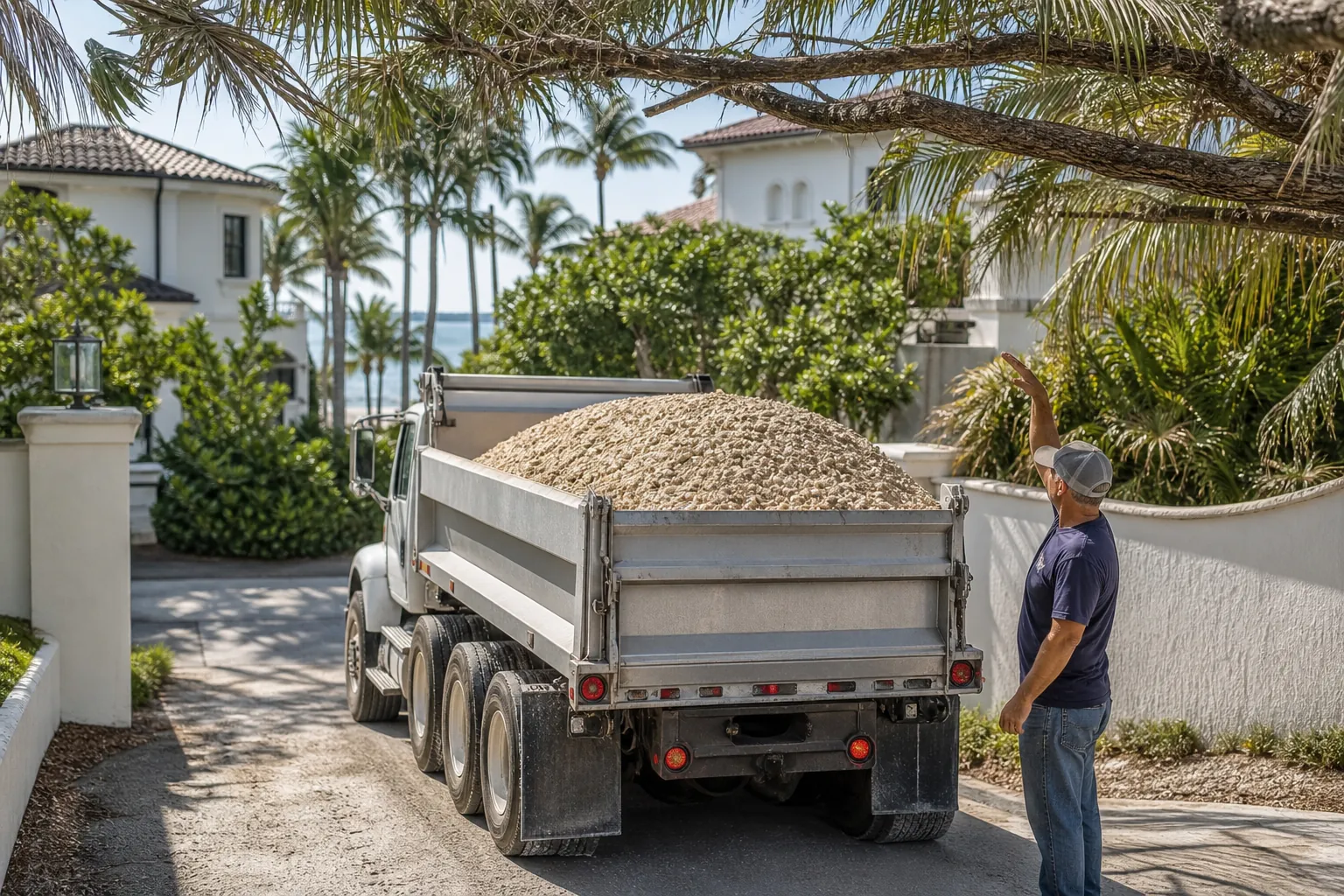
A driveway can look wide enough for a delivery and still have an access problem above it. Tree limbs, utility wires, roof overhangs, and entrance structures all matter when coquina shell arrives by dump trailer. The space needed to travel into a property is not necessarily the space needed to unload.
Planning coquina shell delivery overhead clearance starts with identifying a suitable unloading location and discussing the entire approach before scheduling. Do not assume that a spot is usable simply because a passenger vehicle fits beneath its branches or wires.
Tropical Yards supplies coquina shell and tropical plants, with dump trailer delivery from St. Augustine to Daytona Beach. This guide explains what buyers should check, what information to share, and how to prepare for a delivery without confusing material supply with landscaping labor.
Why overhead clearance changes during unloading
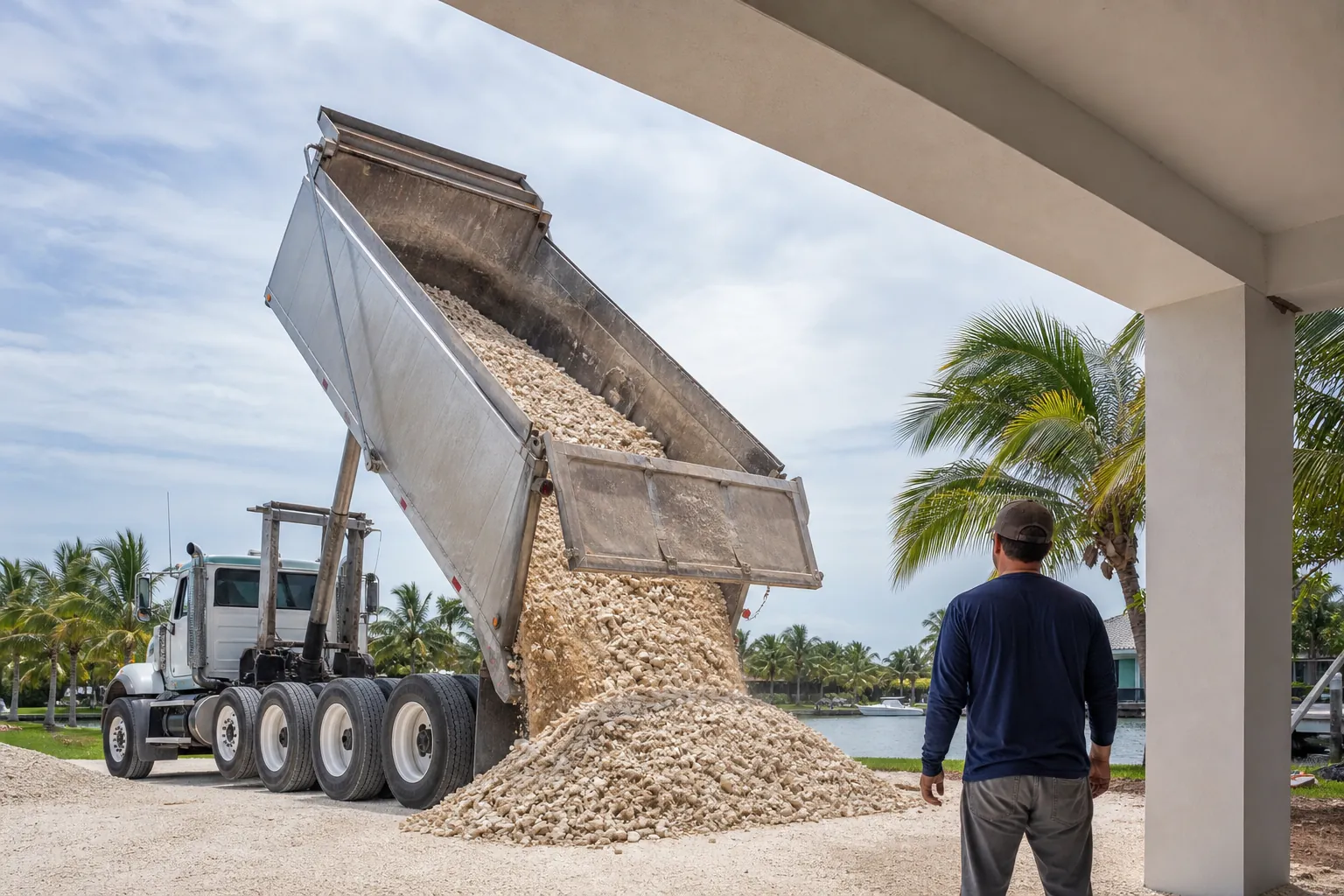
A dump trailer carries material with its bed lowered during travel. During unloading, the front of the bed rises, increasing the equipment's height and changing the space it occupies. An opening that accommodates the trailer in its travel position may not accommodate the raised bed.
The required clearance depends on the actual trailer, its configuration, the unloading operation, and site conditions. There is no single measurement that a buyer should assume applies to every delivery. Ask Tropical Yards what clearance information is needed for the equipment assigned to your order.
Clearance must also account for the approach, positioning, and departure. A low limb at a gate can prevent access even if the unloading area is open. Conversely, an unobstructed driveway does not make an unloading location beneath wires suitable.
Do not treat visible space between equipment and a power line as proof of safety. Electrical hazards require more than avoiding physical contact. The delivery operator must determine whether the location can be used, and utility-related questions may require guidance from the utility company.
Your role as the buyer is to disclose obstacles and offer workable locations. The operator's role is to assess the delivery conditions and decide whether unloading can proceed safely.
Check the full delivery route, not just the destination
Walk the proposed route from the public road to the unloading spot. Look upward as well as across the ground. Florida properties often have mature vegetation, covered entrances, and overhead services that are easy to overlook when concentrating on driveway width.
Make a simple route sketch showing the entrance, turns, overhead obstacles, and proposed unloading location. It does not need to be professionally drawn. Its purpose is to make the access discussion clear before a loaded trailer arrives.
- Identify branches and hanging vegetation along the entrance, driveway, and unloading area.
- Note overhead utility lines crossing the driveway or running beside the proposed unloading spot.
- Point out carports, porte-cocheres, roof edges, gate arches, and other fixed structures.
- Identify any turn where the vehicle or trailer would pass close to a tree trunk, wall, or overhead obstruction.
- Check whether the exit route introduces obstacles that are not present on the approach.
Assess the route under current conditions. A branch can hang lower after rain, and vegetation can obscure wires. If a storm has damaged trees or changed access since you first discussed the order, update Tropical Yards before delivery.
Do not climb trees, use ladders near wires, or lift objects toward power lines to estimate clearance. Where electrical infrastructure is involved, describe the location and seek appropriate guidance rather than attempting your own clearance test.
Choose an unloading spot with open sky and stable ground
An open area away from overhead obstacles is a useful starting point, but overhead clearance is only one part of unloading suitability. The ground also needs to support the delivery equipment and allow safe positioning.
Raised dump beds make ground conditions especially important. Slopes, soft shoulders, saturated soil, and uneven surfaces can affect stability. A location that looks convenient for spreading shell later may be unsuitable for unloading.
Tell Tropical Yards whether the proposed area is paved, gravel, bare soil, or lawn. Mention recent heavy rain, visible rutting, drainage problems, or any place where vehicles have previously sunk. Photographs can help communicate these conditions, although they do not replace an on-site judgment.
- Choose a candidate location away from utility lines, roof overhangs, and tree canopies.
- Describe any slope or uneven surface rather than assuming it is too slight to matter.
- Disclose septic systems, drain fields, irrigation components, buried utilities, and other vulnerable features near the route.
- Leave enough room for the delivery equipment to position without squeezing between obstacles.
- Keep the proposed pile clear of drainage paths, building entrances, and areas needed for vehicle access.
Buyers should also consider where the shell will land and how they will move it afterward. A pile placed too close to a gate or garage can block daily access. A pile far from the project can add significant wheelbarrow work.
Aim for a sensible balance between safe delivery access and manageable DIY handling. Do not prioritize a shorter carrying distance over a suitable unloading location.
Gather useful measurements and photographs
Before calling, collect information that helps Tropical Yards understand the site. Measure accessible ground-level features such as gate width and driveway width where you can do so safely. Describe tight turns and the distance between the entrance and your preferred unloading area.
For overhead features, provide photographs and descriptions rather than guessing at a safe operating height. If you have reliable building measurements or documented dimensions for a fixed entrance structure, share them, but let the supplier assess their relevance.
Photograph the entrance from the road, the route in both directions, and the unloading spot from several angles. Include enough surrounding space to show branches, wires, slopes, and nearby structures. A close-up of the ground alone does not explain the access route.
- Take a wide photograph showing the full driveway entrance and any overhead crossing.
- Show the proposed unloading area with its surrounding trees and structures visible.
- Photograph narrow points and turns from the direction the delivery would approach.
- Describe obstacles that are difficult to see in photographs, including wires hidden against foliage.
- Explain whether parked vehicles, gates, or movable objects will be cleared before arrival.
Avoid relying on a photograph to establish electrical clearance. Camera angles can distort distances, and thin wires may disappear against the background. Make an explicit note whenever a utility line is present.
If you are unsure whether an obstruction matters, include it in the discussion. A complete description is more useful than an optimistic estimate that leaves out a possible restriction.
Keep power lines out of the unloading plan
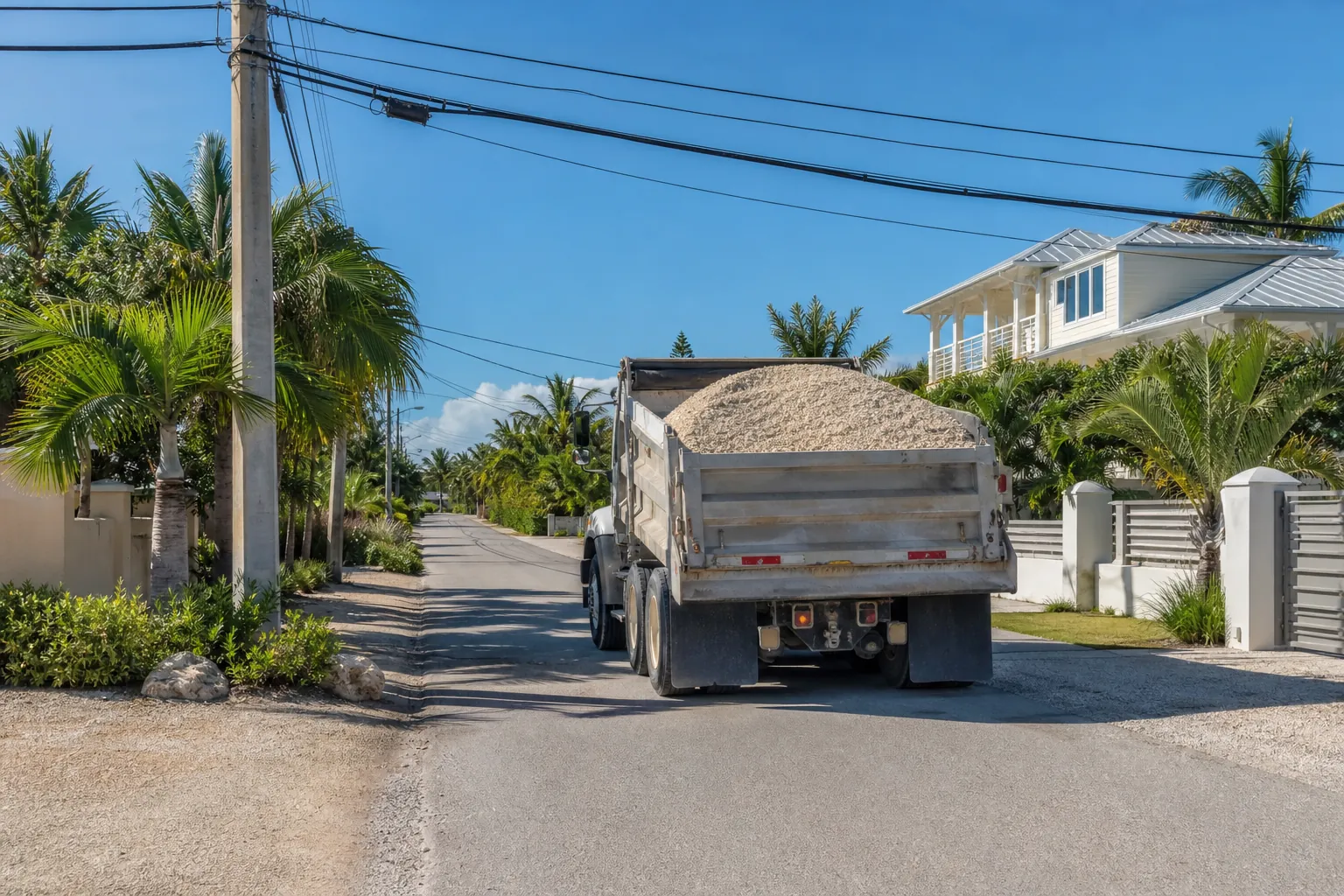
Overhead power lines deserve separate attention because their risk is not limited to a trailer striking a wire. Equipment operating near energized lines can create a serious hazard even without obvious contact.
Do not select a spot directly beneath power lines and assume the operator can stop the bed at a convenient height. Unloading must follow safe operating requirements for the equipment and conditions, not an improvised workaround.
You also should not attempt to move, prop up, cover, or otherwise alter a wire. If line clearance affects access, contact the utility company for appropriate guidance and discuss an alternative unloading location with Tropical Yards.
Other overhead cables should be disclosed as well. Buyers may not be able to identify every line correctly, and a low communications cable can still present a physical obstruction. Treat unknown lines as an issue to resolve, not something to test during delivery.
If equipment contacts a power line during any activity, stay away from the equipment and surrounding area and call emergency services. Do not approach to help or touch the vehicle. Prevention begins with keeping the unloading plan away from overhead electrical hazards.
Plan an alternative when the preferred location is restricted
Sometimes the most convenient spot is beneath a large canopy, beside a carport, or beyond a narrow entrance. In those situations, choose a second candidate location before scheduling rather than waiting until arrival to improvise.
A more open area closer to the entrance may make the delivery discussion simpler. It can also mean more DIY hauling afterward. Think through that trade-off before ordering, especially if the shell is intended for a backyard path or another space with limited vehicle access.
- Identify a backup unloading spot on your property with fewer overhead restrictions.
- Check that the backup pile would not block your only entrance or interfere with drainage.
- Estimate the route you would use to move shell from the pile to the project area.
- Confirm permission before proposing any location on shared or neighboring property.
- Ask about access limitations before assuming delivery can occur on a street or public right-of-way.
Public-road unloading may involve traffic hazards, local restrictions, or permits. It should not be treated as an automatic fallback. Likewise, a shared driveway may have access requirements that need to be addressed beforehand.
If no suitable location is available, discuss the situation before placing the order. Tropical Yards supplies materials and provides dump trailer delivery; it does not trim trees, remove plants, alter entrances, or prepare an unloading area for you.
Order shell around the delivery plan and the DIY project
Access planning and material planning work best together. Before ordering, measure the area where you intend to use coquina shell and decide on a suitable finished depth for your particular project. Ask the supplier how to translate those dimensions into an order quantity.
Keep the project measurement separate from the unloading footprint. The shell may be used across a broad area but arrive as a concentrated pile. Allow for that temporary pile when choosing the delivery location.
For broader material information, start with the coquina shell hub. Keep this clearance checklist focused on getting the material onto your property safely. Shell selection, coverage calculations, and project preparation are separate buying decisions worth resolving before delivery.
Discuss the material's intended use and ask what product characteristics you should expect. Natural shell material can vary in appearance and particle composition. Confirming those details helps you choose material for your own project without assuming every shell product behaves identically.
Think about your tools and handling capacity as well. A shovel, wheelbarrow, rake, gloves, and eye protection may be appropriate for DIY movement and spreading. Choose tools suited to the material and your physical ability, and plan breaks in Florida heat.
Tropical Yards does not spread or install the shell. Arrange your own project work and any independently hired labor separately from the material order and delivery conversation.
Prepare the property before delivery day
Once the proposed access and unloading location have been discussed, make the property ready according to the agreed plan. Preparation should eliminate avoidable obstacles without changing the route in ways the delivery operator has not reviewed.
Move parked vehicles, portable planters, outdoor furniture, and other movable items out of the approach and unloading area. Open the required gate and secure pets away from the delivery route. Keep children and bystanders clear of operating equipment.
- Confirm that the entrance and proposed unloading area are available when the delivery arrives.
- Tell household members where the equipment will travel and where the shell pile is planned.
- Mark known ground-level hazards in a way that does not create another obstruction.
- Provide current contact details and clear instructions for finding the correct entrance.
- Report new obstacles, storm damage, or soggy ground before the delivery proceeds.
If vegetation needs attention, handle that separately before delivery and use qualified help where necessary, especially near utilities. Tropical Yards does not provide trimming, plant removal, or yard cleanup services.
A tarp may help separate a temporary shell pile from the surface beneath it, but ask whether your proposed setup is compatible with unloading. Do not assume a tarp protects paving from equipment loads or makes unstable ground suitable.
What to do when the delivery arrives
Meet the operator if possible and identify the unloading spot discussed beforehand. Point out overhead lines, ground hazards, and any changes since the original access conversation. Do not assume that earlier photographs capture everything the operator needs to know.
The operator may determine that a location is unsuitable after seeing it in person. Be prepared to discuss the backup spot rather than urging unloading beneath an obstacle or on questionable ground.
Stay clear while the equipment is positioning and unloading. Do not walk behind the trailer, stand near the discharge area, or try to guide the raised bed around branches. Follow the operator's directions about where to wait.
After unloading is complete and the equipment has departed, you can begin your own material handling. Inspect the pile's surroundings before moving shell, maintain access to doors and gates, and avoid spreading material into drains or neighboring areas.
Discuss your coquina shell delivery access
A useful delivery conversation covers three things: the route into the property, the space above the equipment during unloading, and the ground supporting it. Clear photographs, honest descriptions, and a backup location help address those questions before delivery day.
Tropical Yards offers coquina shell sales and tropical plant sales, including palm trees, hibiscus, bougainvillea, ferns, and other tropical plants. Dump trailer delivery of plants and coquina shell is available from St. Augustine to Daytona Beach.
Call 772-267-1611 to discuss your coquina shell order and delivery access. Explain any branches, wires, covered entrances, or ground concerns so the proposed unloading plan can be reviewed before scheduling.
Call 772-267-1611 to talk through next steps.