How to plan a coquina shell driveway road transition
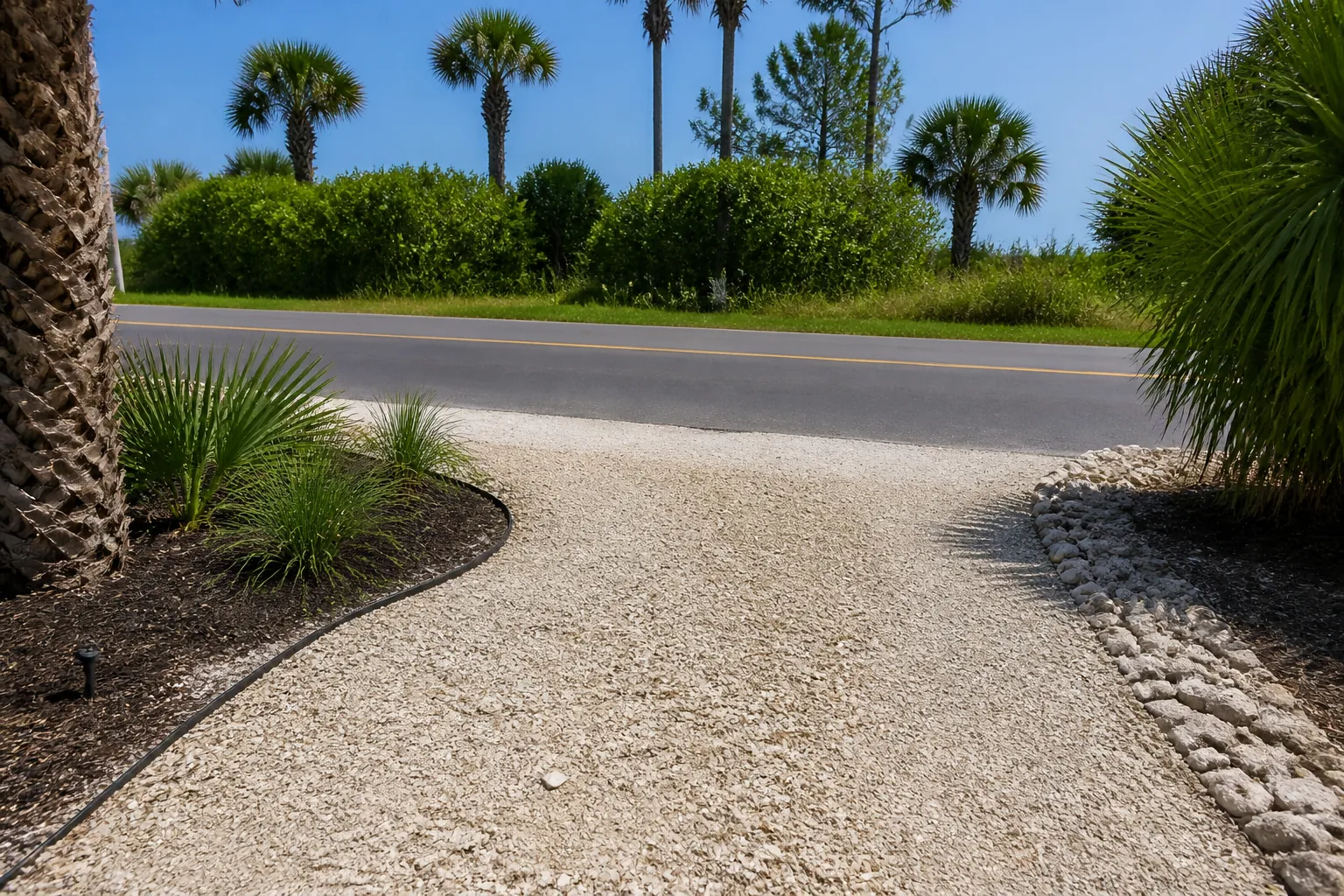
A coquina shell driveway road transition is the meeting point between a loose shell driveway and the road surface. It may look like a small detail, but it affects how vehicles enter, where rainwater flows, and whether shell stays on your property or migrates toward the street.
For Florida homeowners buying material for a DIY project, the first decision is not how much shell to order. It is whether the road connection can safely accept loose material, and whether local rules require a different surface at the driveway entrance.
Tropical Yards supplies coquina shell and tropical plants, with dump trailer delivery from St. Augustine to Daytona Beach. We do not design or install driveway connections. This guide helps you assess an existing entrance, ask the right questions, and plan a material purchase without treating shell as a solution for every road-edge problem.
Start With The Road Connection, Not The Shell Order
A driveway entrance can include several different areas: the private driveway, an apron near the street, a roadside shoulder, a drainage swale, and sometimes a culvert. Those areas may have different ownership and permitting requirements, even when they appear to form one continuous driveway.
Before changing elevations or adding material, identify where your property ends and the public right-of-way begins. A fence, mowing line, or existing shell edge is not necessarily the legal boundary. Check your survey and ask the agency responsible for the road if the limits are unclear.
Requirements can differ among Florida cities, counties, private communities, and state-maintained roads. An existing loose-material entrance does not automatically establish that you can expand it or rebuild it in the same way.
- Ask whether the driveway connection requires approval before you add material or change its shape.
- Confirm whether loose shell is permitted at the street or whether a paved apron is required.
- Ask whether a roadside ditch, swale, shoulder, sidewalk, or culvert must remain unchanged.
- Check whether your homeowners association has separate driveway surface requirements.
- Find out who is responsible for correcting an entrance that sheds material onto the road.
If the connection needs structural work, drainage changes, or a permitted apron, address those matters before ordering shell. A supplier can provide material, but supplying shell does not establish that a particular road connection is approved or suitable.
Assess How Your Existing Entrance Behaves
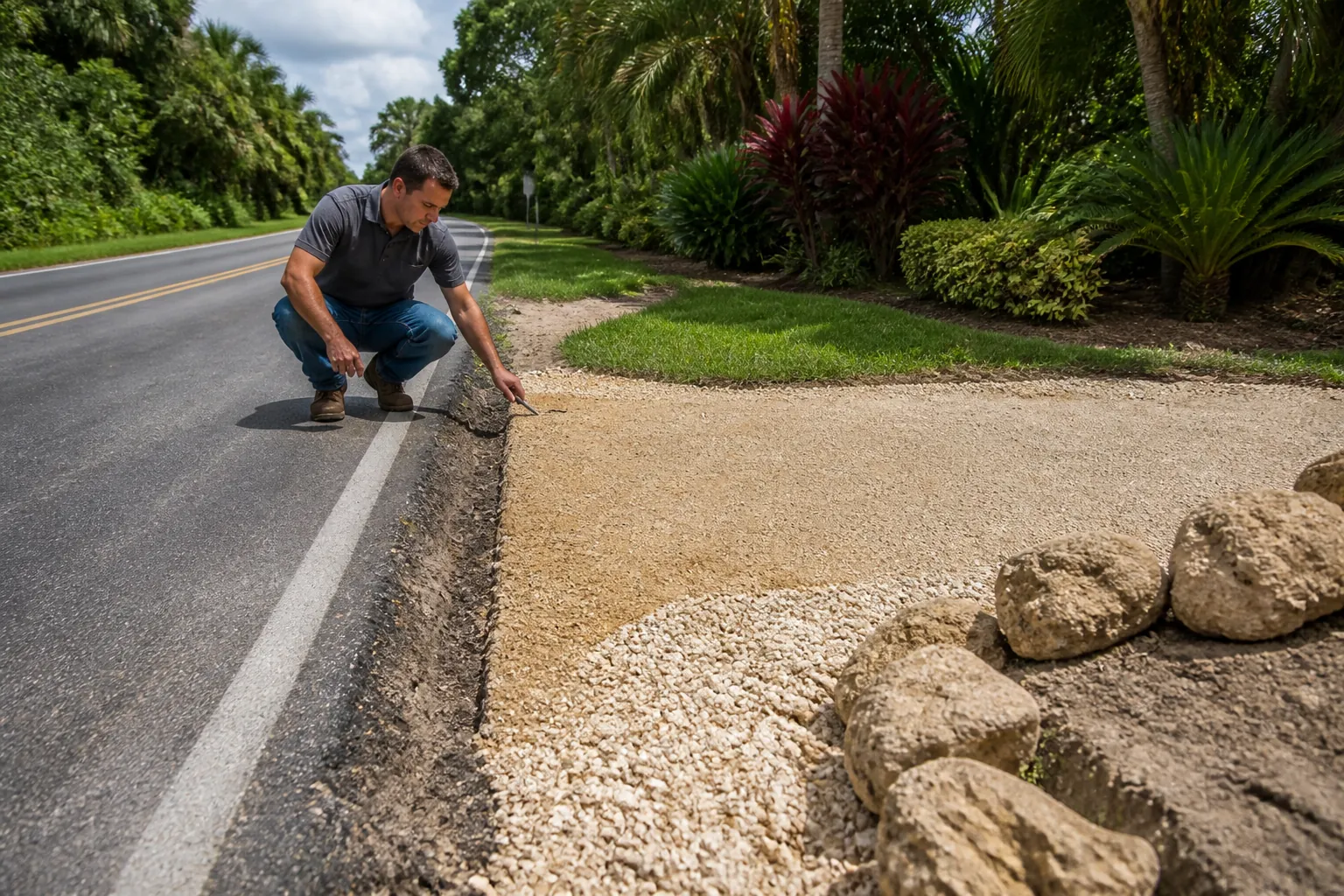
Walk the entrance when it is dry, then observe it again after rain when conditions are safe. Stand off the traveled road and look for the route water takes. Notice whether it enters from the street, leaves the driveway, collects near the pavement edge, or crosses the entrance toward a roadside drainage feature.
Look for depressions, exposed soft soil, and shell accumulated at the road. These clues can help separate a simple surface-material shortage from an underlying support or drainage problem. Repeatedly filling the same rut without understanding its cause can leave you buying more material without improving the connection.
Consider vehicle movement as well. A straight approach behaves differently from an entrance where drivers turn sharply, brake, or accelerate on loose shell. Delivery vehicles, trailers, and heavier vehicles may place different demands on the edge than ordinary passenger cars.
- Record where tires leave ruts rather than assuming the whole driveway needs additional shell.
- Look for a drop beside the pavement that could catch a tire or make entry uncomfortable.
- Check whether shell collects in the gutter, on the pavement, or near a drain opening.
- Note whether runoff cuts channels through the entrance after ordinary rain.
- Observe whether vehicles routinely cross the entrance edge because the usable opening is too narrow.
Take photographs and simple measurements before making changes. If you seek advice from the road authority or a qualified contractor, showing the actual entrance is more useful than describing it as a driveway that needs more shell.
Choose Where Coquina Shell Should Stop
Coquina shell can serve as a loose driveway surface where site conditions and local requirements allow it. However, the point where it meets the road needs particular care. Loose material should not be treated as a way to conceal a broken pavement edge, bridge an unsupported shoulder, or block a drainage channel.
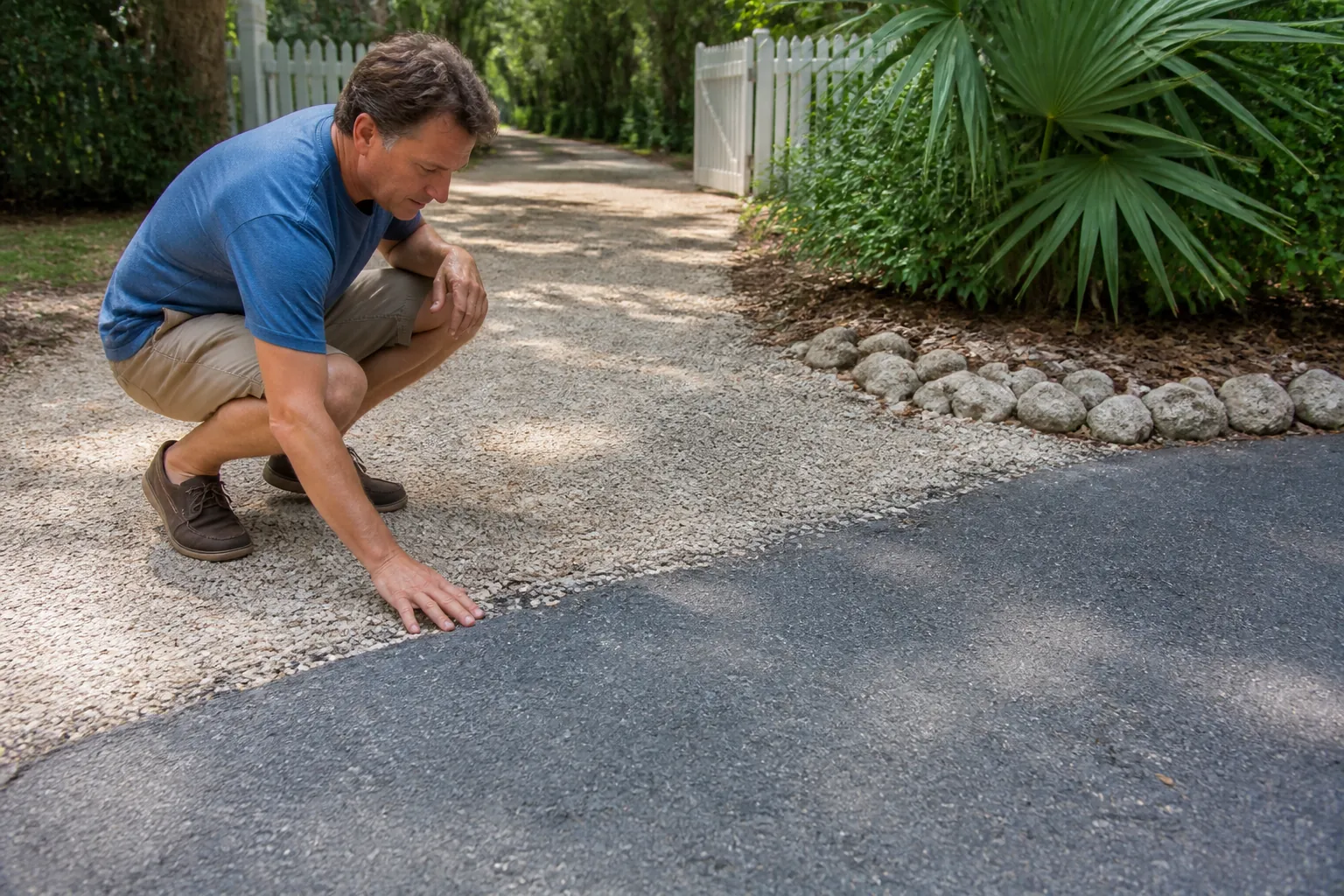
If an existing paved apron is sound and approved, your project may be limited to the private driveway behind it. In that situation, examine the junction between shell and apron. A pile of shell at that junction can create a bump, while an abrupt low spot can collect water or encourage tires to disturb the edge.
If loose shell currently reaches the roadway, confirm that arrangement with the responsible agency before reproducing it. The appropriate stopping point depends on the road connection, not simply on where the previous owner spread material.
Match The Transition To The Existing Surface
At an asphalt road, avoid using shell to cover cracks or hide a crumbling edge. Those conditions may need separate evaluation. Adding loose material over damaged pavement does not restore the pavement's support.
At a concrete apron, inspect the edge and joints before raising the adjacent shell level. Do not obstruct drainage openings or assume that making both surfaces visually level will resolve water movement.
At an unpaved road, the difference between driveway and roadway may be less obvious. Confirm the boundary and road-maintenance requirements before adding shell to a shared surface or changing the entrance grade.
The goal is a connection that works with the approved entrance and keeps driveway material within its intended area. Decorative appearance comes after safe access, drainage, and compliance.
Understand What Shell Can And Cannot Fix
Ordering decisions become easier when you separate surface material from the support beneath it. Coquina shell on top cannot reliably compensate for soft soil, poorly supported edges, or water that repeatedly washes through the driveway.
For an existing shell driveway, additional material may be appropriate where the surface has thinned and the underlying area remains stable. If tires sink, water stands for extended periods, or the surface shifts substantially, investigate the underlying conditions before assuming another layer will solve the problem.
Do not select a universal layer thickness from a photograph or a general online example. The useful amount depends on the existing surface, intended traffic, material characteristics, and whether you are replenishing a driveway or preparing a new area.
Ask the supplier how the available coquina shell is described and what characteristics you should expect. Shell products can differ in fragment size, the amount of finer material, and moisture at delivery. These differences affect handling and the appearance of the finished surface.
- Ask about the available material's composition and approximate fragment-size range.
- Explain whether you are matching an existing shell driveway or covering a newly prepared area.
- Ask whether photographs or a material sample are available before placing your order.
- Confirm how the order quantity is measured so your calculations use the same unit.
- Discuss your delivery location and access separately from questions about material suitability.
For broader material-shopping information, visit the coquina shell page. Keep this road-transition project focused on the entrance itself rather than combining it with unrelated garden paths, decorative beds, or whole-property surface changes.
Plan Drainage Before Raising The Entrance
Florida rain makes elevation choices important. A small addition of material at the driveway mouth can change where water travels, especially beside a shallow swale or a low roadside shoulder.
Do not fill a swale simply because it looks like a depression that should be leveled. It may be carrying runoff along the road. Likewise, do not cover a culvert opening, narrow its entrance, or build shell against it to make the driveway look fuller.
Watch for water arriving from more than one direction. Street runoff, roof runoff, and water from higher ground can meet near the entrance. If you only inspect the driveway during dry weather, you may overlook the reason material keeps moving.
- Keep existing drainage routes visible while evaluating the project.
- Do not raise the entrance to redirect runoff onto a neighboring property.
- Avoid placing stockpiles where rain can carry shell into a storm drain.
- Seek qualified advice when changes involve a culvert, persistent flooding, or uncertain grades.
- Pause material placement if the proposed surface would obstruct a sidewalk or accessible route.
A stable-looking surface on a dry afternoon is not proof that the drainage works. Resolve persistent water problems before making a large purchase, and obtain any required approval before altering roadside drainage features.
Measure The Area And Build A Sensible Order
Measure only the area that is approved and ready to receive shell. For a simple rectangular section, multiply its length by its width to find the square footage. For a flared driveway entrance, divide the shape into manageable sections rather than treating the widest dimension as the width of the entire area.
Next, establish the intended added depth based on the project conditions. Measure existing high and low spots so you do not assume every part needs the same amount. A thin-looking edge and a deep rut represent different volume requirements.
For a volume estimate in cubic yards, multiply area in square feet by depth in feet, then divide by 27. Convert inches to feet before calculating. This is a geometric estimate, not a promise about coverage after placement or compaction.
For example, an area measuring 10 feet by 12 feet has 120 square feet. A hypothetical 2-inch added layer is about 0.167 feet deep. Multiplying those figures and dividing by 27 gives approximately 0.74 cubic yard. The example illustrates the calculation only; it is not a recommended depth for your entrance.
Ask how Tropical Yards measures and supplies the available shell before converting that estimate into an order. Do not assume a fixed weight-to-volume conversion, because material composition and moisture can affect it.
- Separate the transition area from any driveway sections you are not replenishing.
- Write down dimensions and the basis for your planned added depth.
- Identify whether low spots reflect missing surface material or an unresolved base problem.
- Discuss any allowance for handling and settling rather than adding an arbitrary amount.
- Confirm the order quantity and delivery details before scheduling the load.
Prepare For Dump Trailer Delivery
Tropical Yards offers dump trailer delivery of coquina shell and plants from St. Augustine to Daytona Beach. Delivery planning matters at a road transition because the entrance may be both the work area and the access route for the delivery vehicle.
Describe the entrance accurately when arranging delivery. Mention narrow gates, tight turns, slopes, soft ground, overhead branches or wires, and any culvert crossing. Do not assume that access suitable for a passenger car is suitable for a loaded vehicle and trailer.
Choose a proposed unloading area on your property, away from the traveled road, sidewalks, drainage features, and utilities. The delivery provider must assess whether that location is accessible and safe. A dump trailer needs appropriate ground conditions and overhead clearance when unloading.
- Provide clear directions and identify the intended unloading location in advance.
- Discuss whether the driveway entrance must remain open during unloading.
- Move parked vehicles and portable obstacles out of the agreed access route.
- Keep people and pets clear of the vehicle and unloading area.
- Ask about an alternative unloading location if rain makes the intended spot unsuitable.
Plan how you will move the shell from the drop location to the work area. Dump trailer delivery is material delivery, not a promise of precise placement across the driveway. Tropical Yards does not spread, grade, compact, or install the shell.
Organize DIY Placement And Check The Result
Only proceed with DIY work after confirming that the project is allowed and within your capabilities. Keep tools, material, and activity off the traveled roadway. If the work requires road access, traffic control, or changes to a public shoulder, ask the road authority what is required rather than improvising.
Use appropriate footwear, gloves, and eye protection when handling shell. Follow equipment instructions if your project involves powered equipment, and avoid working around moving vehicles. Any digging should follow applicable utility-location procedures.
Place material in manageable amounts so you can monitor the connection instead of building a large mound at the street. Preserve the established drainage path and approved surface boundaries. The appropriate preparation and compaction method depends on the material and site; obtain project-specific guidance where needed.
Once the entrance is usable, observe vehicle movement from a safe location. Look for tire displacement, an abrupt bump, or shell pushed toward the roadway. Recheck after rain for channels, ponding, or material movement. These observations help identify whether the issue is surface quantity, edge support, traffic movement, or drainage.
If shell repeatedly leaves the entrance, stop adding more until you understand why. A permitted apron, different boundary treatment, or correction to an underlying problem may be necessary, but those decisions belong with the appropriate authority or qualified professional.
Order Coquina Shell With A Clear Project Scope
A successful purchase starts with a defined area, a realistic quantity estimate, and a safe delivery location. Keep the road connection separate from unrelated landscaping plans so the order supports the actual work you are ready to do.
Tropical Yards provides coquina shell sales, tropical plant sales, and dump trailer delivery of plants and coquina shell from St. Augustine to Daytona Beach. Available plant categories include palm trees, hibiscus, bougainvillea, ferns, and other tropical plants. These are supply services, not driveway construction or landscaping labor.
When you are ready to discuss shell availability and delivery, call Tropical Yards at 772-267-1611. Have your location, measurements, intended use, and access details ready. Clear information helps you plan the purchase while keeping permitting, drainage decisions, and DIY work in the right hands.
Call 772-267-1611 to talk through next steps.