Coquina shell loose versus compacted volume: planning your order
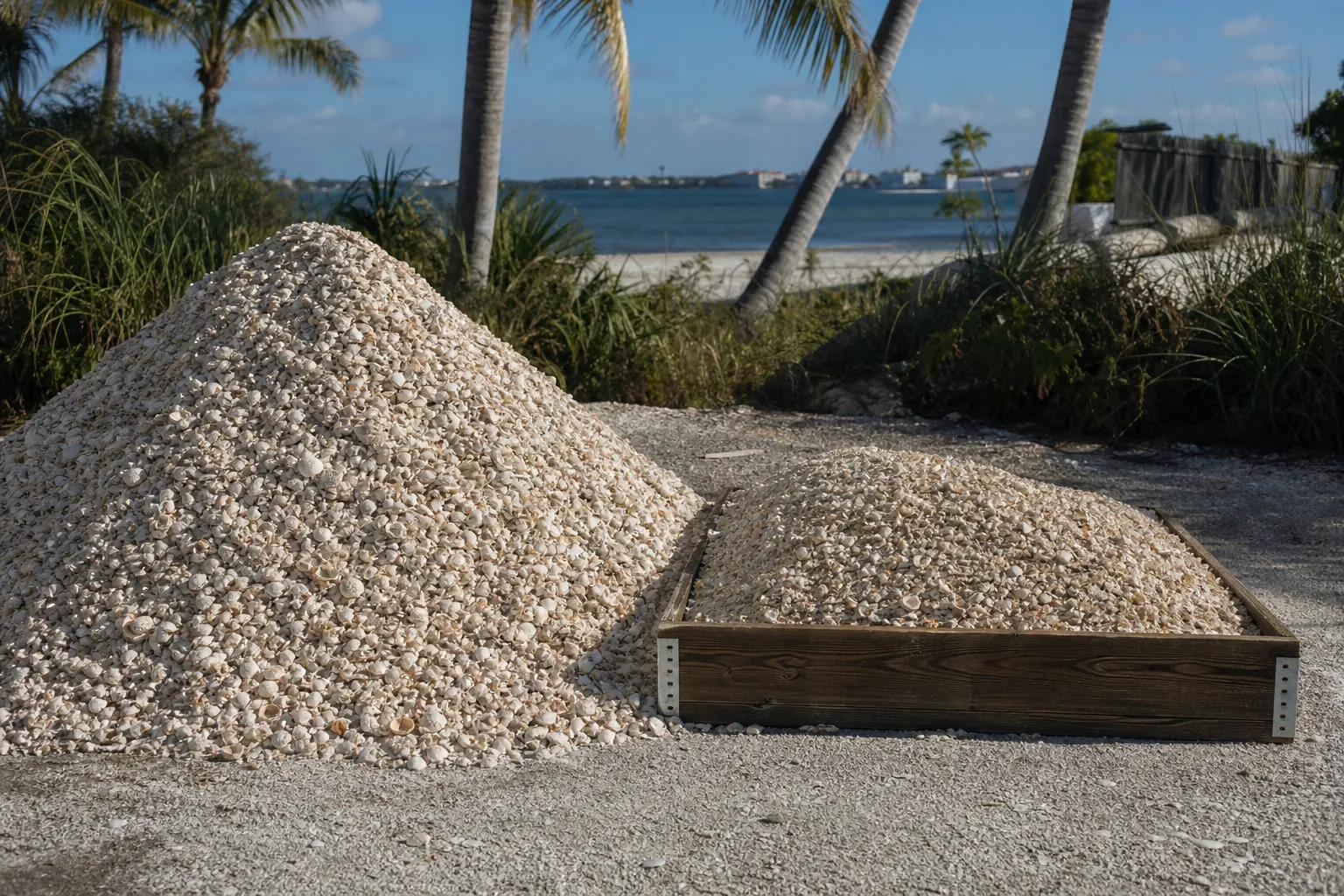
A load of coquina shell arrives loose, but the finished surface may not stay that way. Once you spread, settle, or compact the material, its particles rearrange and the layer can become thinner. That difference matters when you are buying shell for a Florida path, decorative area, or another project where finished depth is important.
Understanding coquina shell loose versus compacted volume helps you estimate an order without treating delivered cubic yards as a promise of finished coverage. The basic calculation is straightforward. The adjustment for settling takes more care because shell composition, moisture, preparation, and your method of working the material all influence the result.
Tropical Yards supplies coquina shell and tropical plants, with dump trailer delivery from St. Augustine to Daytona Beach. This guide focuses on material planning for buyers and DIY users. For product information alongside these calculations, visit the coquina shell page.
What Loose And Compacted Volume Actually Mean
Loose volume describes the space material occupies before deliberate compaction. Shell pieces, smaller fragments, and fines sit together with air spaces between them. A cubic yard is a unit of volume, equal to 27 cubic feet, but that does not tell you how tightly the particles are packed.
Compacted volume describes the space the material occupies after those particles have moved into a denser arrangement. The solid shell does not simply disappear. Instead, some voids become smaller, pieces shift, and fragile fragments may break under pressure.
Think of a container filled with irregular pieces. Shaking or pressing the contents can lower the top surface without taking anything out. Coquina shell behaves similarly, although its response depends on the actual material and the force applied.
Settling and deliberate compaction are related but not identical. Rain, foot traffic, and time can settle a loose layer unevenly. Mechanical compaction applies force intentionally, but its effectiveness depends on the material, layer thickness, equipment, and supporting ground.
For ordering purposes, keep three quantities separate: the loose material purchased, the geometric volume of your intended finished layer, and any additional material justified by settling or site irregularities. Mixing those quantities is a common cause of confusion.
Start With The Finished Area And Depth
Before considering an adjustment, calculate the space you want the shell to occupy. Use the finished depth rather than the height of a freshly dumped pile or a loosely raked layer.
For a rectangular area, multiply length by width to find square footage. For several areas, measure each separately and add the results. Break curves into manageable shapes, and subtract planting beds, paving, or other spaces that will not receive shell.
The calculation is:
Finished cubic yards = area in square feet × depth in inches ÷ 324.
The divisor converts inches to feet and cubic feet to cubic yards. This gives geometric volume only. It does not include a compaction allowance, material lost outside the project, or extra shell needed to fill low spots.
As a hypothetical example, a 12-foot by 30-foot area covers 360 square feet. At a planned finished depth of 3 inches, its geometric volume is 360 × 3 ÷ 324, or about 3.33 cubic yards.
That example demonstrates the math, not a recommended depth for every shell project. The appropriate depth depends on the intended use, the supporting surface, drainage, containment, and whether the shell is decorative or expected to carry traffic.
- Measure the area after deciding where its actual boundaries will be.
- Record the intended finished depth separately from the initial spreading depth.
- Calculate separate sections individually when their depths differ.
- Keep full calculation results until the ordering discussion instead of rounding every measurement upward.
Why There Is No Universal Compaction Percentage
It is tempting to use a single percentage for every coquina shell order. That makes the estimate easy, but it can also make it misleading. Different loads and different projects do not necessarily settle alike.
Particle size distribution matters. Larger pieces can leave substantial spaces between them. Smaller fragments may fill those spaces, while fines can change how the material responds to moisture and pressure. The balance among those components affects packing.
Moisture also matters. A dry, loose material may behave differently from damp material. Excess water can interfere with preparation or make the supporting ground unstable. Wetting shell is not a substitute for understanding the surface beneath it.
The application method matters too. A loosely raked decorative layer will not necessarily reach the same density as material deliberately compacted in controlled layers. Equipment choice and the thickness of each layer influence how much force reaches the material below.
Ask about the shell currently available rather than assuming that an online conversion applies. Useful information includes its general texture, the presence of fines, and whether the supplier has relevant guidance for estimating loose volume for your intended use.
If no reliable adjustment is available, treat a percentage as a planning assumption, not a material specification. A small representative trial can help you understand behavior before committing to a larger DIY area.
Apply A Volume Adjustment Without Mixing Up The Math
There are two common ways to describe an adjustment, and they are not mathematically identical. One adds a percentage to the finished volume. The other describes the percentage of loose volume lost during compaction.
If you are told to order a certain percentage more than your calculated finished volume, multiply the finished volume by one plus that allowance. For example, a hypothetical 20% added allowance would use a multiplier of 1.20.
If the assumption is that loose material loses 20% of its volume, the remaining compacted volume is 80% of the loose volume. To estimate the loose quantity needed, divide the required finished volume by 0.80.
Using the earlier 3.33-cubic-yard example, adding 20% gives about 4.00 cubic yards. Assuming a 20% reduction from loose to compacted volume gives about 4.16 cubic yards. Those numbers illustrate different definitions, not a recommended coquina shell adjustment.
Loose volume needed = required compacted volume ÷ remaining volume fraction.
Before using advice from any source, ask what its percentage means. Is it an added ordering allowance, a measured reduction in volume, or a broad allowance that also includes uneven ground? Clear definitions prevent accidental underordering or excessive extra material.
Do not automatically stack several allowances. If one estimate already includes settling and surface irregularities, adding both again can inflate the order. Keep each adjustment tied to a specific reason.
Separate Shell Settling From Ground Movement
A shell surface can end up low for more than one reason. The shell itself may become denser, but the supporting soil can also compress, wash out, or shift. Additional shell cannot reliably correct a problem that continues below the surface.
Florida sites vary widely. Sandy ground, disturbed fill, wet pockets, roots, and buried debris can all affect how a project behaves. Inspect the intended area before calculating material from a simple length and width.
If the ground is uneven, measure the depth needed at several locations. A uniform 3-inch calculation assumes a reasonably consistent supporting surface. Deeper pockets require additional material even if the shell experiences no volume reduction.
Drainage deserves separate attention. A low area that collects water should not be treated only as a shell quantity problem. Consider where water enters, where it can leave, and whether changing the surface could direct runoff toward a building or neighboring property.
- Identify soft spots before using them as the reference level for finished depth.
- Measure persistent depressions separately instead of hiding them inside a vague compaction allowance.
- Check the planned finished elevation near doors, paving, and drainage features.
- Seek qualified project-specific advice when unstable ground or drainage issues exceed a straightforward DIY project.
Tropical Yards supplies material rather than preparing or installing surfaces. Decisions about grading, base preparation, and compaction remain part of your project planning.
Use A Small Trial To Check Your Assumptions
A representative trial can be more informative than borrowing a ratio from an unrelated material. If you already have access to the same shell, choose a small, bounded area with ground conditions similar to the main project.
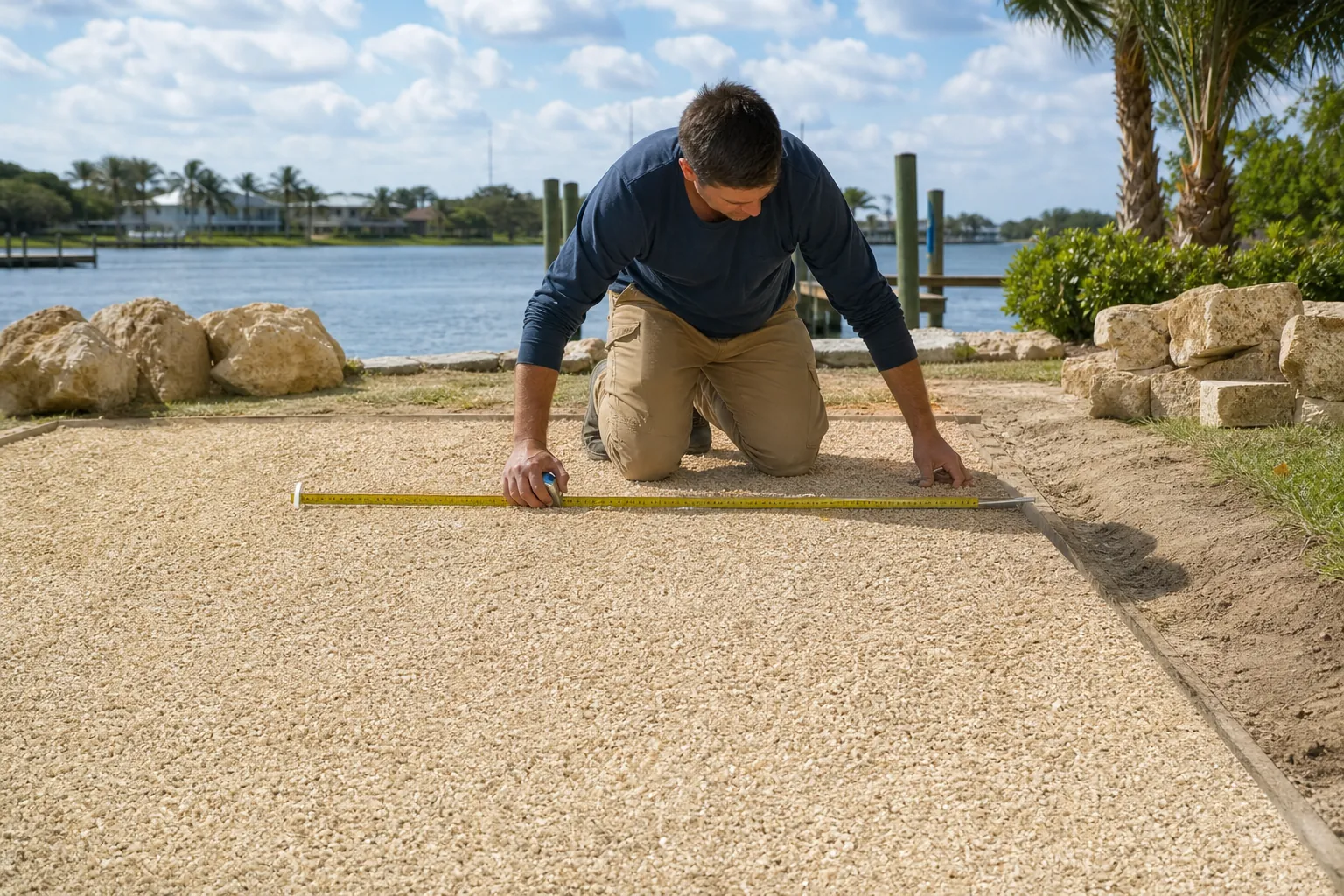
Measure the trial area and record the loose depth at several points after spreading. Then use the settling or compaction method you actually intend to use. Record the resulting depth at the same locations.
Use a stable reference outside the shell layer so that your measurements do not move with the surface. A straight board spanning fixed edges can help, provided the edges themselves remain stable.
If a hypothetical layer changes from 4 inches loose to 3.5 inches after your chosen process, its measured depth reduction is 0.5 ÷ 4, or 12.5%. That observation applies to that trial. It is not a general coquina shell specification.
Depth changes represent volume changes most directly when the trial area stays constant and material does not escape. If shell spreads beyond the edges or the ground underneath moves, the result includes more than particle compaction.
A trial also helps you notice practical issues such as uneven texture, difficult raking, or movement at the perimeter. Use those observations to refine your DIY plan, while recognizing that a small trial may not reproduce conditions across the entire site.
Choose A Quantity That Matches The Project's Purpose
Not every shell application needs the same approach to density. A decorative area around planting beds may prioritize appearance and containment. A walking surface requires attention to stability and transitions. A vehicle-use project introduces additional structural considerations that a volume estimate alone cannot answer.
For decorative use, distinguish between enough shell to create the intended cover and enough material to build a deeper, deliberately compacted layer. Ordering for one purpose while planning for the other can change the quantity substantially.
For traffic-bearing uses, do not assume that a thicker shell layer automatically creates a suitable surface. Ground preparation, drainage, edge restraint, and appropriate construction methods matter. Confirm suitability for the actual use before buying material.
If shell will border tropical plants, keep finished grades and plant needs in mind. Avoid piling material against trunks or stems, and preserve access for watering and inspection. Shell coverage should not obscure the planting depth or create a mound against the plant.
Tropical Yards also sells palm trees, hibiscus, bougainvillea, ferns, and other tropical plants. If your purchase includes plants and shell, plan their placement and unloading needs separately. Plant selection does not change the shell calculation, but planting spaces reduce the area that needs coverage.
Plan Dump Trailer Delivery Around The Loose Load
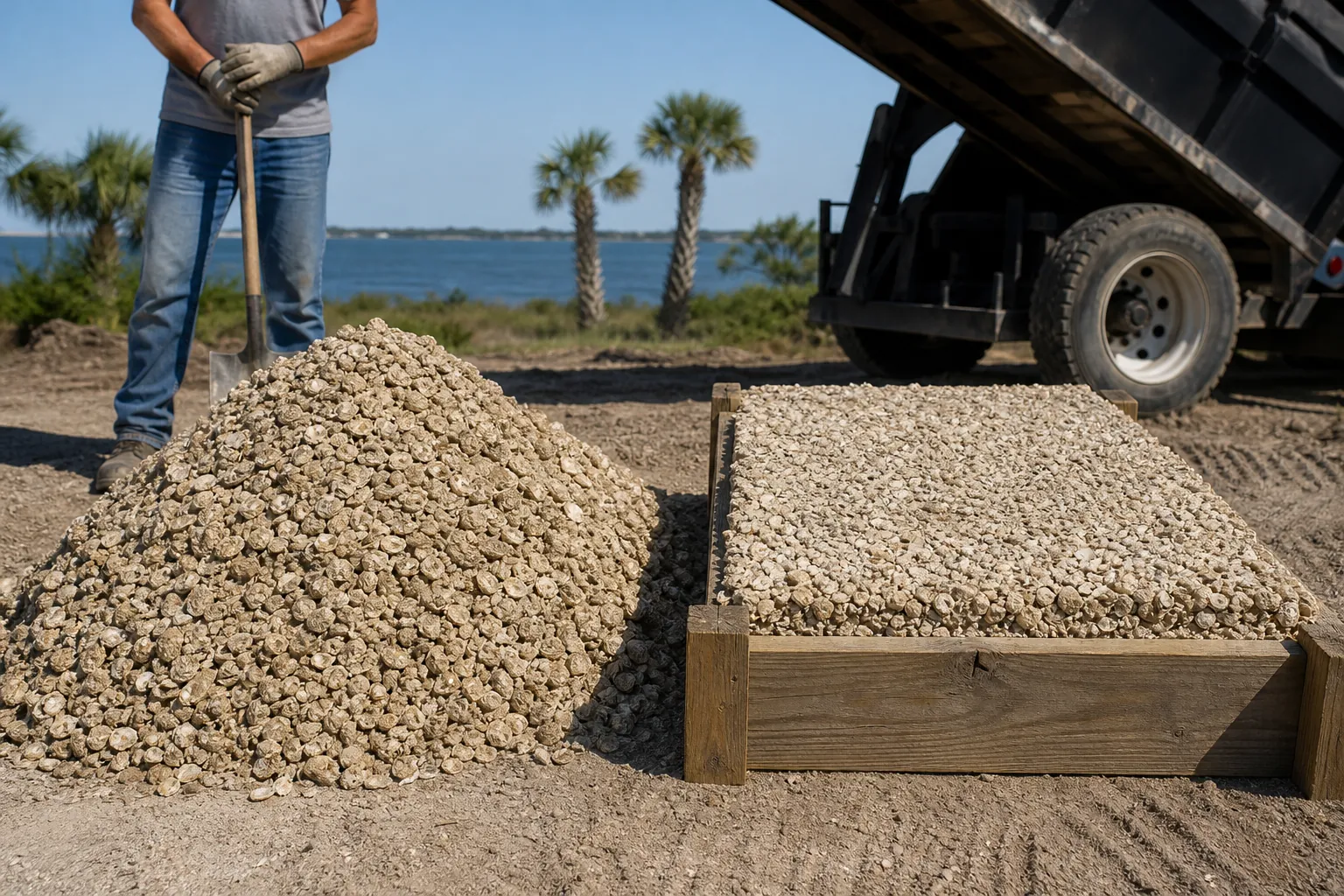
Delivery planning uses the loose material quantity, not just the final footprint. A loose pile needs temporary space before you move and spread it. An order that fits comfortably across a finished path may still create a substantial stockpile at the unloading location.
Tropical Yards offers dump trailer delivery of plants and coquina shell from St. Augustine to Daytona Beach. Discuss your address, access conditions, and intended unloading area before scheduling. Do not assume a trailer can reach every part of a property.
Describe gates, tight turns, overhead obstructions, sloped areas, and soft ground. Keep the proposed route clear of vehicles and loose objects. The suitability of an unloading location needs confirmation rather than a guess based on passenger-car access.
- Choose a proposed unloading area that leaves room to move material safely afterward.
- Keep the shell pile away from drains and routes where escaping material could create an obstruction.
- Explain whether plants are included so their unloading needs can be discussed.
- Ask about delivery quantity limits and whether your planned order requires more than one load.
- Confirm any delivery instructions before the scheduled arrival.
A protective ground covering may help separate shell from an existing surface, but discuss the unloading plan first. Keep people and pets away from the trailer and unloading area. Delivery supplies the material; moving, spreading, and compacting it afterward are separate DIY tasks.
Check Your Estimate Before Ordering
A useful order summary does not need to be complicated. Write down the measured area, chosen finished depth, calculated finished volume, and the reason for any adjustment. Include separate quantities for low spots only when you have measured them.
Then review the uncertainty. If you have not settled on depth, boundaries, or preparation, the estimate is not ready merely because the arithmetic is correct. Resolve those decisions before choosing the purchase quantity.
Ask how the shell is sold and how the order quantity will be described. Volume and weight are different measurements, and a weight-to-volume conversion depends on bulk density and moisture. Avoid converting between them using an unrelated aggregate's density.
If you want extra material for later touch-ups, identify that as a separate reserve rather than labeling it compaction loss. Consider where you would store it and whether leftover shell would interfere with access or other planned work.
For coquina shell availability and dump trailer delivery from St. Augustine to Daytona Beach, call 772-267-1611. Share your measurements, intended use, and delivery conditions with Tropical Yards so you can discuss the material purchase with a clearer plan.
The central distinction is simple: finished space and delivered loose volume are not automatically equal. Measure the finished space first, apply only justified adjustments, and organize delivery around the material as it arrives.
Call 772-267-1611 to talk through next steps.