How to Prepare Container Tropical Plants for Hurricane Winds in Northeast Florida
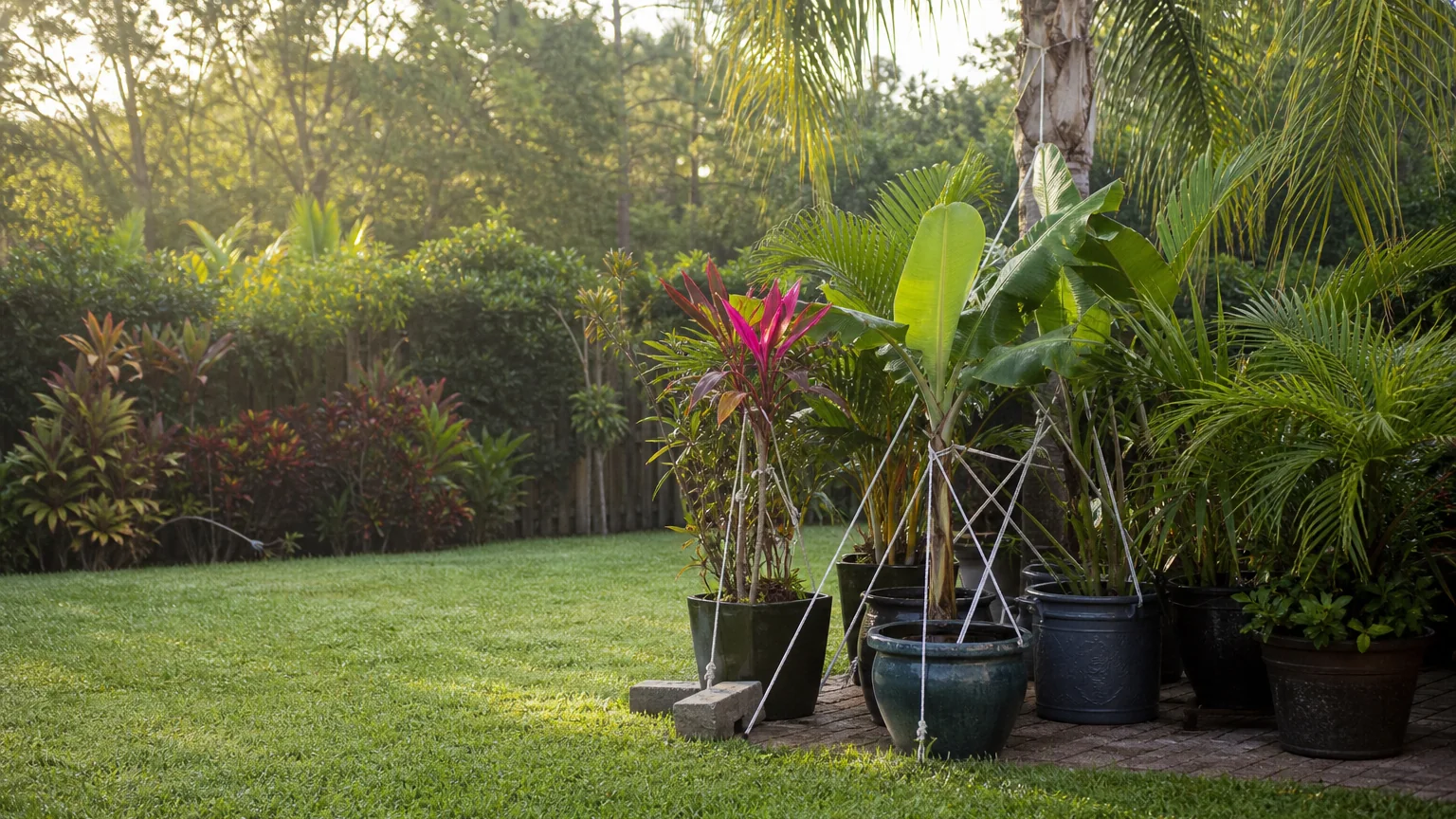
For a Northeast Florida property, the direct answer is to act before a storm watch is issued, not after: move small and medium pots to a sheltered, low spot such as a garage or an interior wall, lay larger containers on their sides so wind cannot catch them like a sail, remove hanging baskets and loose saucers, and stake or tie top-heavy plants low to the pot rather than high on the stem. The National Weather Service's hurricane preparedness guidance treats any loose outdoor item, including planters, as a debris risk once tropical storm force winds arrive, so the work has to be finished well before that point.
This guidance reflects what the National Weather Service and UF/IFAS Extension publish about storm readiness and seasonal plant care, not a guarantee that any container or plant will survive a specific storm. Wind speed, storm track, surge potential, and your yard's exposure all vary by property and by season, so treat this article as a starting checklist. Confirm your own site conditions, any HOA or local rules, and current plant or delivery details directly with Tropical Yards or an appropriate qualified professional before you rely on a plan.
Key takeaways
- Move container plants to shelter and lay large pots on their sides before tropical storm force winds arrive, since loose planters become wind-driven debris once conditions worsen.
- Observe your own wind exposure, drainage, and nearby structures first, because a covered lanai and an open coastal lot call for different levels of preparation.
- A written, repeatable checklist reduces last-minute scrambling, and the National Weather Service publishes general timing guidance for pre-storm tasks that applies statewide.
- Common mistakes include leaving pots on tall stands, using weak stakes, and letting drainage holes clog, all of which increase the chance of tipping or root damage.
- Tropical Yards supplies and delivers tropical plants, palms, flowering plants, privacy plants, and bulk coquina shell, and installation remains the customer's or their landscaper's responsibility.
- Confirm current stock, pot sizes, delivery charges, and scheduling directly with Tropical Yards before ordering, since these details change and are not fixed in this article.
What is the direct answer for a Northeast Florida property?
The short version is timing and mechanics. Timing means starting the work while a storm is still a forecast, not a watch or warning, because winds strengthen quickly along the Northeast Florida coast and container plants are among the easiest outdoor items to overlook until it is too late. Mechanics means reducing the surface area that wind can grab: laying tall or wide pots on their sides, clustering small pots together in a sheltered corner, and removing anything that can swing, such as hanging baskets or wind chimes tied to a plant stand.
The National Weather Service's hurricane preparedness guidance frames this as part of general property readiness, treating unsecured outdoor items as a source of flying debris and a hazard to people, vehicles, and structures nearby. That framing applies directly to container gardens, decks, and patios, whether the property sits near the Intracoastal Waterway, closer to St. Augustine's historic district, or further inland toward the Volusia County line.
Sources: National Weather Service
Which site conditions should you observe first, before a storm is even forecast?
Before hurricane season peaks, walk your own property and note a few things: which containers sit in open, unshielded areas versus under a roof overhang or against a solid wall; which pots are tall relative to their base width, since a top-heavy plant in a narrow pot tips more easily than a short, wide one; and where water tends to pool after a normal rain, since a spot that floods in an afternoon shower will likely flood harder in a tropical system. These observations do not require special equipment, just a careful look at your own yard on a calm day.
UF/IFAS Extension's St. Johns County garden calendar organizes seasonal gardening tasks throughout the year, and hurricane season falls squarely within the months it covers for Northeast Florida gardeners. Reviewing that kind of seasonal guidance alongside your own site walk gives you a realistic sense of which containers need the most attention and which spots on your property already offer some natural shelter.
Sources: UF/IFAS Extension St. Johns County; National Weather Service
What step-by-step checklist should you follow once a storm watch is issued?
Once a tropical storm or hurricane watch covers your part of Northeast Florida, the National Weather Service's guidance points toward finishing outdoor preparation before conditions deteriorate, since winds and rain can arrive well ahead of the storm's official landfall. For container tropical plants, that means working through a short, repeatable sequence rather than improvising in the moment.
A practical order of operations looks like this: first, move the smallest and lightest pots indoors or into a garage; second, cluster the remaining small to medium pots low and close together against a solid wall; third, lay large or heavy containers on their sides in a spot away from windows and walkways; fourth, remove hanging baskets, decorative stakes, and loose saucers; and fifth, check that drainage holes are clear so pooling rain does not add unnecessary weight or promote root rot afterward.
- Move the lightest pots indoors or into a garage first, since they are the easiest to become airborne.
- Cluster remaining small to medium pots low and close together against a solid wall for mutual shelter.
- Lay large or heavy containers on their sides away from windows, doors, and walkways.
- Remove hanging baskets, loose saucers, and decorative stakes that can detach in high wind.
- Confirm drainage holes are clear so pots do not trap excess water on top of storm rainfall.
Sources: National Weather Service
Which common mistakes create avoidable problems?
One frequent mistake is leaving pots on raised plant stands or decorative risers, which raises the plant's center of gravity and makes it far easier for wind to tip over. Lowering pots to ground level, even temporarily, reduces this risk without any special tools. Another common mistake is relying on decorative or lightweight stakes meant for supporting a single stem rather than anchoring an entire root ball; these stakes tend to bend or snap under sustained gusts rather than holding the plant in place.
A third mistake is ignoring soil and drainage until after the storm. UF/IFAS Extension's seasonal guidance for St. Johns County gardeners emphasizes attention to drainage and root health as part of routine care, and a pot with blocked drainage holes can hold standing water for days after a storm, which stresses roots even if the plant survived the wind itself. Checking and clearing drainage before the storm, not just after, helps limit that secondary damage.
Sources: UF/IFAS Extension St. Johns County
When should you consult the National Weather Service or a qualified professional instead of guessing?
Storm timing, track, and intensity are not things to estimate from general habit. The National Weather Service publishes official watches, warnings, and evacuation guidance for coastal Northeast Florida, and that information should always take priority over a personal read of the sky or a neighbor's opinion. If your area is placed under a hurricane warning or an evacuation order, follow that official guidance first, and treat container plant preparation as secondary to personal safety.
Separately, if a container plant preparation task involves something beyond simple pot movement, such as anchoring a large planter to a deck structure, working near power lines, or assessing whether a tall palm poses a falling risk to a roof or fence, that is the point to bring in an appropriate qualified professional rather than attempting it yourself. UF/IFAS Extension's local guidance is useful for routine seasonal plant care, but it is not a substitute for a site-specific safety assessment when structural or electrical risk is involved.
Sources: National Weather Service; UF/IFAS Extension St. Johns County
What should you confirm before ordering plants or scheduling a delivery?
If you are adding or replacing container tropical plants ahead of hurricane season, a few things are worth confirming directly rather than assuming. Current plant varieties, pot sizes, and stock availability change over time, and pricing and delivery charges are not fixed figures that stay accurate indefinitely. Tropical Yards' public page on tropical plants in St. Augustine describes the categories the business supplies, including tropical plants, palm trees, flowering plants, and privacy plants, along with bulk coquina shell, and notes that installation is handled by the customer or their own landscaper rather than by Tropical Yards.
The public delivery information describes larger plant orders and bulk coquina shell arriving by a 14-foot dump trailer, which is useful context when you are planning space for a drop-off ahead of a storm season purchase. Before you place an order, confirm current availability, price, delivery charge, and scheduling directly with Tropical Yards, since these details are not something this article can state as fixed facts.
Sources: Tropical Yards
How does Northeast Florida's coastal climate change the storm risk for container plants?
Properties in St. Augustine, along the Flagler County coast, and through the Volusia County corridor sit closer to open water than many inland Florida communities, which generally means storm winds and rain bands can arrive with less advance buffering than a location further from the coast. The National Weather Service's hurricane preparedness materials note that conditions can deteriorate before a storm's center makes landfall, which matters for anyone waiting until the last possible day to move container plants.
Coastal exposure also brings salt-laden wind, which can stress foliage even on plants that survive physically intact. UF/IFAS Extension's seasonal guidance for the region reflects the reality that Northeast Florida gardeners deal with both wind and salt exposure as part of normal seasonal planning, not just during named storms. That combination is part of why moving vulnerable containers to a sheltered spot matters even when a storm's forecast track suggests only glancing impact.
Sources: National Weather Service; UF/IFAS Extension St. Johns County
What should renters and property managers do to build a repeatable plan?
Renters and property managers face a slightly different challenge, since they may not control structural changes to a patio or balcony but still need a plan for container plants each season. A simple approach is to keep a written checklist on hand, similar to the step-by-step list above, and to note which pots are light enough to move alone versus which ones need two people or a hand truck. Taking a few photos of the container garden before and after a storm season also creates a useful record if damage needs to be discussed with a landlord or property management company.
For a shared property, it is worth confirming with the property manager or HOA whether there are any rules about where plants can be stored temporarily during a storm, since some communities restrict what can be placed in hallways, stairwells, or shared storage areas. Building this into an annual routine, rather than reacting each time a storm approaches, makes the process faster and less stressful. If you are considering new tropical plants, palms, or privacy plants for a rental property this season, you can review current categories on the Tropical Yards tropical plants page, check the delivery page for how larger orders arrive, and call 904-526-8345 or use the contact form to confirm current availability, price, delivery charge, and scheduling before you commit to an order.
Sources: National Weather Service
Related Tropical Yards resources
Frequently asked questions
How far in advance should I prepare container plants before a hurricane reaches Northeast Florida?
The National Weather Service's preparedness guidance points toward completing outdoor tasks before conditions deteriorate, which often begins well before a storm's official landfall. For container tropical plants, that generally means starting once a tropical storm or hurricane watch is issued for your area, not waiting for a warning. Winds and rain bands can arrive ahead of the storm's center, so finishing the checklist a day or more before expected impact gives a safer margin than waiting until the last hours.
Can I leave tropical plants outside during a hurricane if I secure them well?
Securing a plant reduces risk but does not remove it entirely, since wind speed, flying debris, and storm surge vary by storm and location. Moving vulnerable pots indoors, into a garage, or to a sheltered wall is generally safer than leaving anything outside in an open area during high winds. No preparation method can be described as guaranteeing a plant's survival, so treat any outdoor storage as a reduced-risk choice rather than a fully protected one.
Should I water container plants heavily before a storm arrives?
Watering practices before a storm are a separate, more specific topic than general wind preparation, and the right approach depends on the plant, pot size, and expected rainfall. UF/IFAS Extension's seasonal guidance for the region covers routine watering and drainage care throughout the year, and that resource is a better starting point than a general assumption. If you are unsure, confirming with an appropriate qualified professional or reviewing the seasonal extension guidance directly is more reliable than guessing.
Call 904-526-8345 or use the contact form to confirm current availability, price, delivery charge, and scheduling.