Tropical Landscaping in Northeast Florida — Complete Guide to Plants, Design & Costs
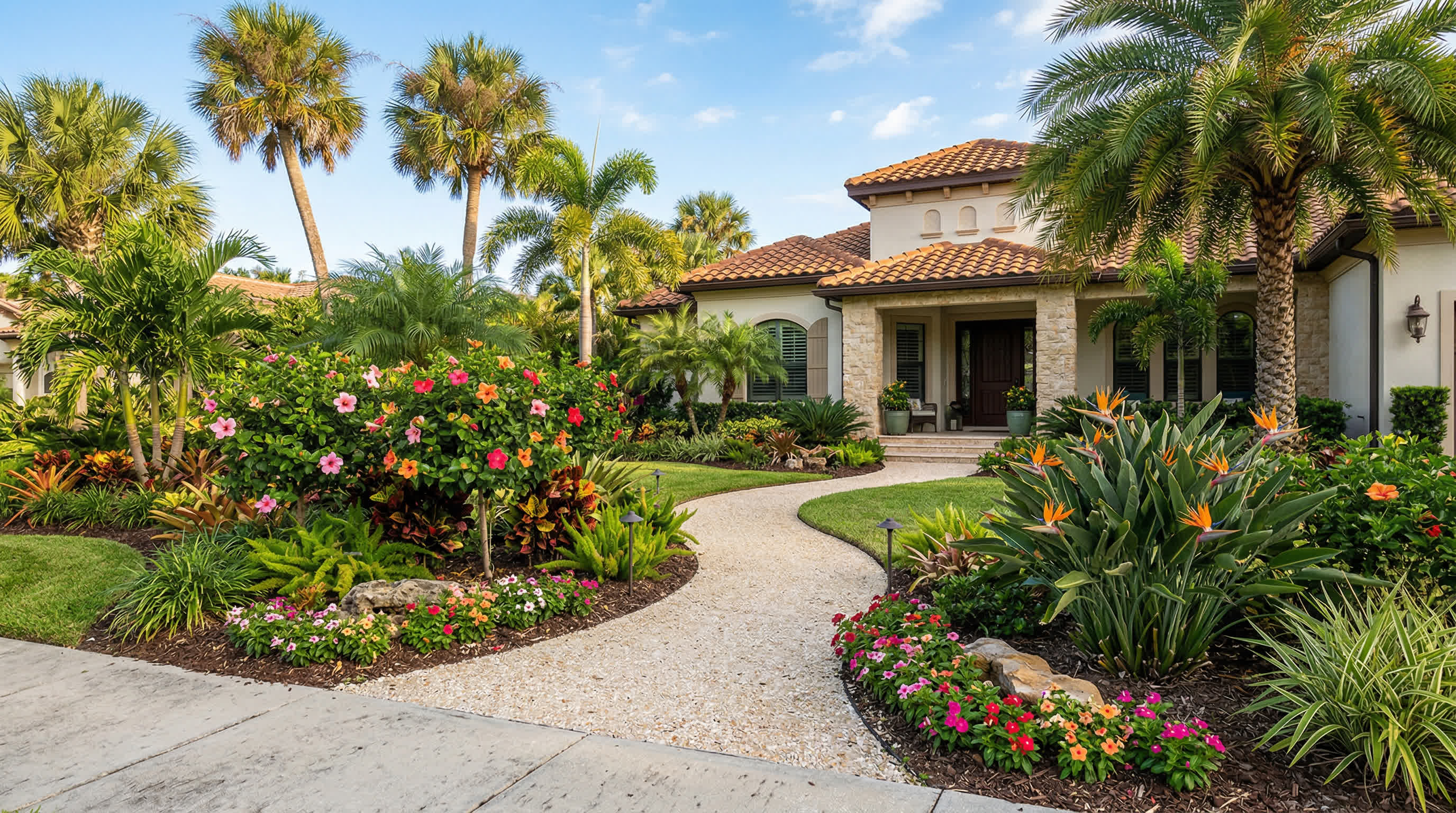
Short answer: Northeast Florida is one of the best regions in the continental United States for tropical landscaping. USDA Hardiness Zones 9a and 9b cover the entire corridor from Daytona Beach to Jacksonville, meaning most tropical and subtropical plants — palms, hibiscus, bougainvillea, ferns, bird of paradise, and dense tropical privacy hedges — thrive here year-round with minimal cold protection. This guide covers everything you need to design, plant, and maintain a tropical yard in St. Augustine, Ponte Vedra, Palm Coast, Flagler Beach, and surrounding cities: the best plants by category, design ideas for front yards, poolside areas and backyard retreats, real landscaping cost data, coquina shell ground cover at $145 per yard, delivery service details, HOA-friendly options, a seasonal planting calendar, and the lowest-maintenance tropical choices for busy homeowners.
Key Takeaways
- Northeast Florida's Zone 9a/9b climate supports true tropical landscaping — average winter lows rarely drop below 25°F in St. Augustine and Ponte Vedra, and most tropical plants survive without any cold protection when chosen correctly.
- The best tropical plants for Northeast Florida include Sabal palms (from $25.99), tropical hibiscus (from $26.99), bougainvillea (from $26.99), tropical ferns (from $17.99), and privacy hedges like Clusia, Cocoplum, and Wax Myrtle.
- Full tropical yard transformations in Northeast Florida typically cost $3,000 to $15,000 depending on lot size, plant selection, and whether coquina shell is used for ground cover — installed landscaping runs roughly $8 to $22 per square foot.
- Coquina shell at $145 per yard is the top mulch and ground cover alternative for Northeast Florida tropical yards — it drains instantly, looks native and coastal, and never needs annual replacement like bark mulch does.
- Tropical Yards delivers tropical plants by dump trailer to St. Augustine, Ponte Vedra, Palm Coast, Flagler Beach, Ormond Beach, and Daytona Beach — one flat delivery fee covers a full load of plants and coquina shell.
- HOA communities throughout St. Johns County and Flagler County — including Nocatee, Ponte Vedra Beach, and World Golf Village — are fully compatible with tropical landscaping when the right plant species and placement strategies are used.
- New construction lots benefit most from a "palms first" planting strategy — getting large-canopy palms in the ground within the first 60 days of move-in so they begin establishing root systems while other areas are still being planned.
In This Article
- Why Northeast Florida is ideal for tropical landscaping (Zone 9a/9b)
- Best tropical plants by category — palms, hibiscus, bougainvillea, ferns, and privacy hedges
- Tropical landscaping design ideas — front yard, poolside, and backyard retreat
- New construction landscaping in Northeast Florida — timeline and what to plant first
- Landscaping costs in Northeast Florida — per square foot and full-yard estimates
- Coquina shell as ground cover and mulch alternative — $145 per yard delivered
- Delivery service — dump trailer delivery to all 6 cities and pricing table
- HOA-friendly tropical landscaping for gated communities
- Seasonal planting calendar for Northeast Florida tropical yards
- Low-maintenance tropical landscaping options for Northeast Florida
- Frequently Asked Questions
Why Northeast Florida is ideal for tropical landscaping (Zone 9a/9b)
Northeast Florida sits at one of the most advantageous geographic positions for tropical landscaping in the United States. The USDA Plant Hardiness Zone map places St. Augustine, Ponte Vedra Beach, Palm Coast, and Flagler Beach solidly in Zone 9a, with portions of coastal St. Johns County and the southern Flagler County coast touching Zone 9b. What that means in practical terms: average annual minimum temperatures range from 20°F to 30°F, and on the immediate coast where the Atlantic Ocean moderates winter lows, hard freezes below 25°F are rare events rather than annual certainties. The combination of warm winters, a long frost-free growing season of roughly 300 days per year, high summer humidity that tropical plants love, and sandy fast-draining soil that mimics the natural habitat of Caribbean and Central American tropicals makes Northeast Florida uniquely suited to the tropical aesthetic that most homeowners associate with South Florida or the Caribbean.
The region's climate is driven by two moderating forces: the Atlantic Ocean to the east and the Gulf Stream offshore current that keeps coastal water temperatures warmer than the interior. Homes within two to three miles of the coast in communities like Ponte Vedra Beach, Vilano Beach, Crescent Beach, and Flagler Beach benefit from the most favorable microclimate in the region — these areas regularly see winter lows 5 to 8 degrees warmer than inland locations, which is the difference between a bougainvillea that blooms through December and one that gets frost-nipped in November. Even inland communities like World Golf Village, Nocatee, and Ormond Beach have embraced tropical landscaping because the right plant selection — emphasizing cold-tolerant tropical species over cold-marginal ones — produces the full tropical aesthetic without the freeze losses that deter homeowners in Zone 8 to the north.
The growing season in Northeast Florida is another major advantage. Most tropical plants go dormant or slow dramatically north of Zone 9, but in St. Augustine and Ponte Vedra, a well-planted tropical yard is actively growing and blooming from March through November — nine full months of the year. During the remaining three months (December through February), tropical palms, hibiscus, and privacy hedges maintain their foliage and structure, just at a slower growth rate. The practical result is that a Northeast Florida tropical landscape looks presentable and healthy 365 days a year, unlike the bare-stick winters that characterize landscaping in Zones 7 and 8 across the Carolinas, Georgia, and the Florida panhandle.
Rainfall patterns also favor tropical landscaping here. Northeast Florida receives 50 to 55 inches of rain per year on average, with the bulk falling during the summer wet season from June through September. This aligns perfectly with the active growing season of tropical plants, providing natural irrigation during the period when plants are growing most aggressively and when supplemental irrigation would otherwise be the most expensive to provide. Established tropical palms, hibiscus, and bougainvillea in Northeast Florida need little to no supplemental irrigation once they have been in the ground for 12 to 18 months, making them genuinely low-cost to maintain compared to the turf-heavy landscaping that dominates many Florida subdivisions.
- Tropical landscaping in Northeast Florida Zone 9a St. Augustine Ponte Vedra Palm Coast
- Best tropical plants for Zone 9b coastal Northeast Florida Flagler Beach Ormond Beach
- Tropical yard design ideas for St. Johns County and Flagler County Florida homeowners
- Why tropical landscaping thrives in Northeast Florida near the Atlantic coast Zone 9
- Tropical plants that survive Northeast Florida winters in St. Augustine and Nocatee FL
What USDA hardiness zone is Northeast Florida, and what does that mean for tropical plants?
Northeast Florida falls in USDA Hardiness Zones 9a and 9b, which means average annual minimum temperatures between 20°F and 30°F. For tropical plants, this translates to a landscape environment where most true tropicals — palms, hibiscus, bougainvillea, bird of paradise, croton, firebush, and tropical ferns — survive and thrive without cold protection in most winters. In Zone 9b coastal areas like Ponte Vedra Beach and Crescent Beach, homeowners can grow an even wider palette including species that would be marginal a few miles inland. The key to success is choosing species that are proven in Zone 9 rather than Zone 10 or 11 plants that are genuinely cold-sensitive, like coconut palms or true tropical fruit trees.
Best tropical plants by category — palms, hibiscus, bougainvillea, ferns, and privacy hedges
Choosing the right tropical plants for a Northeast Florida yard means matching species to the specific conditions of your site — sun exposure, soil drainage, proximity to salt water, and the amount of maintenance you want to commit to. The categories below represent the core plant palette that drives the most successful tropical landscapes across St. Augustine, Ponte Vedra, and the broader First Coast region. All pricing is for nursery-grade plants delivered by Tropical Yards' dump trailer service.
Palms are the structural backbone of any tropical landscape, and Northeast Florida supports a wide range of palm species that perform beautifully in Zone 9. Sabal Palms (Sabal palmetto), Florida's state tree, start from $25.99 and are the most reliable all-around palm for any Northeast Florida property — they handle salt spray, drought, flooding, and the occasional hard freeze with equal indifference. Windmill Palms (Trachycarpus fortunei) from $25.99 are the most cold-hardy ornamental palm available, surviving temperatures as low as 10°F when mature, which makes them a completely bulletproof choice even during the harshest Northeast Florida winters. European Fan Palms (Chamaerops humilis) are a compact, multi-trunk palm that tops out at 10 to 15 feet, making them ideal for smaller front yards or as a foundation planting near a house entry. Queen Palms (Syagrus romanzoffiana) deliver the most dramatic tropical silhouette — long feathery fronds arch out from a smooth gray trunk that can reach 50 feet at maturity — and perform well in the warmer, coastal portions of Zone 9.
Hibiscus starting from $26.99 is the quintessential tropical flowering shrub for Northeast Florida, and for good reason — it blooms almost continuously from March through November, producing flowers the size of dinner plates in every color from pure white to deep red, coral, orange, yellow, and bicolor combinations. Tropical Hibiscus (Hibiscus rosa-sinensis) is the classic poolside and entry planting choice throughout St. Augustine and Ponte Vedra. Rose of Sharon (Hibiscus syriacus) is the cold-hardy relative that blooms reliably throughout Zone 9 and is excellent for homeowners who want the hibiscus look in a shrub that can be used as a privacy hedge or foundation planting. Confederate Rose (Hibiscus mutabilis) is a dramatic large-growing hibiscus that produces multi-inch blooms that open white in the morning and deepen to pink and then red over the course of the day — it is a showstopper specimen plant for any Northeast Florida tropical yard with enough space to accommodate its size.
Bougainvillea from $26.99 is one of the highest-impact tropical plants available for Northeast Florida homeowners who want dramatic color with minimal care. Bougainvillea is not actually a tropical plant in the cold-sensitive sense — it is native to the coastal scrub zones of Brazil and Argentina and is naturally adapted to periods of drought, nutrient-poor sandy soil, and hot dry conditions, all of which Northeast Florida's well-drained sandy soils replicate well. The key to maximizing bougainvillea bloom in Northeast Florida is minimal irrigation and minimal fertilization: overwatering and over-fertilizing produces lush green growth with few blooms, while a drier, lower-nutrient soil stress triggers the spectacular bract production that bougainvillea is famous for. Varieties like 'Barbara Karst' (deep red-magenta), 'San Diego Red' (scarlet), and 'Golden Jackpot' (gold-orange) are proven performers throughout St. Johns County and Flagler County.
Tropical ferns from $17.99 add the lush, layered undergrowth texture that completes the tropical landscape look under palms and large canopy trees. Autumn Fern (Dryopteris erythrosora) is one of the most reliable ferns for the shaded areas of Northeast Florida yards, producing coppery-red new fronds that mature to a glossy dark green — it is evergreen, deer-resistant, and thrives in the dappled shade beneath a Sabal Palm canopy. Macho Fern (Nephrolepis biserrata) is a bold, large-growing fern that produces fronds up to four feet long and creates the kind of lush tropical undergrowth associated with rainforest interiors. It is exceptionally effective as a mass planting beneath a palm canopy or along a shaded fence line. Holly Fern (Cyrtomium falcatum) is a tough, glossy-leaved fern that tolerates more sun than most and holds up exceptionally well in the heat and humidity of Northeast Florida summers.
Privacy hedges for Northeast Florida tropical landscapes should be chosen from the category of dense-growing, heat- and humidity-tolerant shrubs that maintain their foliage year-round and can be maintained at a precise height for HOA compliance. Clusia guttifera (Small-leaf Clusia) has become the dominant privacy hedge plant throughout upscale Northeast Florida communities because it grows dense, holds its shape with minimal shearing, resists whitefly and most common pests, and maintains a deep green color through all four seasons. Cocoplum (Chrysobalanus icaco) is the native alternative that handles coastal salt exposure better than any other hedge plant in the region. Viburnum suspensum (Sandankwa Viburnum) is a faster-growing option that provides dense screening within two to three seasons of planting and tolerates both full sun and partial shade.
- Tropical plants for sale in St. Augustine FL palms hibiscus bougainvillea ferns from $17.99
- Best tropical landscaping plants for Northeast Florida Zone 9a Ponte Vedra Nocatee Flagler Beach
- Sabal palms and Windmill palms for sale St. Augustine FL from $25.99 with dump trailer delivery
- Tropical hibiscus bougainvillea and privacy hedges delivered to Palm Coast and Ormond Beach FL
- Tropical ferns and ground cover plants for shaded yards in St. Johns County and Flagler County FL
What is the best tropical palm for Northeast Florida yards?
The Sabal Palm (Sabal palmetto) is the single best all-around palm for Northeast Florida. It tolerates salt spray, drought, periodic flooding, hard freezes, and nutrient-poor sandy soil — conditions that would stress or kill most other palms. Sabal Palms start from $25.99 and are available in a range of sizes from 3-foot specimens to mature 20-foot palms. For homeowners who want a more refined, formal look, the Windmill Palm is the top choice: it is the most cold-hardy ornamental palm available and is perfectly suited to Zone 9a and 9b. For poolside drama, Queen Palms deliver unmatched tropical silhouette in the warmer coastal portions of the region.
Tropical landscaping design ideas — front yard, poolside, and backyard retreat
Effective tropical landscape design in Northeast Florida follows the same layering principle used in natural tropical forests: a canopy layer of tall palms or large specimen trees, a mid-layer of flowering shrubs and medium-height foliage plants, and a ground layer of ferns, ground covers, and coquina shell or other mulch that ties the planting beds together. The most successful tropical yards in St. Augustine and Ponte Vedra apply this three-layer approach consistently, whether they are designing a 1,500-square-foot front yard or a sprawling 10,000-square-foot estate lot.
Front yard curb appeal in a tropical design starts with the entry statement — typically two matching palms flanking the driveway or front walk, a flowering focal shrub such as a large bougainvillea or hibiscus at the corner of the house, and a clean bed of coquina shell or tropical ground cover that frames the house from the street. For a standard 60-foot-wide front yard in a St. Augustine or Ponte Vedra neighborhood, a pair of 10- to 12-foot Windmill Palms at the driveway entry creates the strongest tropical statement from the street. Add two large-size tropical hibiscus on either side of the front door for color, and mass-plant Clusia or Viburnum along the property line to create a clean, finished edge. The coquina shell bed that connects all of these plantings ties the design together and eliminates the high-maintenance lawn areas that require weekly mowing in Northeast Florida's aggressive summer growing season.
Poolside tropical design is where Northeast Florida homeowners have the most creative latitude. The pool environment creates a warm, protected microclimate that allows slightly more cold-sensitive tropical plants to thrive than would survive in an exposed front yard. A well-designed poolside tropical landscape typically includes at minimum: two to four palms for canopy (Windmill, Sabal, or Queen), a Bird of Paradise specimen at each corner of the pool deck for architectural interest, tropical hibiscus in containers or planted beds along the pool fence, and a mass planting of Macho Fern or Autumn Fern in any shaded area beneath the palm canopy. Bougainvillea trained along a pool fence or trellis adds the vivid color backdrop that turns an ordinary pool area into a genuine Caribbean resort aesthetic. For the pool deck beds themselves, coquina shell at $145 per yard is far superior to bark mulch — it drains instantly and will not float into the pool during heavy rain or splash events the way bark mulch does.
Backyard retreat design for a Northeast Florida tropical yard focuses on creating a sense of enclosure and privacy through strategic planting. A dense privacy hedge along the rear and side property lines using Clusia or Cocoplum creates the green walls that make a backyard feel like a private outdoor room rather than an exposed suburban lot. Within that enclosed space, a designed tropical garden with winding mulched paths, specimen palms, colorful hibiscus and croton, and shaded seating areas beneath a palm canopy creates the kind of destination backyard that serves as both a daily retreat and an entertainment space. Firebush (Hamelia patens), Plumbago, Pentas, and Powderpuff (Calliandra haematocephala) are excellent mid-layer plants that provide continuous color throughout the warm season and attract butterflies and hummingbirds as a bonus.
For larger lots or estate-scale projects, consider creating distinct zones within the overall tropical landscape — a shaded garden walk beneath a canopy of Sabal Palms, a sun garden with bougainvillea and Bird of Paradise, a fragrance garden near the patio or outdoor dining area planted with Gardenia, Angel's Trumpet, and tropical jasmine, and a utility zone with fast-growing Wax Myrtle or Clusia providing privacy from neighbors or the street. The zoning approach produces a landscape that rewards exploration and engagement rather than the flat, uniform look of a conventional lawn-based yard.
- Tropical front yard landscaping design ideas for Northeast Florida St. Augustine Ponte Vedra
- Poolside tropical landscaping plants and design for St. Johns County and Flagler County FL
- Backyard tropical retreat landscaping for Nocatee World Golf Village and Palm Coast FL
- Tropical curb appeal landscaping design with palms hibiscus and coquina shell St. Augustine FL
- Tropical landscaping design ideas for Northeast Florida gated communities and large lots
How do you create a resort-style tropical backyard in Northeast Florida?
A resort-style tropical backyard in Northeast Florida starts with a privacy perimeter — a dense hedge of Clusia or Cocoplum along property lines creates the enclosed "room" feel that defines resort landscapes. Inside that perimeter, layer palms for canopy height, Bird of Paradise and hibiscus for color at eye level, and tropical ferns or ground cover beneath. Coquina shell paths and bed edging tie the whole design together. The key difference between a resort look and a standard Florida yard is density — tropical resort gardens are intentionally lush and layered, not sparse and manicured. Pack planting beds with overlapping plants at different heights and allow them to grow into each other over time.
Ready to Start Your Tropical Landscaping Project?
Palms from $25.99, hibiscus from $26.99, bougainvillea from $26.99 — delivered by dump trailer to your Northeast Florida yard.
Get a Free Quote Call 772-267-1611New construction landscaping in Northeast Florida — timeline and what to plant first
New construction landscaping in Northeast Florida requires a different approach than re-landscaping an established yard because the soil conditions, grading, and site context are all in flux during the first months after move-in. Builder-grade landscaping — typically a few palms, foundation shrubs, and sod — is rarely more than a starting point, and most new construction homeowners in Nocatee, World Golf Village, Silverleaf, and other active Northeast Florida communities begin planning their real tropical landscaping project within the first year of taking possession of a new home.
The most important principle for new construction tropical landscaping is plant large trees and palms first, everything else second. Palms and large specimen trees are the elements that take the longest to reach their design intent, and every month of establishment time they accumulate makes a measurable difference in how your yard looks at the two-year and five-year marks. Getting a pair of 12-foot Windmill Palms or a cluster of Sabal Palms in the ground within the first 60 days of move-in — even before you have finalized the rest of your landscape plan — is one of the highest-return decisions a new construction homeowner can make. Those palms will be actively establishing their root systems while you spend the next several months planning beds, finalizing hardscape, and deciding on hedge placement.
A practical new construction landscaping timeline for a typical Northeast Florida subdivision lot looks like this: Days 1 to 60 — install palms and any other large specimen trees; establish an irrigation system before planting if budget allows; allow soil to settle after grading. Months 2 to 4 — install privacy hedges along property lines; begin bed edging and define planting areas; install coquina shell in areas where plant installation is complete. Months 4 to 6 — install mid-layer flowering shrubs (hibiscus, bougainvillea, bird of paradise, pentas, plumbago); install tropical ferns and ground cover plants in shaded areas. Months 6 to 12 — fill in gaps, assess what has established well and what needs replacement, add seasonal color plants, and adjust irrigation zones to reflect the mature planting scheme.
New construction soil in Northeast Florida presents a specific challenge: builder grading compacts the upper soil layer, which slows root penetration and establishment for the first 12 to 18 months. Combat this by adding organic material to planting holes when installing palms and large shrubs, by keeping mulch coverage consistent (coquina shell or bark mulch) to moderate soil temperature extremes, and by watering newly planted palms on a disciplined schedule — daily for the first two weeks, every other day for the following month, and then twice weekly through the first growing season. Tropical plants in new construction soil need more supplemental irrigation during establishment than the same plants installed in a well-amended, established garden bed.
- New construction tropical landscaping Northeast Florida Nocatee Silverleaf World Golf Village
- What to plant first in a new construction yard in St. Augustine and Ponte Vedra FL
- New construction landscaping timeline for Zone 9a Northeast Florida tropical plants
- Tropical landscaping for new construction homes in Palm Coast and Flagler County FL
- Best tropical plants for new construction lots in St. Johns County FL with dump trailer delivery
When should you start landscaping a new construction home in Northeast Florida?
Start as early as possible — ideally within the first 30 to 60 days of move-in. The most time-sensitive elements are large palms and specimen trees, which need maximum establishment time. Even if you are not ready to finalize the full landscape design, getting palms in the ground during the first months gives them a full growing season head start. Builder-grade sod and foundation plantings can be supplemented or replaced in phases — but palms planted on day one will be visibly larger and better established at the two-year mark than palms planted a year later, making that first-year establishment period the highest-value window for planting investment.
Landscaping costs in Northeast Florida — per square foot and full-yard estimates
Understanding realistic landscaping costs is essential for planning a tropical yard project in Northeast Florida. Costs vary significantly depending on whether you are doing DIY plant installation with delivered plants, hiring a landscape contractor for design and installation, or taking a hybrid approach where you purchase and have plants delivered, then handle installation yourself. This section covers all three scenarios with real price ranges derived from the Northeast Florida market.
DIY installation with delivered plants is the most cost-effective approach for homeowners who are willing to dig and plant. In this model, Tropical Yards delivers plants by dump trailer to your property — one flat delivery fee covers the entire load — and you install the plants at your own pace. Plant pricing for a typical tropical landscape package in this scenario runs as follows: palms from $25.99 (small specimens) to $350+ (large balled specimens), hibiscus from $26.99 per plant, bougainvillea from $26.99 per plant, tropical ferns from $17.99 per plant, and Clusia or Cocoplum privacy hedge plants from $18 to $45 per plant depending on size. A full front yard transformation for a typical 60-foot-wide lot in a Northeast Florida subdivision — 2 palms, 8 to 10 flowering shrubs, 20 hedge plants, and 3 yards of coquina shell — typically runs $600 to $1,200 in plant and material costs plus the flat delivery fee.
Professional installation adds contractor labor costs on top of plant and material costs. Northeast Florida landscape contractors typically charge $8 to $12 per square foot for basic planting bed installation (soil prep, plant installation, mulching) and $14 to $22 per square foot for complete landscape design, grading, irrigation, edging, and planting. For a 3,000-square-foot front yard and backyard project, expect a full-service professional landscape installation to run $24,000 to $66,000 depending on plant sizes, irrigation complexity, and hardscape elements. Many homeowners use professional contractors for the design phase and then handle ongoing plant additions themselves through direct-delivery services like Tropical Yards to keep costs manageable after the initial installation.
Specific cost benchmarks for common Northeast Florida tropical landscaping projects: A front yard curb appeal upgrade (2 palms, 6 flowering shrubs, privacy hedge along one property line, coquina shell beds) runs $800 to $2,500 in materials for DIY installation or $4,000 to $8,000 professionally installed. A poolside tropical redesign (4 palms, 8 to 10 accent shrubs, bed edging, coquina shell, bird of paradise specimens) runs $1,200 to $3,500 DIY or $6,000 to $12,000 professionally installed. A complete backyard retreat transformation on a quarter-acre lot (privacy hedge perimeter, palm canopy, flowering shrub layers, paths, coquina shell ground cover throughout) runs $3,000 to $8,000 DIY or $15,000 to $35,000 professionally installed. Coquina shell at $145 per yard is a fixed cost regardless of installation method and is one of the most impactful dollar-for-dollar investments in a Northeast Florida tropical landscape.
- Tropical landscaping cost per square foot Northeast Florida St. Augustine Ponte Vedra 2026
- How much does tropical landscaping cost in St. Johns County and Flagler County FL
- Full yard tropical landscaping estimates for Palm Coast Ormond Beach Daytona Beach FL
- Tropical plant installation costs Northeast Florida DIY vs professional landscaping
- Landscaping cost guide Northeast Florida palms hibiscus bougainvillea coquina shell pricing
Coquina shell as ground cover and mulch alternative — $145 per yard delivered
Coquina shell is one of the most distinctive and practical ground cover materials available for tropical landscapes in Northeast Florida, and at $145 per yard delivered, it offers exceptional value compared to the alternatives. Coquina is a naturally occurring sedimentary rock found throughout the Florida coast, composed of compressed fragments of ancient shell and coral — it is the same material used to build the Castillo de San Marcos in St. Augustine, making it deeply native to the Northeast Florida landscape aesthetic. As a garden ground cover, coquina shell delivers a unique set of advantages that bark mulch, pine straw, and decorative rock cannot match.
The primary functional advantage of coquina shell is drainage. Coquina is porous and drains almost instantaneously — a heavy summer rain that would pond on a bark mulch bed drains through a coquina bed without creating any standing water. This is critical for tropical plant health in Northeast Florida's clay-influenced inland soils, where poor drainage can cause root rot in otherwise healthy plants. It is also important for poolside and waterfront properties where waterlogged mulch beds create mosquito breeding habitat, fungal disease conditions, and aesthetically unpleasant odors during the humid summer months. A coquina-mulched bed next to a pool cage stays dry, clean, and odor-free regardless of how much rain falls.
Coquina shell's visual appearance is another major advantage for tropical landscapes. Its off-white, cream, and tan coloration creates a clean, coastal contrast against the deep greens of Clusia hedges, the glossy fronds of palms, and the vivid colors of hibiscus and bougainvillea. Unlike white marble chips or crushed limestone, coquina has a natural, organic texture that looks at home in a tropical garden rather than in a formal European-style landscape. It does not look harsh or clinical the way solid white stone does — instead, it has the warm, aged quality of a Caribbean village garden or a coastal Florida cottage yard. Communities throughout Ponte Vedra Beach, St. Augustine Beach, and Flagler Beach have embraced coquina shell as the signature ground cover material precisely because it looks like it belongs at the Florida coast.
Unlike organic mulches that decompose and need annual replacement, coquina shell is essentially permanent. Once installed at a depth of two to three inches, a coquina bed will maintain its appearance for years with only occasional raking to redistribute shell that has been displaced by rain splash or foot traffic. This permanence translates to meaningful long-term cost savings: a homeowner who installs coquina shell in planting beds during year one will not need to re-mulch those beds every spring at $100 to $250 per application the way bark mulch users do. Over a five-year horizon, coquina shell typically costs less than bark mulch despite the higher initial price, once annual re-application costs are factored in.
For larger landscape projects, Tropical Yards delivers coquina shell in bulk on the same dump trailer load as your plants, with no minimum quantity and no additional logistics required. A typical Northeast Florida front yard transformation uses three to five yards of coquina shell; a full backyard retreat with defined planting beds and paths typically uses six to twelve yards. Coquina shell can also be used as a path material, as an edging fill between bed borders, or as a loose-fill surface for patio and seating areas where you want a permeable, natural-looking surface that does not absorb heat the way concrete or pavers do in the Florida sun.
- Coquina shell ground cover and mulch alternative Northeast Florida St. Augustine $145 per yard
- Coquina shell delivered to Ponte Vedra Palm Coast Flagler Beach for tropical landscape beds
- Best mulch for tropical planting beds in Northeast Florida coastal yards coquina vs bark mulch
- Coquina shell for poolside tropical landscaping in St. Johns County and Flagler County FL
- Bulk coquina shell delivery to Nocatee Ormond Beach Daytona Beach FL dump trailer service
How much coquina shell do I need for a typical Northeast Florida yard?
A standard 2-to-3-inch coverage depth requires approximately one yard of coquina shell per 100 square feet of bed area. A typical front yard planting bed with two palm trees and shrub borders covering 300 square feet needs three yards; a poolside redesign with perimeter beds covering 500 square feet needs five yards; a full backyard retreat transformation with defined paths and perimeter hedges covering 800 to 1,200 square feet needs eight to twelve yards. Coquina shell is $145 per yard delivered to all six Northeast Florida cities served by Tropical Yards, and it can be included on the same dump trailer load as your plant order.
Delivery service — dump trailer delivery to all 6 cities and pricing
Tropical Yards delivers tropical plants and coquina shell by dump trailer throughout Northeast Florida. The dump trailer delivery model is specifically designed for the scale of material that a real landscape transformation requires — large palms, hedge plants in quantity, and bulk coquina shell cannot be transported in a standard pickup truck or fit in a single SUV load from a garden center. One dump trailer delivery from Tropical Yards can carry everything for a complete yard project — palms, shrubs, privacy hedges, ferns, and coquina shell — in a single trip, which means one flat delivery fee covers everything regardless of total weight or volume.
Delivery service operates Monday through Saturday, 7 AM to 5 PM. To schedule a delivery, call or text 772-267-1611 or submit a quote request at www.tropicalyardstaugustine.com/contact/. Provide your address, a list of the plants you want, and the approximate quantities; Tropical Yards will confirm plant availability and schedule a delivery window within one business day. No minimum order quantity is required — the flat delivery fee applies whether you order five plants or fifty, plus as much coquina shell as will fit on the load.
| City / Service Area | Dump Trailer Delivery Fee |
|---|---|
| St. Augustine (incl. St. Augustine Beach, Vilano Beach, Anastasia Island) | $250 |
| Ponte Vedra (incl. Ponte Vedra Beach, Nocatee, Palm Valley) | $275 |
| Palm Coast (incl. Hammock, Flagler County coastal communities) | $300 |
| Flagler Beach (incl. Beverly Beach, Marineland) | $300 |
| Ormond Beach (incl. Ormond-by-the-Sea, Tomoka) | $350 |
| Daytona Beach (incl. Daytona Beach Shores, Port Orange) | $375 |
Coquina shell at $145 per yard is priced separately from plants and can be added to any plant delivery order at no additional delivery charge — it loads onto the same dump trailer. This means a homeowner in St. Augustine who orders plants and four yards of coquina shell pays the $250 delivery fee once, regardless of whether the trailer contains plants only or plants and bulk coquina. This combined-load model is one of the primary reasons Tropical Yards customers consistently report lower total project costs than comparable purchases from local garden centers or landscaping supply companies.
- Tropical plant dump trailer delivery to St. Augustine Ponte Vedra Palm Coast Flagler Beach FL
- Dump trailer delivery fee for tropical plants Ormond Beach Daytona Beach Northeast Florida
- Tropical plants and coquina shell delivered same load St. Augustine FL $250 delivery fee
- Bulk tropical plant delivery Nocatee World Golf Village Silverleaf St. Johns County FL
- Tropical plant delivery schedule and pricing for all Northeast Florida cities and communities
HOA-friendly tropical landscaping for gated communities
The majority of new construction and established neighborhoods in Northeast Florida are governed by homeowners associations (HOAs) with architectural review requirements — from the large master-planned communities of Nocatee and Palencia to the gated country club communities of Ponte Vedra Beach and World Golf Village. The good news for tropical landscaping enthusiasts is that the plant species and design approaches that work best in Northeast Florida's climate also happen to produce the clean, polished, upscale aesthetic that HOA architectural control committees consistently approve. Tropical landscaping is not at odds with HOA compliance — it just requires intentional plant selection and placement.
The most important principle for HOA-compliant tropical landscaping is controllability. HOA committees approve plants that can be maintained at a specified size and shape through regular trimming. This means that the best HOA-friendly choices are those that respond well to shearing — Clusia guttifera, Cocoplum, Viburnum, and Podocarpus all form dense, uniform hedges that can be maintained at any height from three to eight feet. Avoid plants with aggressive spreading habits (Wax Myrtle will need frequent trimming to stay in bounds in a tight HOA setting), plants with visible seed pods or fruit that drop on common areas or neighboring lots, or specimen plants that will eventually exceed HOA-specified height limits without costly professional pruning.
For gated communities like Sawgrass Players Club, Marsh Landing, The Plantation at Ponte Vedra Beach, Nocatee's Coastal Oaks, and World Golf Village's King & Bear, the standard HOA-friendly tropical landscape palette includes Clusia guttifera hedges maintained at five to seven feet along property lines, Windmill Palms as accent trees at front entries (they grow slowly enough to stay in scale with the house for 15 or more years without ACC intervention), tropical hibiscus as foundation plantings near the house (controlled by regular pruning), bougainvillea on trellises attached to fence structures (avoid allowing it to sprawl into common areas), and coquina shell or black-edged mulch beds as the finished ground cover that gives the landscape its polished, model-home appearance.
Before beginning a significant landscaping project in any Northeast Florida HOA community, submit a simple planting plan to your architectural review committee that includes the plant species, proposed mature sizes, and planned placement distances from structures and property lines. Most HOA committees process routine landscape additions within two to four weeks, and approval is nearly universal for the plant species described above. Keep a copy of the approved plan on file — it protects you in the event of a future resident complaint and establishes a documented record of your compliance with community standards.
- HOA-friendly tropical landscaping for Nocatee Palencia Sawgrass Ponte Vedra gated communities
- HOA-approved tropical plants for World Golf Village and St. Johns County gated neighborhoods
- Clusia and Cocoplum privacy hedges for HOA communities in Northeast Florida Zone 9
- Tropical landscaping that meets architectural review requirements in Palm Coast and Flagler County
- HOA-compliant tropical yard design for Ormond Beach and Daytona Beach gated communities
What tropical plants are typically approved by HOAs in Northeast Florida gated communities?
HOAs in Northeast Florida gated communities almost universally approve Clusia guttifera, Cocoplum, Podocarpus, and Viburnum for privacy hedges; Sabal Palms, Windmill Palms, and European Fan Palms as accent trees; and tropical hibiscus, Bougainvillea (on structures), Bird of Paradise, and Plumbago as ornamental shrubs. The key factors in HOA approval are mature size (will the plant eventually exceed height limits?), maintenance requirements (can it be kept tidy with regular trimming?), and community aesthetic fit. Clusia guttifera and Windmill Palms check all three boxes and are the top recommendations for homeowners navigating a conservative HOA review process.
Seasonal planting calendar for Northeast Florida tropical yards
Timing tropical plant installation correctly in Northeast Florida dramatically improves establishment success rates and reduces the supplemental irrigation needed to get new plants through their first months in the ground. The region's distinct wet and dry seasons, combined with the risk of occasional winter cold snaps, create a planting calendar with clear optimal windows that experienced Northeast Florida gardeners and landscapers follow consistently.
Spring (March – May) is the single best planting window for tropical plants in Northeast Florida. Soil temperatures have warmed above 60°F, freeze risk is essentially zero after mid-March, and the approaching summer wet season means that natural rainfall will begin supplementing irrigation within weeks of planting. Plants installed in March and April have the entire summer growing season to establish root systems before facing their first winter. Spring is the optimal window for installing palms, hibiscus, bougainvillea, tropical ferns, and privacy hedges. Nearly every plant in the Northeast Florida tropical palette can be successfully installed in spring with excellent establishment outcomes.
Summer (June – August) is a viable but demanding planting window. Tropical plants establish well in summer because soil temperatures are ideal for root growth, but the intense heat and humidity stress newly installed plants and require aggressive irrigation management. Plants installed in summer need watering every day for the first two to three weeks — missing even a single day during a July heat wave can stress a newly planted palm or hibiscus severely. Summer is the least recommended window for large palm installation because the combination of heat stress and transplant stress is maximized. However, container-grown shrubs, ferns, and smaller accent plants establish surprisingly well in summer when irrigation is managed carefully.
Fall (September – November) is the second-best planting window, and for palms specifically, it may actually rival spring. The combination of still-warm soil temperatures in September and October, declining heat stress as temperatures moderate in November, and the beginning of the dry season (which prevents overwatering) creates excellent conditions for palm root establishment. Hibiscus, Bougainvillea, and Clusia hedge plants also establish well in fall and will show strong new growth by the following spring. Avoid installing cold-sensitive species (marginally hardy tropicals, Bougainvillea in exposed sites) in late November when the first cold fronts begin arriving.
Winter (December – February) is the most limited planting window but is not off-limits for palms and cold-hardy tropicals. Sabal Palms, Windmill Palms, and European Fan Palms can all be planted in January and February — they simply establish more slowly because cool soil temperatures reduce root metabolism. Clusia and Cocoplum hedges planted in winter survive without issue and will begin active growth as soon as soil temperatures warm in March. Avoid winter planting for Bougainvillea, Bird of Paradise, and any tropical species that is marginal in Zone 9 — these plants need the warm weather of spring to establish before facing their next winter.
- Best time to plant tropical plants in Northeast Florida seasonal calendar St. Augustine FL
- Spring tropical planting guide for St. Johns County Flagler County and Ponte Vedra FL
- Fall tropical plant installation calendar for Palm Coast Ormond Beach and Flagler Beach FL
- Year-round tropical planting guide for Zone 9a Northeast Florida coastal communities
- Seasonal tropical landscaping calendar for St. Augustine Nocatee World Golf Village FL
What is the best month to plant tropical palms in Northeast Florida?
March and April are the optimal months for planting tropical palms in Northeast Florida. At that time, soil temperatures are warm enough to support active root growth, freeze risk is essentially zero, and the approaching summer wet season will provide natural rainfall support within weeks of installation. October is the second-best option — soil is still warm from summer, and the decline of heat stress gives newly transplanted palms a gentler establishment period than summer planting. Avoid installing large palms in July and August when the combination of transplant stress and heat stress is highest, unless you can commit to daily irrigation monitoring throughout the establishment period.
Low-maintenance tropical landscaping options for Northeast Florida
One of the most persistent myths about tropical landscaping is that it requires intensive maintenance to keep it looking lush and polished. In reality, a well-designed tropical landscape using the right species for Northeast Florida's climate can be one of the lowest-maintenance yard options available — significantly less demanding than traditional lawn-based landscaping that requires weekly mowing throughout the 30-week Florida growing season. The key is selecting plants that are naturally adapted to the specific conditions of your site rather than fighting the environment with high-maintenance species that need constant attention to thrive.
The lowest-maintenance tropical plants for Northeast Florida are those that are native or near-native to the Southeast Florida and Gulf Coast region: Sabal Palms require essentially zero care once established — no pruning, no fertilization, no special irrigation. They simply grow. Wax Myrtle (Morella cerifera) is a fast-growing native shrub that requires only annual or twice-annual shearing to maintain its privacy hedge form. Firebush (Hamelia patens) grows aggressively from spring through fall, blooms continuously without deadheading, and cuts back to the ground each winter only to regrow vigorously in spring. Beautyberry (Callicarpa americana) produces stunning clusters of vivid purple berries in fall without any fertilization or irrigation beyond establishment. These native tropicals are the foundation of a genuinely low-maintenance tropical yard.
For non-native tropicals with low maintenance requirements, the top choices are Windmill Palms (no pruning necessary beyond removing dead fronds twice per year), Bougainvillea (thrives on neglect — less water and fertilizer mean more blooms), Bird of Paradise (clumping habit requires no pruning; just remove spent flower stalks), Clusia guttifera hedges (shear two to three times per year to maintain shape; otherwise no care required), and Croton (Codiaeum variegatum), which holds its vivid multicolor foliage year-round without fertilization and rarely suffers pest or disease problems in Northeast Florida's climate.
Replacing lawn with tropical plant beds and coquina shell ground cover is the single most significant maintenance-reduction strategy available to Northeast Florida homeowners. One thousand square feet of lawn requires approximately 30 minutes of mowing, edging, and cleanup every week during the seven-month summer growing season — that is 14 hours of maintenance time per season, every season, forever. Replace that same 1,000 square feet with a tropical planting bed containing palms, hibiscus, privacy hedges, and coquina shell mulch, and the annual maintenance drops to approximately two hours of light trimming and occasional raking. For homeowners who pay a lawn service, reducing turf area through tropical bed expansion directly reduces the monthly maintenance bill.
Irrigation efficiency is another dimension of low-maintenance tropical landscaping. Established tropical plants in Northeast Florida require dramatically less supplemental irrigation than lawn turf, which needs watering two to three times per week during dry periods to maintain its appearance. A well-established tropical bed with palms, hibiscus, and ground cover plants can be maintained on a once-per-week irrigation schedule during dry periods and requires no supplemental irrigation at all during the summer wet season. Installing drip irrigation in tropical planting beds rather than overhead spray systems reduces water use further and eliminates the fungal disease pressure that overhead irrigation creates on tropical foliage in humid Northeast Florida conditions.
- Low-maintenance tropical landscaping plants Northeast Florida St. Augustine Ponte Vedra FL
- Easy-care tropical plants for Zone 9a Florida yards palms hibiscus clusia and coquina shell
- Low-maintenance tropical landscaping to replace lawn in Northeast Florida communities
- Drought-tolerant tropical plants for low-maintenance yards in Palm Coast and Flagler Beach FL
- Low-water tropical landscaping options for St. Johns County and Flagler County Florida homeowners
What are the lowest-maintenance tropical plants for a Northeast Florida yard?
The lowest-maintenance tropical plants for Northeast Florida are Sabal Palms (essentially zero maintenance once established), Windmill Palms (prune dead fronds twice per year — that is the full maintenance requirement), Firebush (cut back in late winter, otherwise no care), Wax Myrtle (shear twice per year for hedge shape), Bougainvillea (water sparingly, fertilize minimally, and it will bloom prolifically), and Clusia guttifera hedge plants (shear two to three times per year). Replacing lawn areas with these plants and coquina shell ground cover eliminates weekly mowing and reduces annual yard maintenance time by 80 percent or more.
Shop Tropical Plants for Northeast Florida
125+ tropical varieties including palms, hibiscus, bougainvillea, ferns, and privacy hedges — delivered by dump trailer to all 6 cities.
Get a Free Quote Call 772-267-1611Frequently Asked Questions
What is the best tropical landscaping plant for Northeast Florida?
The Sabal Palm (Sabal palmetto) is the single most versatile and reliable tropical landscaping plant for Northeast Florida. It tolerates every condition the region presents — salt air, sandy soil, drought, flooding, and occasional hard freezes — without requiring any special care. For flowering color, tropical hibiscus is the top choice, producing large blooms from March through November in dozens of color combinations. For privacy hedging, Clusia guttifera has become the dominant choice across upscale Northeast Florida communities for its density, low maintenance, and year-round deep green appearance.
How much does tropical landscaping cost in Northeast Florida?
Tropical landscaping costs in Northeast Florida range from $600 to $3,500 for a DIY front yard transformation using delivered plants (palms from $25.99, hibiscus from $26.99, bougainvillea from $26.99, ferns from $17.99, coquina shell at $145 per yard) to $15,000 to $65,000+ for a professionally designed and installed full-property tropical landscape. Professional installation runs $8 to $22 per square foot depending on project complexity, plant sizes, and whether irrigation and hardscape are included. The most cost-effective approach for most homeowners is purchasing plants directly from Tropical Yards via dump trailer delivery and handling installation personally.
Can I grow true tropical plants in Northeast Florida without them dying in winter?
Yes — Northeast Florida's Zone 9a/9b climate supports a wide range of true tropical plants year-round. Sabal Palms, Windmill Palms, hibiscus, bougainvillea, bird of paradise, firebush, plumbago, croton, and most tropical ferns all survive Northeast Florida winters without cold protection when planted in the right location. The key is avoiding cold-marginal species like Coconut Palms, Areca Palms (marginal in 9a), and cold-sensitive fruiting tropicals (mangoes, papayas) that reliably freeze in Northeast Florida winters. Stick to Zone 9-proven species and the result is a genuinely tropical yard that looks great 12 months per year.
What is coquina shell and why is it used in Northeast Florida landscaping?
Coquina shell is a naturally occurring sedimentary material made of compressed ancient shell fragments found throughout the Florida coast. At $145 per yard delivered, it is used as a ground cover and mulch alternative in tropical landscaping because it drains instantly (unlike bark mulch that retains moisture and promotes fungal issues), looks native and coastal in the Northeast Florida setting, never decomposes and requires no annual replacement, and resists washing and floating during heavy rain events. It is particularly popular for poolside beds, waterfront properties, and HOA communities where a clean, polished ground cover appearance is required year-round.
Does Tropical Yards deliver to all cities in Northeast Florida?
Yes — Tropical Yards delivers to St. Augustine ($250), Ponte Vedra ($275), Palm Coast ($300), Flagler Beach ($300), Ormond Beach ($350), and Daytona Beach ($375) by dump trailer. One flat delivery fee covers a full load of plants and coquina shell regardless of the quantity ordered. To schedule a delivery, call or text 772-267-1611 Monday through Saturday, 7 AM to 5 PM. Deliveries can typically be scheduled within two to five business days of order placement, depending on plant availability and delivery area.
What tropical plants are best for a privacy hedge in Northeast Florida?
The top three privacy hedge plants for Northeast Florida tropical landscapes are Clusia guttifera (Small-leaf Clusia), Cocoplum (Chrysobalanus icaco), and Wax Myrtle (Morella cerifera). Clusia is the most popular choice in upscale communities because it grows dense, holds its shape with minimal trimming, resists pests, and maintains deep green color year-round. Cocoplum is the top choice for coastal and waterfront lots where salt exposure is a factor. Wax Myrtle is the fastest-growing option, reaching screening height in one to two growing seasons. All three are available through Tropical Yards with dump trailer delivery to all Northeast Florida cities. Browse the full selection at www.tropicalyardstaugustine.com/privacy-plants-florida/.
When is the best time to plant tropical landscaping in Northeast Florida?
March through May is the optimal planting window for tropical plants in Northeast Florida. Soil temperatures are warm, freeze risk is zero after mid-March, and the approaching summer wet season provides natural irrigation support within weeks of installation. Fall (September through October) is the second-best window, particularly for palms. Winter planting (December through February) is feasible for cold-hardy species like Sabal and Windmill Palms and Clusia hedges, but should be avoided for cold-sensitive tropicals like Bougainvillea and Bird of Paradise in exposed locations.