When Should Northeast Florida Yards Pause Irrigation During August Rain?
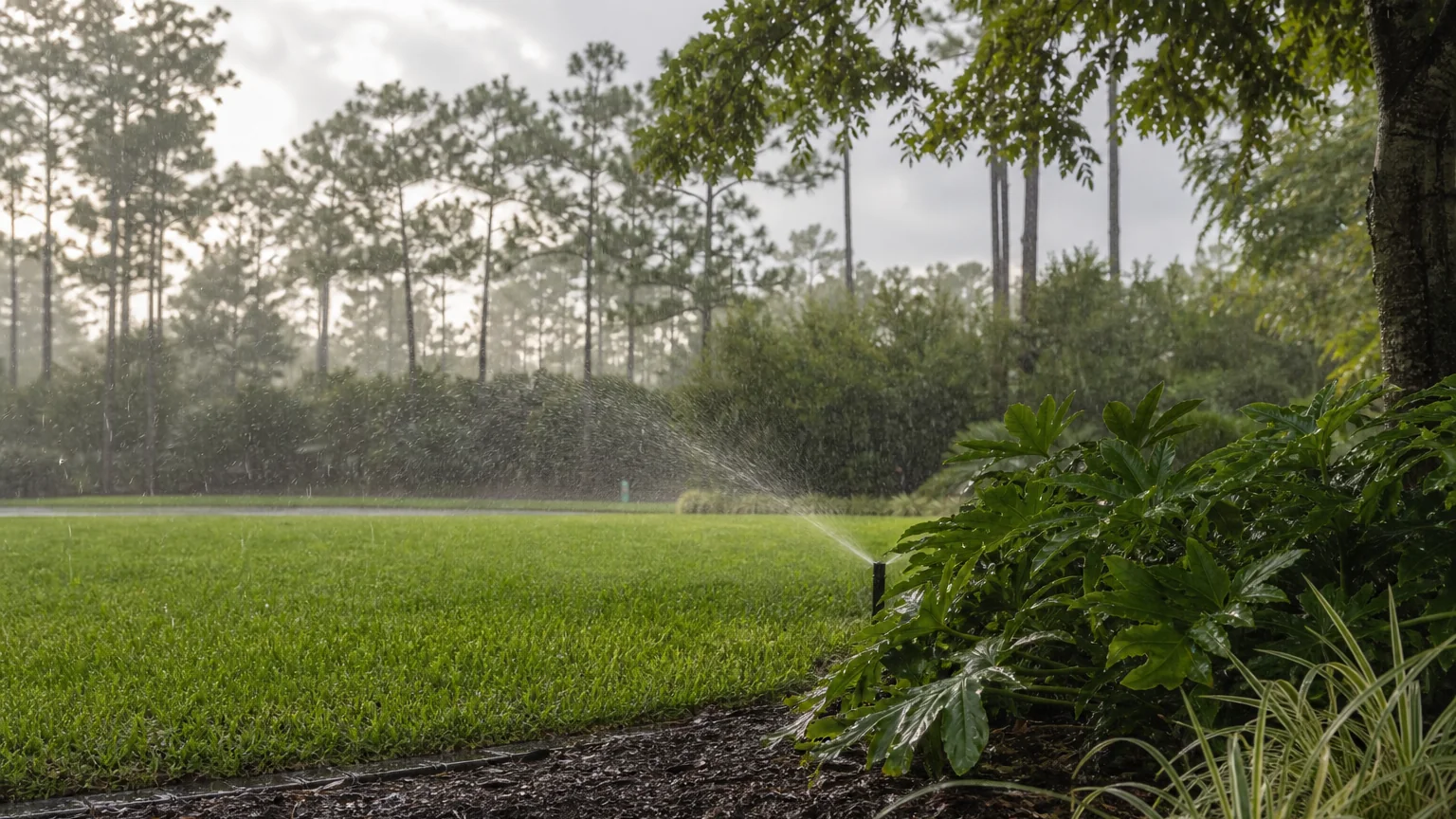
Northeast Florida homeowners should pause irrigation any time recent rainfall has already saturated the top several inches of soil, which during August often happens after a single afternoon thunderstorm delivering half an inch or more. Rather than watering by a fixed clock schedule, check the soil with a finger or a simple probe before running a zone. If the ground feels moist at root depth, skip that cycle and wait a day before checking again, rather than adding water on top of what has already fallen from the sky that same afternoon.
The exact number of days to pause depends on soil type, slope, plant maturity, container versus in-ground placement, and how quickly a given yard drains, none of which can be judged from a general article. UF/IFAS Extension St. Johns County publishes seasonal watering guidance that applies broadly to the region, and that guidance is the factual floor used here. Tropical Yards supplies and delivers tropical plants, palms, flowering plants, privacy plants, and bulk coquina shell, but irrigation scheduling and system adjustments on a specific property should be confirmed with an appropriate qualified professional or your local extension office.
Key takeaways
- Pause irrigation whenever the soil already feels moist a few inches down after rain, rather than following a fixed calendar schedule regardless of recent weather.
- August thunderstorms in Northeast Florida can deliver a substantial amount of water in a short time, so checking soil moisture after each storm matters more than sticking to a preset timer.
- Standing water around containers or root balls for more than a few hours is a warning sign that drainage needs attention before more water is added.
- Newly delivered tropical plants are more vulnerable to wet-root stress during rainy weeks and should be checked more often than established landscape plants.
- Changes to an irrigation controller, rain sensor, or backflow device should be confirmed with an appropriate qualified professional rather than adjusted by guesswork.
- Tropical Yards supplies and delivers plants and coquina shell but does not perform irrigation work or installation, so those tasks fall to the customer or their own contractor.
What is the direct answer for a Northeast Florida property?
The short answer is to pause irrigation whenever recent rain has already wet the root zone, and to resume only after checking soil conditions rather than assuming a fixed number of days off. In St. Augustine and the surrounding corridor, August is typically one of the wettest months of the year, with afternoon storms that can drop a half inch to an inch of rain in under an hour. When that happens, running a sprinkler zone the same evening adds water the plants do not need and can push soil past the point where roots get enough oxygen.
UF/IFAS Extension St. Johns County's water conservation guidance for community landscapes recommends adjusting irrigation to actual rainfall and soil moisture rather than a static timer, which is the same principle that applies to individual yards. A rain sensor attached to an irrigation controller is one practical tool for this, since it can automatically skip a cycle after a qualifying rain event. Even without a sensor, a homeowner can get a reasonably accurate read by simply checking the ground before deciding whether to water at all.
Sources: UF/IFAS Extension St. Johns County
Which site conditions should the reader observe first?
Before deciding whether to pause a zone, it helps to look at a handful of specific conditions rather than relying on a general impression of the weather. Start with the soil itself. Sandy soils common in Northeast Florida drain quickly on the surface but can still hold moisture at root depth longer than they appear to from the top. Push a finger, a screwdriver, or a soil probe down three to four inches near the base of a plant and note whether it feels moist, damp, or dry before making a decision.
Next, look at drainage patterns across the yard. Areas near downspouts, low spots, or compacted soil near a driveway often hold water longer after a storm than the rest of the property. Containers and raised beds behave differently from in-ground planting because they can either drain very fast or, if a drainage hole is blocked, hold water almost indefinitely. Finally, check the plants themselves for early stress signs such as yellowing lower leaves or a slightly mushy feel at the base of the stem, which can point to wet roots rather than a lack of water.
Sources: UF/IFAS Extension St. Johns County
What step-by-step checklist should the reader follow?
A simple, repeatable checklist removes guesswork during a stretch of unpredictable August weather. The goal is not to memorize a rigid rule but to build a habit of checking conditions before watering, especially in the days right after a storm has passed through the neighborhood. Most Northeast Florida yards benefit from treating each week somewhat independently rather than locking in one schedule for the entire summer, since rainfall totals during August can vary noticeably from one week to the next even within the same county or subdivision.
The following steps work as a general starting point for most Northeast Florida yards, though specific timing should still be adjusted to the individual property and confirmed against UF/IFAS seasonal guidance where questions come up. Walking the property after each significant storm, rather than only glancing at a weather app, tends to catch problems like pooling water or a blocked drain before they affect plant health. Over a few weeks, this habit usually reveals which parts of a yard dry out quickly and which stay wet longer than expected.
- Check a rain gauge or a reliable local rainfall report before the next scheduled irrigation cycle.
- Probe the soil three to four inches deep near root zones rather than judging moisture from the surface alone.
- Look for standing water around containers, low spots, or planting beds and note how long it takes to drain.
- Skip the next irrigation cycle if the soil already feels moist at root depth, then recheck the following day.
- Resume a normal schedule gradually rather than returning to full watering the moment the rain stops.
Sources: UF/IFAS Extension St. Johns County
Which common mistakes create avoidable problems?
One of the most common mistakes is leaving an irrigation controller on a fixed schedule through the entire summer without adjusting for rainfall. This is easy to do since many controllers are set once in spring and left alone, but August rainfall patterns in Northeast Florida shift quickly enough that a schedule set in May can be adding unnecessary water by midsummer. A rain sensor helps, but only if it is working correctly and set to a reasonable threshold that actually skips a cycle after real rainfall rather than a light sprinkle.
Another frequent mistake involves mulch. A thick layer of mulch piled directly against a plant stem can trap moisture against the bark long after the surrounding soil has dried, creating conditions for rot even when the rest of the bed looks fine. Homeowners also sometimes assume that because a storm passed quickly, the ground has already dried out, when in fact sandy soil near the surface can look dry while remaining saturated a few inches down. Checking rather than assuming is the simplest way to avoid both problems.
Sources: UF/IFAS Extension St. Johns County
How does August rain differ from typical irrigation demand in St. Augustine?
August sits in the middle of Florida's wet season, and the St. Johns County Garden Calendar reflects that by noting reduced supplemental watering needs during this stretch compared to the drier spring months. Many established landscape plants in the St. Augustine area can go through several days of August without any irrigation at all if regular rain is falling, since natural rainfall during this period often meets or exceeds what a typical irrigation schedule would otherwise supply to the same beds.
This seasonal shift is one reason a fixed irrigation schedule set for April or May conditions is often mismatched with August reality. Rainy season also brings the risk of overcorrection in the other direction, where a homeowner turns off irrigation entirely for the whole month and forgets to check back in during a dry stretch between storms. The more reliable approach is to treat each week somewhat independently, using recent rainfall and soil checks rather than the calendar date alone as the deciding factor.
Sources: UF/IFAS Extension St. Johns County
When should the reader consult an authority or qualified professional?
Some decisions go beyond a simple soil check and are worth confirming with either UF/IFAS Extension resources or an appropriate qualified professional. Reprogramming an irrigation controller, adjusting a rain sensor, dealing with a backflow device, or investigating a drainage issue that causes water to pool for extended periods after storms are all tasks where getting it wrong can affect either plant health or a home's plumbing and irrigation system.
UF/IFAS Extension St. Johns County publishes horticulture fact sheets covering a range of seasonal plant care topics and is a reasonable first stop for questions specific to soil type, plant species, or regional rainfall patterns. For anything involving irrigation system components themselves, such as valves, controllers, or backflow prevention, an appropriate qualified professional familiar with local code and water regulations is the right resource, since that work falls outside general yard care advice and outside what Tropical Yards provides.
Sources: UF/IFAS Extension St. Johns County
How should newly delivered tropical plants be treated during rainy weeks?
Plants that have recently been delivered and planted are more sensitive to both underwatering and overwatering than established landscape plants because their root systems have not yet spread into the surrounding soil. During a rainy August stretch, this means checking new plantings more frequently than the rest of the yard, since a newly disturbed root ball can hold water differently than the native soil around it, sometimes staying wet for days after the surrounding bed has already dried.
General guidance on tropical plant care, including how to observe new plantings during their first few weeks, is covered in more detail on the tropical plant care page at /tropical-plant-care/, and plant options commonly delivered in the St. Augustine area are listed at /tropical-plants-st-augustine/. Those pages are a useful starting point for general care questions, though specific watering adjustments for a given property and planting date should still be based on direct observation of the soil and plant condition rather than a generic timetable.
Sources: UF/IFAS Extension St. Johns County
What should the reader confirm before ordering plants or delivery?
Before placing an order for tropical plants, palms, flowering plants, privacy plants, or bulk coquina shell during rainy season, it helps to have a realistic sense of current soil conditions on the property so plants are not sitting in saturated ground the moment they arrive. Tropical Yards supplies and delivers these products, including larger orders brought out by a 14 foot dump trailer, but installation itself is handled by the customer or their own landscaper, not by Tropical Yards.
Because availability, current pricing, and delivery scheduling can change, those details should always be confirmed directly rather than assumed from an older page or a general estimate. This is especially true during a wet stretch of summer when delivery timing may need to work around soil conditions or access to the property. Reaching out ahead of an order gives both the homeowner and the delivery team a chance to plan around current weather rather than guessing what conditions will look like on the day of arrival.
Sources: UF/IFAS Extension St. Johns County
Related Tropical Yards resources
Frequently asked questions
Should irrigation be turned off completely during August in Northeast Florida?
Not necessarily. Turning a system off entirely can leave plants without water during a dry stretch between storms, which happens even in the rainy season. A better approach is to pause individual cycles when the soil is already moist and resume watering once it dries at root depth. A working rain sensor on the irrigation controller can help automate part of this decision, though checking the soil directly remains the most reliable method.
How long after a heavy August storm should a yard wait before watering again?
There is no single number that applies to every yard, since soil type, drainage, and plant maturity all affect how long moisture stays in the root zone. A more reliable method is checking the soil three to four inches deep before the next scheduled cycle and skipping that cycle if it still feels moist, then rechecking daily until it has dried enough to justify watering again.
Can too much rain hurt newly planted tropical plants in sandy soil?
Yes, newly planted material with an undeveloped root system can be affected by prolonged wet conditions, particularly if drainage around the root ball is poor or mulch is holding water against the stem. Checking new plantings more often than established landscape plants during rainy weeks and watching for signs like yellowing leaves or a soft stem base helps catch problems early.
Call 904-526-8345 or use the contact form to confirm current availability, price, delivery charge, and scheduling.