2026-04-07
Large Tropical Plants & Specimen Trees for Sale in St. Augustine — Instant Impact
Why Large Plants Create Instant Curb Appeal
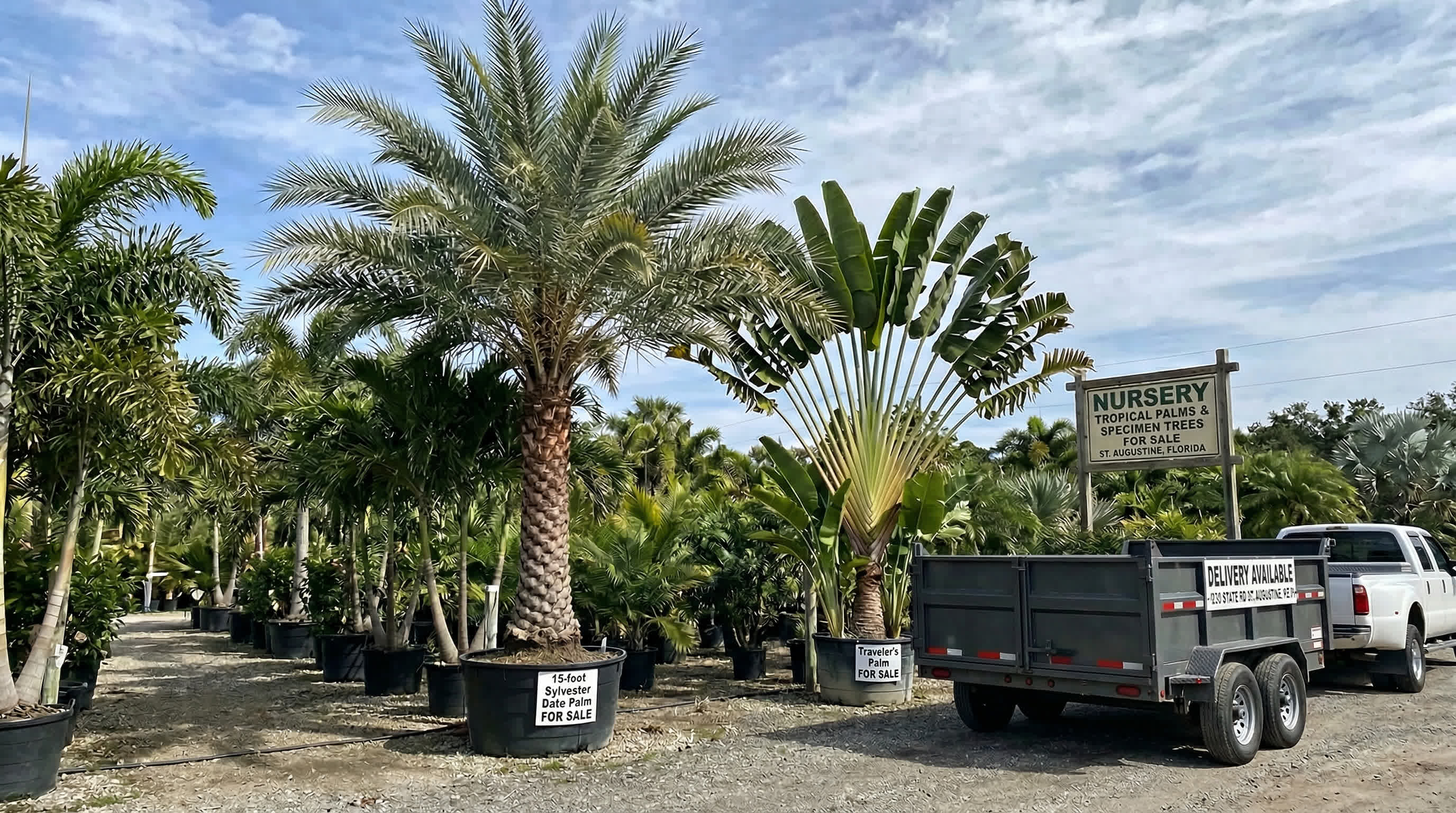
There's a fundamental difference between a yard planted with small starter plants and one anchored by large specimen trees. Small gallon-pot plants look sparse and optimistic — it takes years before they create the impression you're going for. Large specimen palms and tropical trees deliver the full visual impact on installation day. Drive up to a property anchored by a 15-foot Sylvester palm, a pair of Royal palms flanking an entry drive, or a 12-foot Traveler's palm as a focal centerpiece, and you understand immediately why serious landscaping always includes specimen material.
In St. Augustine, where the median home sale price has climbed steadily and buyers care about first impressions, a well-executed specimen planting is one of the highest-ROI investments you can make. Appraisers and real estate professionals consistently note that mature tree canopy and established tropical plantings add measurable value — sometimes $10,000–$20,000 on higher-end properties — in St. Johns County's competitive market.
This guide covers the best large specimen trees and palms available at Tropical Yards in St. Augustine — what they look like, how they perform in Zone 9a/9b, what size options are available, and how to plan for large-specimen delivery and installation. We also address the key question: which large specimens make sense for St. Augustine's climate, and which ones are risky investments given occasional hard freezes.
The Sylvester Palm — St. Augustine's Premier Statement Palm
The Sylvester palm (Phoenix sylvestris), also known as the Wild Date Palm or Sugar Date Palm, is one of the most sought-after specimen palms in North Florida. With distinctive silver-blue fronds, diamond-cut trunk scars (when professionally maintained), and an eventual height of 30–50 feet, the Sylvester creates a sense of Old World elegance that few other palms match. Think of the Canary Island Date Palm's dramatic silhouette, scaled to fit most residential properties.
Key specs for Sylvester palms in St. Augustine:
- Cold hardiness: 12–15°F — Zone 9a safe in inland locations, Zone 9b coastal with ease
- Salt tolerance: Moderate — suitable for coastal neighborhoods but not direct oceanfront
- Mature height: 30–50 feet
- Growth rate: Slow — this is a buy-big-or-wait-long tree
- Light: Full sun required
- Best placement: Entry drives, front yards with ample space, commercial entries, estate properties
Sylvester palms are best purchased at specimen size — 10 to 15+ feet in height — because their slow growth rate means a small nursery tree can take a decade to reach an impressive trunk. When you invest in a large Sylvester, you're essentially buying time. Available at Tropical Yards in multiple specimen sizes; call 772-267-1611 for current pricing and available trunk heights.
Looking for Specimen-Size Palms?
Call us to check current inventory on Sylvester palms, Royal palms, and large Traveler's palms.
Royal Palm — Maximum Grandeur for Large Properties
The Royal Palm (Roystonea regia) is Florida's most majestic native palm — smooth white trunks with a striking green crownshaft, soaring to 50–80 feet with graceful pinnate fronds up to 13 feet long. Royal palms are what you see lining the boulevards of Palm Beach and Coconut Grove — they convey a level of horticultural investment and permanence that immediately elevates a property's character.
For St. Augustine, Royal palms are best suited to Zone 9b coastal locations (Anastasia Island, the Historic District, Vilano Beach) where the ocean moderates temperatures. They are sensitive to hard freezes and should not be planted in Zone 9a inland areas of St. Johns County without cold protection. The 1989 Christmas freeze killed Royal palms throughout the region, and another event of that magnitude is possible. With that caveat understood, for coastal St. Augustine properties in 9b, Royal palms are a spectacular long-term investment.
Royal palms are self-cleaning — dead fronds drop on their own, eliminating the maintenance cost of professional palm trimming. Fast-growing under good conditions, a Royal palm planted at 8–10 feet can add several feet of new growth per year once established. Specimen-size trees (10–15 feet of clear trunk) run $250–$600+ depending on height and supplier.
Traveler's Palm — The Dramatic Focal Tree
The Traveler's Palm (Ravenala madagascariensis) is instantly recognizable — its enormous banana-like leaves fan out in a perfect flat plane, creating a living sculpture that functions like architectural art in the landscape. Despite its common name, it's not a true palm but a relative of the bird of paradise family. Mature specimens can reach 30 feet with a dramatic spread, and they produce multiple side shoots that create dense clumps over time.
In St. Augustine's Zone 9b areas, Traveler's palms thrive and are one of the most striking specimen plants available. They perform best in sheltered locations away from hard frost and strong winds, which can shred the large leaves. In protected courtyards, atrium gardens, or as a focal point on the south side of a building, Traveler's palms create an extraordinary tropical statement that stops visitors in their tracks. The plant's unique leaf arrangement means even a single specimen becomes the defining visual element of an entire yard.
Large Specimen Trees That Work in Zone 9a/9b
Large Bougainvillea Standards
When bougainvillea is trained on a standard trunk and allowed to grow to 8–10 feet as a tree form, it becomes a spectacular focal-point specimen. The massive flower-bract display in hot magenta, orange, or red is unmatched among tropical flowering plants. Bougainvillea standards work particularly well as flanking specimens at a driveway entry or as a centerpiece in a large planting bed. Hardy to about 30°F with dieback, they reliably return from established root systems in Zone 9.
Large Hibiscus Standards and Tree Forms
Standard-form hibiscus — trained to a single trunk and allowed to develop a full crown — can be planted as 6–8 foot specimens that deliver immediate impact. The enormous blooms (some varieties reach 10 inches in diameter) on a mature tree-form hibiscus create a show that persists from spring through fall. Multiple stems can be grown together in a clump for a large shrubby effect, or maintained as true standards for a more formal landscape structure.
Large Bird of Paradise
Bird of paradise (Strelitzia reginae and Strelitzia nicolai) comes in two forms. The orange-and-blue flowering Strelitzia reginae is a compact perennial that grows in clumps 3–5 feet tall — best purchased as a large established clump for immediate impact. The giant white bird of paradise (Strelitzia nicolai) is truly a specimen tree, growing 15–20+ feet with enormous paddle-shaped leaves and striking white-and-purple flowers. Nicolai creates an architectural, tropical-hotel quality in any garden. Both are hardy in Zone 9b; nicolai should be protected from hard freezes in 9a.
Large Crinum Lilies
Queen Emma crinum lily and other large crinum varieties create impressive mounding clumps 4–6 feet tall and wide, with dramatic strap leaves and fragrant flower stalks that emerge repeatedly through the growing season. Large established clumps purchased at size deliver immediate landscape presence — and crinum lilies are among the most low-maintenance tropical plants available for Zone 9.
Mule Palm — The Cold-Hardy Show Palm
For inland St. Augustine properties in Zone 9a, the Mule Palm (×Butiagrus nabonnandii) is the answer to the wish for a coconut-palm silhouette in a cold-hardy body. A hybrid of the Queen Palm and the Pindo Palm, mule palms inherit the feathery, tropical appearance of Queen palms and the cold hardiness (to 10°F) of Pindo palms. They grow to 25 feet with a 15-foot spread and are exceptional specimen palms for World Golf Village, Northwest St. Johns County, and other Zone 9a locations where tropical palms normally struggle.
Planning Large Specimen Planting in St. Augustine
Spacing and Site Preparation
Large specimens require proper spacing for long-term success. Sylvester palms need at least 8–10 feet clearance from structures; Royal palms and Traveler's palms should be placed 10–15 feet from buildings and 20 feet from power lines. Soil preparation matters: even in sandy Florida soil, digging a large planting hole and incorporating compost, slow-release palm fertilizer, and proper backfill technique makes a measurable difference in establishment speed and long-term vigor.
Professional Installation Considerations
Specimen-size palms and trees — anything above 10 feet or in a container over 25 gallons — typically require equipment to move and install properly. A bobcat or skid steer is standard for planting 15-gallon-and-up palms. Larger specimens may require a crane or equipment lift. Factor these costs into your planning, and always use proper installation technique: plant at the correct depth (crown slightly above grade for palms), backfill firmly, stake temporarily for wind resistance, and water deeply at installation and for the first 90 days.
Specimen Sizing Guide
| Tree/Palm | Specimen Size | Immediate Impact | Cold Hardiness |
|---|---|---|---|
| Sylvester Palm | 8–15+ ft trunk | Maximum | 12–15°F (Zone 9a) |
| Royal Palm | 10–20+ ft clear trunk | Maximum | 28–30°F (Zone 9b only) |
| Traveler's Palm | 10–15 ft spread | Maximum | 28–32°F (Zone 9b) |
| Mule Palm | 8–15 ft overall | High | 10°F (Zone 8b) |
| Giant Bird of Paradise | 8–12 ft | High | 25–28°F (Zone 9b) |
| Bougainvillea Standard | 6–10 ft | High | 28–30°F (dieback, regrows) |
Specimen Plants Around St. Augustine's Historic Properties
St. Augustine's Historic District and surrounding neighborhoods — Lincolnville, Uptown, North City, Aviles Street — have a long tradition of dramatic specimen tree plantings. The grand live oaks overarching Cathedral Place and the Spanish-colonial architecture create a context where large tropical specimens look entirely at home. Traveler's palms and Royal palms flank historic entrances throughout the region; large crinum lilies appear in the foundation beds of Victorian-era cottages in Uptown; specimen bougainvillea trained on historic garden walls create a Mediterranean feeling entirely appropriate to the city's history.
For homeowners in these neighborhoods, large-specimen tropical planting isn't just about curb appeal — it's about joining a horticultural tradition that the city has maintained for generations. And unlike small starter plants, specimen trees planted today begin creating that sense of permanence and maturity immediately.
Delivery of Large Plants to St. Augustine
Tropical Yards delivers via 14-ft dump trailer throughout Northeast Florida. For large specimen orders, we can advise on quantities, loading strategy, and site access requirements. Delivery pricing below:
| Delivery Area | Delivery Fee |
|---|---|
| St. Augustine (all areas) | $250 |
| Ponte Vedra Beach | $275 |
| Palm Coast / Flagler Beach | $300 |
| Ormond Beach | $350 |
| Daytona Beach | $375 |
For large specimen orders, call 772-267-1611 to discuss available sizes and schedule delivery. Specimen palms sell quickly — advance ordering is recommended for the best selection. Browse our full tropical plant selection, or see the delivery page for full service area details. We also carry coquina shell at $145/yard to complete your specimen landscape beds.
Frequently Asked Questions
How much does a large specimen Sylvester palm cost in St. Augustine?
Large specimen Sylvester palms with 8–15 feet of clear trunk typically range from several hundred to over a thousand dollars depending on trunk height and source. The investment reflects decades of slow growth — buying specimen size means you're purchasing time. Call Tropical Yards at 772-267-1611 for current pricing on available trunk heights.
Are Royal palms safe to plant in St. Augustine?
Royal palms are safe in Zone 9b coastal areas of St. Augustine (Historic District, Anastasia Island, Vilano Beach) where the ocean moderates temperatures. They should not be planted in Zone 9a inland areas of St. Johns County. The rare hard freeze events that periodically affect inland St. Augustine can damage or kill Royal palms; coastal 9b locations rarely drop below 28°F even in severe winters.
What is the fastest-growing large palm for instant impact in St. Augustine?
Royal palms are among the fastest-growing large palms — adding multiple feet per year under good conditions in Zone 9b. Foxtail palms (Wodyetia bifurcata) also grow quickly and have a beautiful lush tropical appearance, though they are more cold-sensitive. For Zone 9a, the Pindo palm is reliable and grows moderately quickly. Call us to discuss which fast-growing specimen best fits your location and budget.
Can large specimen palms be transported by dump trailer?
Yes, within size limits. Tropical Yards delivers via 14-ft dump trailer, which can handle most residential specimen palm sizes — typically up to around 15-gallon container size or balled-and-burlapped material. Very large specimens (over 25 gallons or 15+ feet of clear trunk) may require specialized tree-moving equipment. We can advise on your specific order when you call.
What tropical plants give the biggest visual impact at the smallest cost in St. Augustine?
For maximum impact per dollar, large clumping plants offer excellent value: 7-gallon or 10-gallon hibiscus in multiple colors, large established crinum lily clumps, multi-gallon bougainvillea, and large bird of paradise clumps all create strong visual presence without the cost of large palm specimens. Combine two or three 7-gallon specimen-quality shrubs with one well-placed palm for a dramatic, balanced planting.
How do I protect large tropical specimens from St. Augustine's occasional hard freezes?
For Zone 9b, most large tropical specimens survive St. Augustine's typical winters without protection. For the rare hard freeze (below 28°F), wrapping the crown of sensitive palms with frost cloth and stringing incandescent lights (not LED) inside the wrap for heat generation provides meaningful protection. Watering the night before a freeze helps too — moist soil retains heat better than dry soil. Large specimens with established root systems recover better from freeze damage than newly planted material.