2026-04-07
Rare & Exotic Tropical Plants for Sale in St. Augustine — Hard-to-Find Varieties
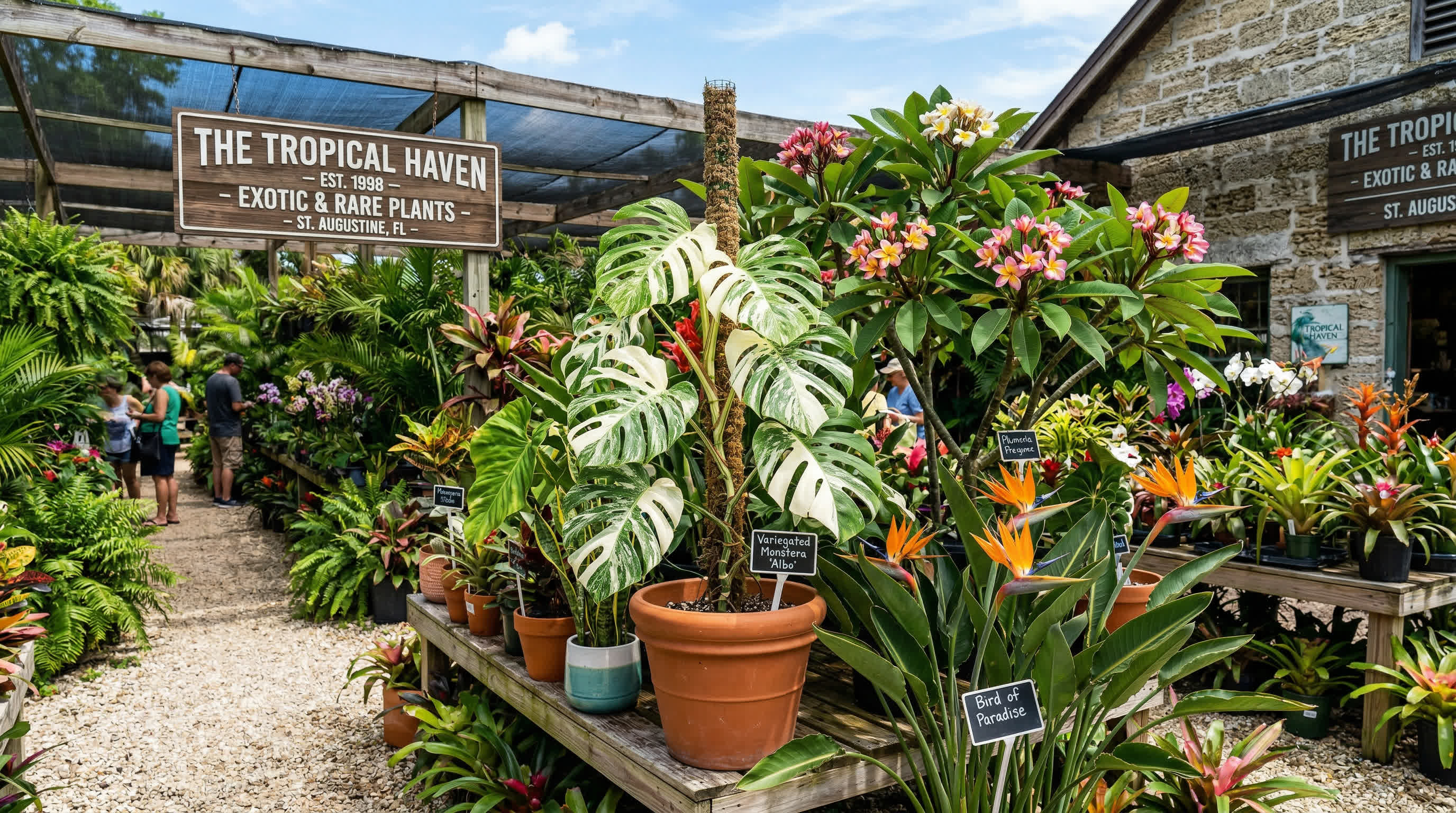
Most people know that palms, hibiscus, and bougainvillea grow in St. Augustine. What surprises even longtime residents is how far the zone 9b climate stretches when it comes to unusual, exotic, and hard-to-find tropical species. Plumeria with its legendary Hawaiian fragrance, bird of paradise with its otherworldly flowers, ornamental gingers with their dramatic foliage, and bromeliads ranging from tiny epiphytes to massive ground-covering clumps — all of these grow outdoors in St. Augustine, all year round or at minimum across the long growing season. This guide covers the exotic tropicals that thrive in St. Augustine's climate, what makes each one special, and how to source and successfully grow them in Northeast Florida.
Why St. Augustine's Zone 9b Climate Opens the Door to Exotic Tropicals
The USDA hardiness zone map classifies St. Augustine as zone 9b, which means average annual minimum temperatures of 25°F to 30°F. This is a critical threshold: it's cold enough that a handful of the most frost-sensitive tropicals need protection on the rare nights when temperatures drop below 30°F, but warm enough that most tropical and subtropical species survive and flourish outdoors year-round.
Importantly, the urban heat island effect and the thermal moderating influence of St. Augustine's surrounding water bodies — the Matanzas River, the Tolomato River, and the nearby Atlantic — push actual performance closer to zone 10a in many microclimates within the city. Homeowners in historic neighborhoods like Lincolnville, Abbott Tract, and Davis Shores often find that plants rated for zone 10 actually survive here, especially when planted against south-facing walls or fences that radiate stored daytime heat on cold nights.
The long, hot, humid growing season — essentially March through November — gives tropical plants the time they need to grow, bloom, and store energy for their brief winter rest. Plants that would be mere annuals in Atlanta or Charleston become permanent, impressive specimens in St. Augustine.
Plumeria — The Scent of Hawaii in Your St. Augustine Yard
Plumeria (Plumeria rubra and related species) is perhaps the most evocative tropical plant you can grow in St. Augustine. The flowers — clusters of waxy, fragrant blooms in white, yellow, pink, red, coral, and multicolored combinations — are the iconic flower of Hawaiian leis and represent everything romantic about tropical living. The fragrance is intensely sweet and unmistakable, carrying across a garden on warm evenings.
In St. Augustine's zone 9b climate, plumeria is deciduous — it loses its leaves in November or December and re-leafs each spring starting around March or April. During this dormant phase, it requires almost no water and no fertilization. Once temperatures consistently stay above 65°F overnight, new leaves emerge rapidly and the plant begins its spectacular bloom cycle.
Growing Plumeria in St. Augustine
Plumeria is almost exclusively a full-sun plant — it needs 6+ hours of direct sun daily to bloom properly. It demands excellent drainage above all else; root rot from wet, poorly-draining soil is the number one killer of plumeria in Florida. In St. Augustine's sandy soil, drainage is typically adequate, but raised planting beds or elevated positions are ideal. Never plant plumeria in low-lying areas that collect water after rain.
Fertilize with a high-phosphorus formula (such as a 10-30-10 or similar bloom-booster) from when leaves emerge in spring through September. A plumeria that is under-fertilized produces fewer blooms; one that is well-fed produces clusters of flowers continuously from June through October. During winter dormancy, the bare branches look unusual but are completely healthy — resist the urge to water or fertilize.
During the rare hard freeze events that occasionally occur in St. Augustine (typically once every few winters), drape frost cloth over your plumeria or, if it's in a container, bring it under cover overnight. Established in-ground plumeria in protected spots typically survives light freezes without damage.
Bird of Paradise — Architectural Drama That Commands Attention
There are two bird of paradise species worth growing in St. Augustine, and they are dramatically different from each other.
White Bird of Paradise (Strelitzia nicolai)
White bird of paradise is a large, structural plant that eventually reaches 15–20 feet or more in St. Augustine's warm climate, developing a trunk-like base and producing enormous paddle-shaped leaves that fan out dramatically. It is reliably cold-hardy in zone 9b and requires essentially no winter protection. The white and purple flowers appear on mature plants (usually 4–5 years after planting) but are secondary to the spectacular foliage — this is primarily a structural, architectural plant that creates an instant tropical atmosphere. Planted in groups of three or more, white bird of paradise creates a dramatic tropical canopy that transforms any landscape.
Orange Bird of Paradise (Strelitzia reginae)
The more familiar orange and blue bird of paradise is smaller (3–5 feet), clumping, and produces its famous flowers — the spiky orange and blue bloom that resembles a tropical bird in flight — repeatedly through the year on established clumps. It is also cold-hardy in zone 9b, though it appreciates a sheltered location. Plant in full to partial sun in well-draining soil. Once established, orange bird of paradise is remarkably drought-tolerant and low-maintenance. A clump allowed to mature undisturbed will produce flowers for decades.
Ornamental Gingers — Foliage and Fragrance for the Tropical Garden
The ginger family (Zingiberaceae) is one of the most underused plant groups in St. Augustine landscapes, which is a shame because many species are completely cold-hardy here and provide foliage and floral interest unlike anything else in the tropical palette.
Shell Ginger (Alpinia zerumbet)
Shell ginger is the most cold-hardy and commonly available ornamental ginger for North Florida, and it thrives in St. Augustine's climate. Growing 6–10 feet tall with large, glossy, reed-like foliage, it produces hanging clusters of white and pink shell-shaped flowers in spring and early summer. The variegated form — 'Variegata' — has yellow-and-green striped foliage that adds dramatic color to shaded garden beds year-round. Shell ginger may die back to the ground in cold winters but re-emerges vigorously from established rhizomes each spring.
Butterfly Ginger (Hedychium coronarium)
Butterfly ginger earns its name from its intensely fragrant white flowers, which are produced in August and September — exactly when most other tropical plants have passed their peak. The fragrance is pure and sweet, carrying across the yard in evening. Growing 4–6 feet tall with wide, tropical-looking leaves, butterfly ginger is one of the few plants that provides both dramatic foliage and spectacular late-summer fragrance. It prefers moist, partially shaded spots — ideal under palms or near downspouts where it gets moisture.
Spiral Ginger (Costus speciosus and related species)
Spiral gingers get their name from the distinctive spiral arrangement of their leaves along an upright, cane-like stem. They produce conelike flower heads in orange, red, yellow, or pink depending on the species, and the foliage is attractive throughout the growing season. Spiral gingers are moderately cold-tolerant in zone 9b — established clumps survive most St. Augustine winters and return strongly from the base each spring.
Bromeliads — The Workhorses of the Shade Garden
Bromeliads are one of the most versatile and underappreciated plant families for St. Augustine landscapes. Ranging from tiny air plants (Tillandsia) that require no soil to large, dramatic ground-covering Neoregelia clumps, bromeliads fill the shadiest corners of tropical gardens where few other plants thrive.
In St. Augustine, the most garden-worthy bromeliads are the cold-tolerant terrestrial types: Neoregelia species and cultivars, which form low, wide rosettes of colorful leaves — red, burgundy, orange, variegated — and spread by producing offsets (pups) that create dense, weed-suppressing carpets over time. A single Neoregelia plant purchased today becomes a ground-covering colony in 3–4 seasons without any replanting effort.
Aechmea (urn plant) bromeliads are another excellent choice for St. Augustine shade gardens. Their colorful flower spikes — pink, red, blue, or orange — last for months, and the plants require almost no care once established. They grow epiphytically in the wild (on trees), meaning they can be planted at the base of palms, anchored in tree crotches, or mounted on pieces of bark for a truly exotic landscape display.
Most bromeliads appreciate filtered light rather than full sun — ideal for the shaded zones under palm trees and large oaks that are common in St. Augustine's historic neighborhoods. They need excellent drainage (no standing water in the crown for extended periods) but otherwise require minimal care.
Heliconias — Tropical Drama in a Florida Landscape
Heliconias are the showiest tropical flowers you can grow in North Florida, producing waxy, lobster-claw-shaped bracts in brilliant combinations of red, orange, and yellow that last for months and are unlike anything else in the garden. They are a warm-weather specialty that requires thoughtful placement in zone 9b St. Augustine.
The key to success with heliconia in St. Augustine is selecting cold-tolerant species and giving them a protected microclimate. Golden yellow heliconia (Heliconia psittacorum cultivars like 'Andromeda' and 'Parrot's Beak') are among the most cold-tolerant species and succeed in zone 9b when planted in sheltered spots — against a south-facing masonry wall, for example, or in a courtyard with thermal mass. They die back in cold winters but re-emerge strongly from their rhizomes when warm weather returns in spring.
For a safer heliconia-like effect in St. Augustine, bougainvillea and tropical hibiscus provide the bold tropical color that heliconias are famous for, with far greater cold tolerance and ease of care.
Rare Palms Worth Seeking Out
Beyond the standard Sabal, Sylvester, and Queen palms common in St. Augustine yards, several rare and unusual palm species thrive in zone 9b and add distinctly different character to the landscape.
Bismarck Palm (Bismarckia nobilis)
The Bismarck palm is one of the most spectacular landscape palms available, producing enormous silvery-blue fronds that can span 10–12 feet. A single mature Bismarck is a garden destination in itself. It is cold-tolerant enough for zone 9b and grows slowly but impressively, eventually reaching 50+ feet. If you want a palm that makes visitors stop and stare, this is it.
Bottle Palm (Hyophorbe lagenicaulis)
The bottle palm has a distinctive swollen trunk base that tapers dramatically toward the top, giving it an unmistakable silhouette. It is cold-sensitive (prefers zone 10) but succeeds in protected St. Augustine microclimates and is a conversation piece wherever it's planted. Best grown in containers that can be brought indoors during rare hard freezes.
Foxtail Palm (Wodyetia bifurcata)
Foxtail palms are increasingly popular in St. Augustine for their lush, full fronds that arc gracefully like a fox's tail, and for their rapid growth rate compared to most palms. They are cold-tolerant enough for zone 9b and self-clean (old fronds fall cleanly without cutting), making them among the lowest-maintenance ornamental palms available. Visit our palm trees page to see current availability.
Ti Plants (Cordyline) — Colorful Foliage Anchors
Ti plants (Cordyline fruticosa) come in an extraordinary range of foliage colors — solid burgundy, green-with-pink margins, multi-colored varieties with combinations of red, purple, pink, yellow, and green — and they are genuinely cold-hardy in zone 9b St. Augustine. Growing 3–6 feet tall with strap-like leaves, ti plants work beautifully as colorful accent plants in tropical beds, as container specimens on patios, or in mass plantings for year-round color.
Unlike many foliage plants, ti plants tolerate partial shade, making them versatile for the full range of exposure conditions in St. Augustine yards. They are low-maintenance once established — they need only basic water and occasional fertilization to maintain their vibrant foliage color.
Elephant Ears (Alocasia and Colocasia) — Tropical Scale
Elephant ear plants are nature's way of adding instant, dramatic tropical scale to any landscape. Species range from the gigantic Alocasia macrorrhiza (giant taro), which produces leaves 3–4 feet across on plants that reach 8–10 feet, to the dramatic Alocasia 'Black Velvet' with its small, jewel-like leaves in near-black velvet with silver markings. Colocasia (taro) species are equally dramatic and more cold-tolerant, dying back to the ground in winter and re-emerging as massive clumps the following spring.
Elephant ears appreciate moist, partially shaded spots in St. Augustine landscapes — the margins of ponds, drainage swales, or shaded beds where moisture collects. Their enormous leaves create instant drama and a convincingly exotic tropical atmosphere in any yard.
Shopping for Rare Tropicals: What to Know
Rare tropical plants have some different considerations when buying compared to common nursery stock:
- Call ahead for availability: Unusual varieties come in and sell out. Contact Tropical Yards at 772-267-1611 to ask about current availability before making a trip.
- Larger specimens are worth the premium for slow growers: For slow-growing species like Bismarck palms or mature bird of paradise clumps, buying a larger established specimen compresses years of growth into your landscape immediately. The premium over a starter plant is justified.
- Consider microclimate placement carefully: Exotic species at the edge of zone hardiness need thoughtful placement — south-facing exposures near masonry walls, away from frost pockets in low-lying areas, and close to the thermal mass of structures that radiate heat on cold nights.
- Ground cover matters: Around rare, irreplaceable plants, the choice of ground cover affects soil moisture, temperature, and root health. Coquina shell at $145/yard is ideal around exotic tropicals because it moderates soil temperature, maintains drainage, and presents a refined, showcase-worthy appearance around specimen plants.
Delivery for Rare Tropical Plants
Tropical Yards delivers throughout Northeast Florida. See our delivery page for full coverage and pricing:
| Delivery Area | Delivery Fee |
|---|---|
| St. Augustine | $250 |
| Ponte Vedra | $275 |
| Palm Coast | $300 |
| Flagler Beach | $300 |
| Ormond Beach | $350 |
| Daytona Beach | $375 |
Caring for Exotic Tropicals Through St. Augustine Winters
Most years in St. Augustine, winter care for exotic tropicals amounts to nothing more than watching and enjoying. The city's mild winters — average January lows in the low 50s°F — allow most zone 9b plants to simply rest and then re-emerge in spring. However, the rare hard freeze event (temperatures below 30°F for extended periods) requires preparation:
- Frost cloth: Keep a supply of frost cloth (row cover fabric) on hand for the two to three nights per winter when temperatures may threaten. Drape it over cold-sensitive plants like plumeria, heliconia, and ti plants on those nights. Remove it during the day to allow sun and air circulation.
- Mulch deeply around roots: A 4–5-inch layer of coquina shell or organic mulch over the root zone of cold-sensitive plants insulates soil temperature and protects roots even when above-ground portions experience some freeze damage.
- Resist pruning freeze damage until spring: If exotic tropicals sustain frost damage, do not cut off the affected growth until all cold weather has passed — typically late February in St. Augustine. The damaged foliage actually provides some insulation for the plant's core. New growth will push out from the base once warm temperatures return.
- Container strategy: For the most cold-sensitive exotics — bottle palms, heliconia, and others rated for zone 10 — growing in containers allows you to move plants under cover (garage, enclosed porch) on the two or three genuinely cold nights per year. The rest of the year, they live outdoors in the landscape just as in-ground plants do.
Frequently Asked Questions
Can plumeria grow in St. Augustine, FL?
Yes. Plumeria grows well in St. Augustine's zone 9b climate during the warm season. It thrives in full sun with excellent drainage and produces its legendary fragrant blooms from late spring through early fall. Plumeria is deciduous — it loses its leaves in winter — but re-leafs vigorously each spring. During the rare hard freeze below 28°F, cover or bring containers indoors overnight. Call 772-267-1611 to ask about current plumeria availability at Tropical Yards.
Does bird of paradise grow in St. Augustine?
White bird of paradise (Strelitzia nicolai) is reliably hardy in zone 9b and grows into a spectacular 15–20 foot specimen in St. Augustine over time. Orange bird of paradise (Strelitzia reginae) also succeeds here, producing its iconic orange and blue flowers repeatedly through the year. Both species prefer full sun, good drainage, and minimal fertilization once established. Visit our tropical plants page to see current selection.
What exotic tropical plants grow in zone 9a/9b Florida?
St. Augustine's zone 9b climate supports many exotic tropicals: plumeria, bird of paradise (white and orange), ornamental gingers (shell ginger, butterfly ginger, spiral ginger), bromeliads, ti plants, exotic hibiscus cultivars, elephant ears, cannas, cycads, traveler's palms, Bismarck palms, foxtail palms, and many more. The key is selecting varieties with cold tolerance to zone 9 and providing frost protection during rare hard freezes.
Where can I buy rare tropical plants in St. Augustine FL?
Tropical Yards in St. Augustine specializes in hard-to-find tropical varieties alongside popular staples. With 125+ varieties and knowledgeable staff, it's the best local source for unusual tropicals in Northeast Florida. Call 772-267-1611 to ask about current availability of specific species. Browse the full tropical plants collection online for ideas.
Are bromeliads easy to grow in St. Augustine?
Bromeliads are exceptionally well-suited to St. Augustine's climate. They tolerate humidity, grow in dappled shade or bright indirect light, and many are cold-tolerant enough for zone 9b. Neoregelia and Aechmea species are especially tough and work beautifully as ground cover in shaded tropical beds. They multiply by producing offsets (pups) that can be separated and replanted — one plant becomes many over time.
Do ornamental gingers grow in St. Augustine?
Several ornamental ginger species thrive in St. Augustine. Shell ginger (Alpinia zerumbet) is reliably cold-hardy in zone 9b and produces beautiful hanging flower clusters. Costus (spiral ginger) and Hedychium (butterfly ginger) also perform well here. Most gingers die back to the ground in winter and re-emerge vigorously each spring from established rhizomes. They prefer partial shade and moist, rich soil — ideal for the shaded areas under palm trees in St. Augustine yards.
Find Rare Tropicals for Your St. Augustine Yard
Call us to ask about current availability of exotic and hard-to-find varieties. Delivery throughout Northeast Florida.