Tropical Plants for Sale in Northeast Florida: Complete 2026 Buyer's Guide
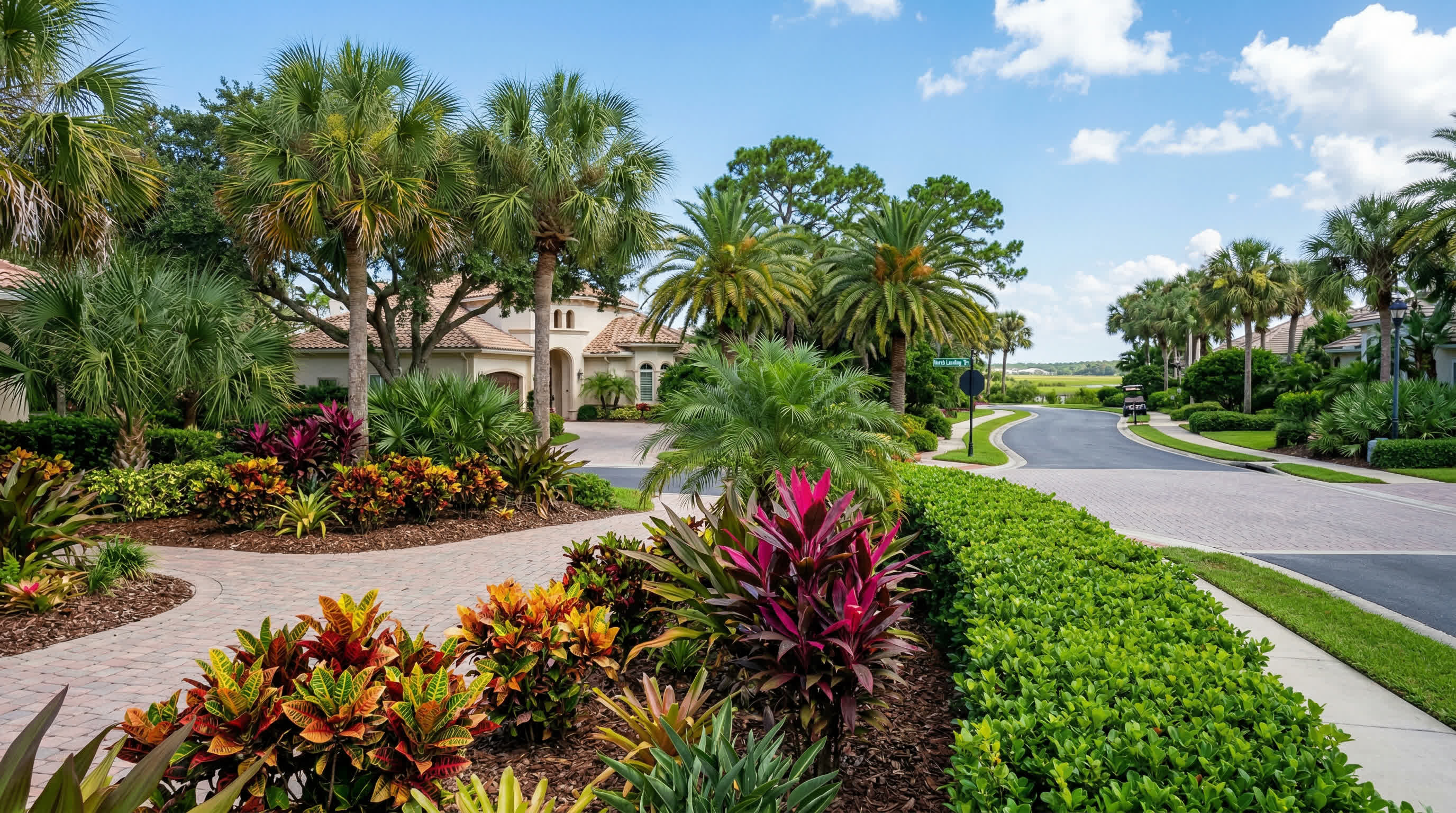
Short answer: Tropical plants for sale in Marsh Landing, Ponte Vedra need to be salt-tolerant, wind-resistant, and capable of thriving in the sandy, fast-draining soils common to Intracoastal Waterway lots. The best choices for Marsh Landing waterfront properties include Sabal palms, Windmill palms, Thatch palms, Cocoplum, Green Buttonwood, Wax Myrtle, and tropical hibiscus, all of which handle salt spray without significant leaf burn. Tropical Yards delivers these plants by dump trailer to Marsh Landing and surrounding Ponte Vedra communities for a Delivery is $275 within 25 driving miles of St. Augustine, plus $2 per mile past 25 miles, counted both ways., with no minimum on plant quantity.
Key Takeaways
- Marsh Landing sits directly on the Intracoastal Waterway in Ponte Vedra, meaning waterfront lots face constant salt spray, sandy soil, and seasonal wind exposure, plant selection must account for all three stressors.
- Salt-tolerant palms like Sabal Palm, Windmill Palm, and Thatch Palm are proven performers for Marsh Landing waterfront lots and do not require frequent replacement after nor'easter events.
- Cocoplum, Green Buttonwood, and Wax Myrtle create dense privacy hedges that hold up along waterfront lot lines where traditional privacy shrubs like Viburnum often fail due to salt damage.
- Tropical hibiscus, Bougainvillea, and Bird of Paradise bring resort-style color to poolside and entry areas, and all three tolerate the well-drained sandy soils common throughout Marsh Landing Country Club.
- Coquina shell costs $145 per cubic yard with a 4-yard minimum. Delivery is $275 within 25 driving miles of St. Augustine, plus $2 per mile past 25, counted both ways.
- Marsh Landing's ACC (Architectural Control Committee) typically requires plants that maintain a clean, upscale aesthetic, avoid aggressive spreading species and confirm hedge heights with your HOA before planting.
- Coquina shell at $145 per cubic yard with a 4-yard minimum is a top mulch choice for Marsh Landing properties because it looks native, drains instantly, and does not wash into the waterway like traditional bark mulch.
In This Article
- What tropical plants survive salt spray and wind on Marsh Landing waterfront lots?
- Which palm trees are best for Marsh Landing Ponte Vedra waterfront homes?
- What privacy hedge plants work on Intracoastal lots in Marsh Landing?
- How do you create a resort-style poolside landscape in Marsh Landing?
- What are Marsh Landing HOA and ACC landscaping requirements for tropical plants?
- How much does tropical plant delivery to Marsh Landing Ponte Vedra cost?
- Frequently Asked Questions
What tropical plants survive salt spray and wind on Marsh Landing waterfront lots?
The best tropical plants for Marsh Landing waterfront lots are species that have evolved along coastlines and estuaries, plants whose leaves have natural wax coatings, leathery surfaces, or small surface area to resist salt burn and dehydration from wind. On Intracoastal-facing lots in Marsh Landing Country Club, you are dealing with two distinct challenges: airborne salt drift that deposits sodium chloride on leaf surfaces, and highly porous sandy soil that drains fast and holds almost no moisture between watering cycles. The plants that thrive here are the same ones that line the barrier islands and tidal creeks of Northeast Florida naturally.
Sabal Palm (Sabal palmetto), Florida's state tree, is arguably the single most salt- and wind-tolerant large plant available for Marsh Landing properties. It is impossible to overstate how well this palm performs along the Intracoastal, it naturally colonizes hammocks right at the salt marsh edge throughout St. Johns County. Cocoplum (Chrysobalanus icaco) is an equally bulletproof choice for mid-height screening; its thick, round leaves resist salt burn, and it grows dense enough to create genuine visual privacy in two to three growing seasons. Green Buttonwood (Conocarpus erectus) is a Florida native that grows naturally in brackish-zone mangrove transition areas, making it one of the most salt-tolerant large shrubs or small trees available for Marsh Landing waterfront planting.
For color, Bougainvillea is a standout performer in the sandy, fast-draining soils of Ponte Vedra's barrier-island-adjacent lots. It actually blooms more aggressively in low-nutrient, dry conditions, and its waxy bracts shed salt without permanent damage. Firebush (Hamelia patens) is a Florida-friendly tropical shrub that handles both salt exposure and occasional drought, producing brilliant red-orange flowers nearly year-round. Sea Grape (Coccoloba uvifera) rounds out the waterfront-ready lineup, it is naturally coastal, its large round leaves are salt-adapted, and it doubles as a dramatic architectural specimen for entry areas or large open beds.
- Salt-tolerant tropical plants for sale for Marsh Landing Country Club waterfront lots in Ponte Vedra
- Wind-resistant tropical shrubs and palms for Harbour Island Ponte Vedra Intracoastal properties
- Coastal tropical plants delivered to Sawgrass Players Club and Palm Valley waterfront homes
- Salt spray-resistant tropical landscaping plants for The Plantation at Ponte Vedra Beach
- Florida-native salt-tolerant tropical plants for Nocatee and Ponte Vedra Beach waterfront yards
Does salt air really damage tropical plants in Marsh Landing?
Yes, airborne salt deposits on leaf surfaces pull moisture out through osmosis and can cause edge burn, premature leaf drop, and in severe cases, dieback of new growth. The solution is to choose salt-tolerant species (Sabal Palm, Cocoplum, Sea Grape, Buttonwood, Bougainvillea) rather than common nursery plants like Ixora or standard Arborvitae, which struggle within a few hundred feet of salt water. Rinsing plant foliage with fresh water after major storm events also reduces salt accumulation significantly.
Which palm trees are best for Marsh Landing Ponte Vedra waterfront homes?
The best palm trees for Marsh Landing waterfront homes are Sabal Palm, Windmill Palm, Thatch Palm, and Medjool Date Palm, all of which tolerate salt spray, fast-draining sandy soil, and the tropical storm wind events that Northeast Florida experiences every few years. Coconut Palms, despite their tropical appeal, are marginal performers north of Central Florida and are not recommended for Marsh Landing properties where a hard freeze can kill an unprotected trunk within a single night.
Sabal Palms are the undisputed workhorse for Marsh Landing lots. They can be planted in clusters of varying heights to create an immediate tropical canopy effect along waterfront lot lines or behind a pool cage. Because Sabal Palms are Florida natives, they require essentially no irrigation once established and will survive salt spray, drought, and freeze events with no special protection. Expect mature Sabal Palms to reach 30 to 50 feet over a 20-year horizon, providing significant canopy shade over patios and pool decks.
Windmill Palms (Trachycarpus fortunei) are a top choice for homeowners who want a refined, single-trunk accent palm with a formal look appropriate for Marsh Landing's upscale aesthetic. They are significantly more cold-hardy than most tropical palms and handle the occasional hard freeze that can hit Ponte Vedra in January or February. Windmill Palms max out at 20 to 25 feet, making them ideal for planting near the house without risk of root intrusion or canopy overgrowth. Their shaggy burlap-like trunk adds textural interest that looks particularly elegant flanking a front entry or along a driveway median.
Thatch Palms (Thrinax radiata) are the coastal specialists of the palm world, they grow naturally on sandy beaches and tidal flats throughout the Caribbean, making them among the most salt-tolerant palms you can plant in Northeast Florida. They are slower-growing than Sabal Palms, which means they work best as accent palms or in groupings rather than as the primary canopy tree. For poolside planting in Marsh Landing, a trio of Thatch Palms at staggered heights creates the kind of lush, Caribbean resort look that high-end landscape designers charge premium prices to achieve.
For homeowners who want dramatic scale, Medjool Date Palms deliver immediate architectural impact with their thick, columnar trunks and arching fronds. They perform well in Marsh Landing's sandy soil but require professional installation due to their weight and the precision needed to establish their root ball correctly. A pair of Medjool Dates flanking a driveway entrance is one of the most recognizable luxury landscape statements in Ponte Vedra.
- Salt-tolerant palm trees for sale for Marsh Landing Ponte Vedra waterfront properties
- Sabal palms and Windmill palms delivered to Sawgrass Country Club and TPC Sawgrass residential lots
- Thatch palm and Medjool Date palm delivery to Harbour Island Ponte Vedra Beach homes
- Tropical palm trees for sale with dump trailer delivery to Palm Valley and Nocatee FL
- Wind-resistant palms for Intracoastal Waterway lots in Marsh Landing Country Club
Can you plant Coconut Palms at Marsh Landing Ponte Vedra?
Coconut Palms (Cocos nucifera) are marginal in Northeast Florida and are generally not recommended for Marsh Landing. They are cold-sensitive below about 32°F and Ponte Vedra occasionally dips into the upper 20s during hard winter freezes. While some homeowners try them as accent plants near a pool enclosure where microclimate warmth helps, the risk of cold kill makes them a poor investment for a prominent landscape feature. Sabal Palms, Windmill Palms, and Thatch Palms give you the tropical look with far greater long-term reliability.
Ready to Transform Your Marsh Landing Yard?
Contact Tropical Yards for current plant availability and a quote. Call 904-526-8345 to discuss your project and delivery needs.
Get a Free Quote Call 904-526-8345What privacy hedge plants work on Intracoastal lots in Marsh Landing?
The best privacy hedge plants for Marsh Landing Intracoastal lots are Cocoplum, Green Buttonwood, Wax Myrtle, Clusia guttifera, and Walter's Viburnum, all of which tolerate salt air, grow dense enough to create genuine screening, and can be maintained at heights that satisfy Marsh Landing's HOA guidelines. Standard privacy hedge choices like Leyland Cypress or Italian Cypress are poor fits for waterfront Ponte Vedra lots because their fine foliage is highly susceptible to salt burn.
Cocoplum is the top recommendation for waterfront privacy hedging at Marsh Landing. It grows naturally along coastal hammocks and tidal creek edges throughout Northeast Florida, which means it is genetically programmed to handle exactly the conditions your lot presents. Cocoplum responds beautifully to shearing, making it easy to maintain at a precise height specified by your ACC. It also produces small fruits that attract native birds, a bonus for homeowners who want wildlife activity along their waterfront. Planted at 3-gallon size and spaced three feet apart, Cocoplum will form a dense hedge six to eight feet tall within four to five growing seasons.
Green Buttonwood is another coastal-native option for large, tall screening along rear lot lines or along the waterway's edge. Left unpruned, it becomes a multi-trunk small tree reaching 15 to 20 feet, which can be ideal for creating a natural buffer between your property and the water. Pruned as a hedge, it holds its shape well and provides enough density to significantly reduce wind velocity through your yard, a practical benefit for waterfront Marsh Landing properties where strong onshore winds can make patio living uncomfortable during summer afternoon thunderstorm season.
Clusia guttifera (Small-leaf Clusia) has emerged as one of the most popular privacy hedge plants across Northeast Florida's upscale communities, including Marsh Landing Country Club, Sawgrass Players Club, and The Plantation at Ponte Vedra. Its thick, leathery leaves resist salt and wind, it grows dense with minimal shearing, and it maintains its deep green color year-round. It is also highly resistant to the whitefly infestations that have devastated Ficus hedges across Florida in recent years. Clusia does require regular trimming to maintain its hedge form, but the effort is modest compared to the results.
Wax Myrtle (Morella cerifera) is the fast-track option if you need privacy now. It is an aggressive grower in Northeast Florida, expect two to three feet of new growth per year, and it tolerates sandy, nutrient-poor soils as well as periodic flooding of its root zone, which can occur in low-lying areas of waterfront Marsh Landing lots during heavy rain events. Wax Myrtle is also highly fragrant, and its gray-blue waxy berries attract songbirds and Cedar Waxwings throughout the winter months.
- Cocoplum privacy hedge plants for sale for Marsh Landing Country Club waterfront lots in Ponte Vedra
- Clusia guttifera privacy hedges delivered to Sawgrass Players Club and TPC Sawgrass homes
- Wax Myrtle and Green Buttonwood privacy screening for Harbour Island Ponte Vedra Beach
- Salt-tolerant privacy hedge plants for sale for The Plantation at Ponte Vedra and Palm Valley
- Tropical privacy hedges with dump trailer delivery to Nocatee and Sawgrass Country Club FL
How fast do privacy hedges grow on Marsh Landing waterfront lots?
Growth rates depend on species, irrigation, and fertilization. Wax Myrtle is the fastest at two to three feet per year, followed by Clusia guttifera at one to two feet per year, then Cocoplum at roughly one foot per year. Tropical Yards can supply any size you need on a single dump trailer delivery.
How do you create a resort-style poolside landscape in Marsh Landing?
Creating a resort-style poolside landscape in Marsh Landing requires layering three plant categories: architectural palms for height and drama, tropical flowering shrubs for color and fragrance, and groundcover plants or coquina shell mulch for the clean, finished look that differentiates a true resort garden from a standard Florida yard. The goal is to replicate the visual density and layered lushness of a luxury Caribbean resort pool deck using plants that actually survive Northeast Florida's climate.
Start with palms as the architectural bones of the design. Two or three Windmill Palms positioned at the back corner of a pool cage create an immediate sense of tropical enclosure without roots that threaten the pool deck or screen enclosure. If the pool deck has an open, sightline-blocking area toward the Intracoastal, a cluster of three Sabal Palms at staggered heights, say, a 6-foot, 12-foot, and 18-foot specimen, creates the kind of layered canopy that takes decades to achieve in a subtropical forest but can be planted in a single afternoon with the right equipment and properly sized nursery stock.
For mid-layer color, tropical hibiscus is the quintessential poolside flowering shrub. Standard Tropical Hibiscus (Hibiscus rosa-sinensis) blooms in shades of red, pink, orange, yellow, and bicolor combinations, and a well-fed plant in Ponte Vedra's sandy soil will produce new flowers almost daily throughout the warm season (March through November). Position hibiscus where you will see it from the pool deck and lounging areas rather than from the street, the blooms are large and attention-grabbing up close. Plumbago is another top poolside shrub for Marsh Landing; its lavender-blue flower clusters bloom profusely and coordinate beautifully with the greens and blues of a swimming pool backdrop. Ixora (Ixora coccinea) is technically marginal for direct salt exposure but thrives in sheltered poolside microclimates where a home or fence provides a windbreak against salt drift.
Bird of Paradise (Strelitzia reginae) is one of the most powerful design statements available for Marsh Landing pool landscapes. A single large clump of Bird of Paradise positioned at the corner of a pool cage or beside a pool entry door creates an immediate luxury signal. Its bold, paddle-shaped leaves stand out against pool cages and light-colored hardscape, and the distinctive orange and blue flowers provide color accents that no other plant matches. Bird of Paradise performs well in Northeast Florida's sandy soils and actually thrives with minimal water once established.
For groundcover and mulch in poolside planting beds, coquina shell at $145 per cubic yard with a 4-yard minimum is the premium choice for Marsh Landing properties. Coquina shell drains immediately, there is virtually zero standing water in a coquina-mulched bed, which eliminates the mosquito breeding and soil-borne disease issues that organic bark mulch creates in humid coastal environments. Coquina also has the right coastal aesthetic for Marsh Landing's waterfront setting, the off-white color reflects heat away from plant roots, and it does not wash into the waterway during heavy rain events the way lighter bark mulch does. A typical poolside planting bed refresh at Marsh Landing requires approximately three to five yards of coquina shell.
- Resort-style tropical pool landscaping plants for sale for Marsh Landing Country Club Ponte Vedra
- Tropical hibiscus and Bird of Paradise poolside plants delivered to Sawgrass Players Club and TPC Sawgrass
- Coquina shell mulch at $145 per cubic yard with a 4-yard minimum delivered to Harbour Island and Ponte Vedra Beach pool yards
- Plumbago, Ixora, and Bougainvillea poolside tropical plants for The Plantation and Sawgrass Country Club
- Poolside tropical plant delivery to Palm Valley and Nocatee FL with dump trailer service
What is the best mulch for tropical plant beds at Marsh Landing waterfront properties?
Coquina shell at $145 per cubic yard with a 4-yard minimum is the top recommendation for Marsh Landing waterfront planting beds. It drains instantly, does not wash into the Intracoastal, resists hurricane-level rainfall runoff, and has a clean coastal aesthetic that fits Marsh Landing's upscale waterfront setting perfectly. Eucalyptus or cypress bark mulch is a reasonable second choice for interior planting beds away from the waterway, but coquina shell is the superior option for any bed where drainage speed and visual presentation are priorities.
What are Marsh Landing HOA and ACC landscaping requirements for tropical plants?
Marsh Landing Country Club's Architectural Control Committee (ACC) requires advance approval for significant landscaping changes, including the addition of large trees, privacy hedges along lot lines, and any hardscape modifications. While the specific plant list and height restrictions can vary by lot type and position, the general principle is that plantings must maintain a manicured, upscale appearance consistent with the community's luxury market positioning and must not obstruct sight lines in ways that affect neighboring properties or community common areas.
Before ordering tropical plants for a major Marsh Landing landscaping project, submit a planting plan to the ACC that includes plant species, mature sizes, and placement distances from lot lines and structures. This is particularly important for waterfront lots where vegetation along the Intracoastal frontage may be subject to additional oversight from both the HOA and from St. Johns County or the St. Johns River Water Management District, depending on the proximity to the ordinary high-water line. Most routine planting, adding hibiscus, refreshing mulch, planting a few accent palms, does not require formal approval, but a complete privacy hedge installation or a major palm planting project typically does.
From a practical plant-selection standpoint, the ACC's aesthetic requirements work in your favor when choosing tropical species: the salt-tolerant, low-maintenance plants that perform best in Marsh Landing's coastal environment are also the ones that maintain the clean, lush appearance the community expects. Cocoplum, Clusia, and Buttonwood hedges that are sheared regularly look far more polished and controlled than the common alternatives (Ixora, Viburnum, or Podocarpus) that tend to look ragged after a season of salt exposure. Choose species that naturally look refined and manicured, and you will have fewer ACC compliance conversations to navigate.
For waterfront lots specifically, avoid planting large-canopy trees within the waterway setback zone and be cautious about plants with aggressive root systems near seawalls and dock structures. Sabal Palms are actually ideal for seawall-adjacent planting because their fibrous root system causes essentially no structural damage to hardscape compared to the aggressive surface roots of Live Oaks or Laurel Oaks. If your Marsh Landing lot includes a boat dock or seawall, Sabal Palms, Thatch Palms, and Cocoplum are your safest choices for planting within 15 feet of those structures.
- HOA-approved tropical plants for Marsh Landing Country Club Ponte Vedra waterfront lots
- ACC-compliant privacy hedge plants for Sawgrass Players Club and The Plantation Ponte Vedra
- Salt-tolerant tropical plants that meet Harbour Island Ponte Vedra HOA landscaping standards
- Tropical landscaping plants for TPC Sawgrass and Sawgrass Country Club HOA communities in Ponte Vedra Beach
- HOA-friendly tropical hedges and palms with delivery to Nocatee and Palm Valley FL communities
How much does tropical plant delivery to Marsh Landing Ponte Vedra cost?
Tropical Yards delivers tropical plants by dump trailer to Marsh Landing and all Ponte Vedra communities for a Delivery is $275 within 25 driving miles of St. Augustine, plus $2 per mile past 25 miles, counted both ways., regardless of how many plants are on the load. That single delivery fee can cover a complete landscape installation including palms, privacy hedge plants, flowering shrubs, and coquina shell mulch in one trip, which makes the per-plant delivery cost extremely efficient when ordering for a full-yard transformation versus buying a few plants at a time from a local garden center.
Contact Tropical Yards for current plant availability and a quote. Call 904-526-8345 to discuss your project and delivery needs.
Coquina shell is $145 per cubic yard with a 4-yard minimum delivered, and it can be included on the same dump trailer load as your tropical plants. Most Marsh Landing homeowners find that a full planting project, say, 20 hedge plants, 4 palms, and 4 yards of coquina shell, costs significantly less than equivalent materials purchased from retail nurseries, even after accounting for the delivery fee. Tropical Yards prices are wholesale-adjacent because plants come directly from Florida growers, not through retail markup chains.
Contact Tropical Yards for current plant availability and a quote. Call 904-526-8345 to discuss your project and delivery needs.
| City / Community | Dump Trailer Delivery Fee |
|---|---|
| St. Augustine | Request a quote |
| Ponte Vedra (incl. Marsh Landing, Sawgrass, The Plantation) | Request a quote |
| Palm Coast | Request a quote |
| Flagler Beach | Request a quote |
| Ormond Beach | Request a quote |
| Daytona Beach | Request a quote |
To get a quote for your Marsh Landing property, call or text 904-526-8345 or use the contact form at www.tropicalyardstaugustine.com/contact/. Provide your address, a rough list of the plants you want, and an idea of how many total plants you need, we will confirm availability and pricing within one business day.
- Contact Tropical Yards for current plant availability and a quote. Call 904-526-8345 to discuss your project and delivery needs.
- Tropical plants and coquina shell delivered to Sawgrass Players Club and TPC Sawgrass Ponte Vedra Beach
- Bulk palm tree and hedge plant delivery to Harbour Island and The Plantation Ponte Vedra
- Coquina shell at $145 per cubic yard with a 4-yard minimum delivered to Palm Valley and Nocatee FL with tropical plants
- Same-load tropical plant and coquina shell delivery to Sawgrass Country Club and Ponte Vedra Beach homes
Frequently Asked Questions
What tropical plants are best for Marsh Landing Ponte Vedra waterfront yards?
The top tropical plants for Marsh Landing waterfront yards are Sabal Palm, Windmill Palm, Thatch Palm, Cocoplum, Green Buttonwood, Clusia guttifera, Wax Myrtle, tropical hibiscus, Bird of Paradise, and Bougainvillea. These species tolerate salt spray, fast-draining sandy soil, and the wind exposure common on Intracoastal Waterway lots. Avoid species with fine-textured foliage (Leyland Cypress, Italian Cypress, standard Arborvitae) that are highly susceptible to salt burn in waterfront settings.
How much does tropical plant delivery to Marsh Landing cost?
Coquina shell costs $145 per cubic yard with a 4-yard minimum. Delivery is $275 within 25 driving miles of St. Augustine, plus $2 per mile past 25, counted both ways.
Do I need HOA approval to plant tropical hedges at Marsh Landing?
Significant landscaping changes at Marsh Landing Country Club, including major privacy hedge installations along lot lines and large tree plantings, typically require ACC (Architectural Control Committee) approval before installation. Submit a planting plan that includes plant species, mature sizes, and placement distances from lot lines. Routine planting such as replacing existing shrubs or adding accent palms generally does not require formal approval, but when in doubt, contact your HOA board before ordering plants.
What is the best mulch for Marsh Landing waterfront planting beds?
Coquina shell at $145 per cubic yard with a 4-yard minimum is the best mulch for Marsh Landing waterfront planting beds. It drains immediately, does not float or wash into the Intracoastal Waterway during heavy rain, resists mold and fungus growth in humid coastal conditions, and has a clean coastal aesthetic that matches Marsh Landing's setting. Unlike organic bark mulch, coquina shell does not break down and need annual replacement, it retains its appearance for years with minimal maintenance.
Can palm trees damage seawalls or dock structures at Marsh Landing?
Sabal Palms and Windmill Palms are among the safest trees to plant near seawalls and dock structures because their fibrous root systems do not exert the lateral pressure that causes cracking and displacement in hardscape. Sabal Palms can be planted as close as 5 to 8 feet from a seawall without concern. By contrast, Live Oaks, Laurel Oaks, and any tree with aggressive surface roots should be kept at least 20 feet from seawall footings. Always confirm setback requirements with your HOA and a local landscape contractor before planting within the waterway setback zone.
How do I order tropical plants for delivery to Marsh Landing Ponte Vedra?
Call or text Tropical Yards at 904-526-8345 or visit www.tropicalyardstaugustine.com/contact/ to request a quote. Provide your Marsh Landing address, the plant species you want (or describe your project goal and we can recommend plants), and the approximate quantity. We serve all Ponte Vedra addresses, including Marsh Landing Country Club, Sawgrass Players Club, The Plantation, Harbour Island, and TPC Sawgrass, for Delivery is $275 within 25 driving miles of St. Augustine, plus $2 per mile past 25 miles, counted both ways.. We operate Monday through Saturday, 7 AM to 5 PM.
What tropical plants work for privacy screening near the Intracoastal Waterway at Marsh Landing?
Cocoplum, Green Buttonwood, and Clusia guttifera are the top three choices for privacy screening on Intracoastal-adjacent lots at Marsh Landing. All three are dense-growing, salt-tolerant, and can be maintained as a formal hedge. Cocoplum and Buttonwood are Florida natives with superior salt tolerance, while Clusia guttifera is the fastest-growing of the three and has become a preferred hedge plant in nearly every upscale Ponte Vedra community. Wax Myrtle is an excellent fast-start option if you need screening within one to two growing seasons.
Get the product details in Northeast Florida
125+ tropical plant varieties and bulk coquina shell delivered by dump trailer to Marsh Landing and all Ponte Vedra communities.
Get a Free Quote Call 904-526-8345