2026-04-07
Best Tropical Plants for Nocatee, FL — New Construction Landscaping Guide
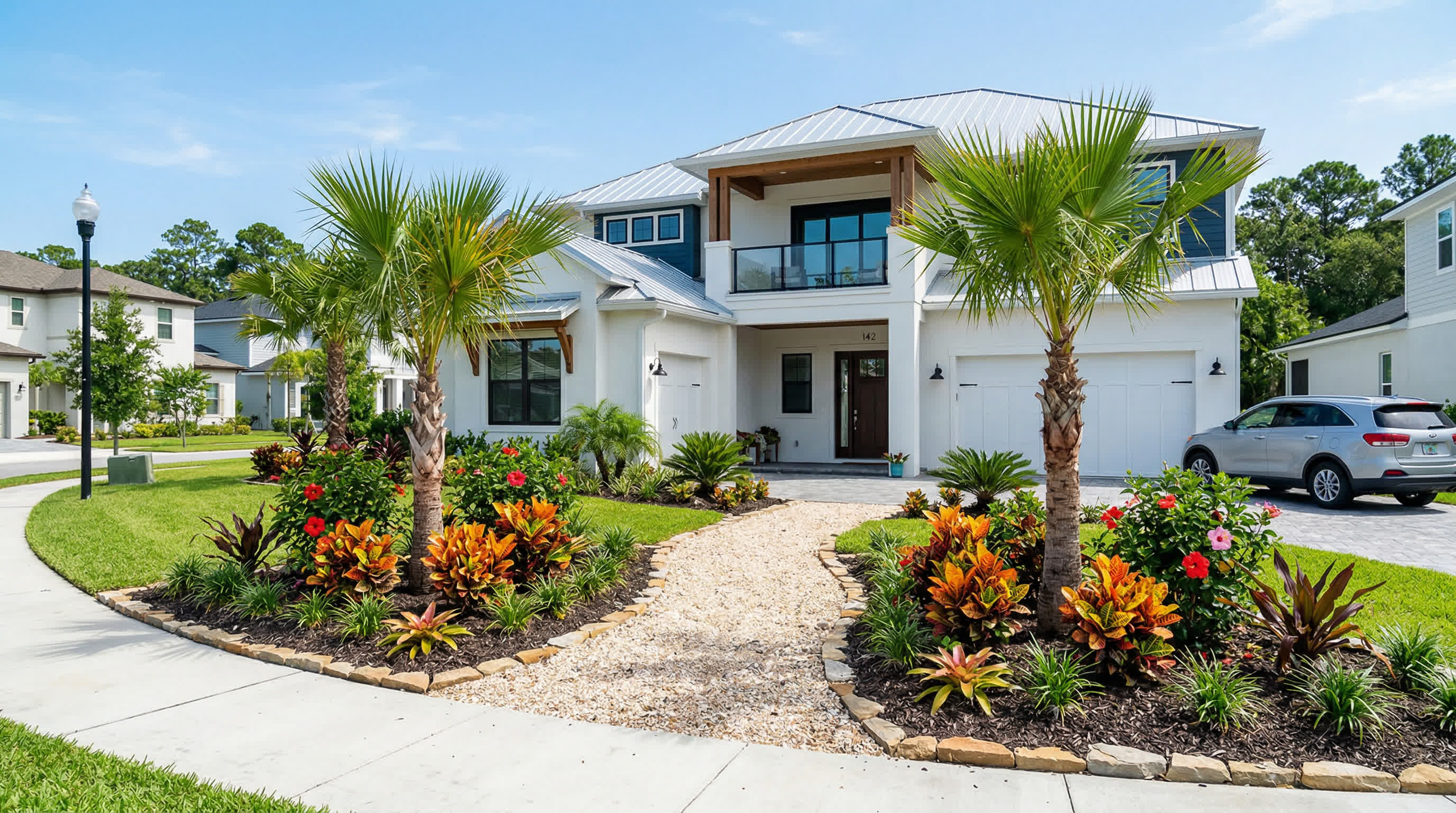
If you've recently moved into a new construction home in Nocatee — or you're watching your yard sit as a patch of bare sand while your neighbors' landscapes slowly take shape — you're asking the same question as thousands of new Nocatee homeowners: what should I plant, and where do I start? This guide covers exactly that: the best tropical plants for Nocatee's climate, soil, and HOA environment, plus how coquina shell landscaping can pull the whole design together.
Nocatee is one of the fastest-growing and most award-winning master-planned communities in the United States, spanning roughly 14,000 acres across Ponte Vedra in St. Johns County (and a portion of Duval County). With its network of parks, trails, and a vibrant Town Center, it's a community where curb appeal genuinely matters — and where a well-landscaped yard adds both beauty and resale value. The good news is that Nocatee's climate is ideal for lush, tropical landscaping. Here's everything you need to know to get it right.
Understanding Nocatee's Growing Conditions: Zone 9a and Sandy Soil
Before choosing plants, it helps to understand what you're working with. Nocatee falls in USDA Hardiness Zone 9a, which means average minimum winter temperatures of 20–25°F. This places Nocatee in a subtropical sweet spot — warm enough for a broad palette of tropical plants, but cold enough that you'll want freeze-tolerant varieties for anything you plant as a permanent feature.
Soil is the other critical factor. St. Johns County soils are predominantly sandy, with low organic content and fast drainage. The upside: almost no standing water after rain, and most tropical plants that hate "wet feet" will thrive here. The downside: sandy soil doesn't hold nutrients well, and newly constructed lots are often stripped down to subgrade material with minimal topsoil remaining. For new construction homes especially, amending beds with compost or quality soil mix at planting time makes a meaningful difference in how quickly plants establish.
Nocatee also has a network of neighborhood-level ARB (Architectural Review Board) guidelines. While rules vary by sub-community, the general direction across Nocatee encourages Florida-Friendly Landscaping — plants that are drought-tolerant once established, appropriate for the local climate, and compatible with the community's aesthetic. The tropical plants covered in this guide check all those boxes. See our companion guide on tropical plants for Ponte Vedra for additional plant ideas suited to the broader area.
Best Palm Trees for Nocatee, FL
No Nocatee yard is truly complete without at least one palm tree. Palms define the North Florida tropical aesthetic, and the right species will anchor your landscape for decades. The key is selecting palms proven in Zone 9a's freeze conditions — not every palm sold at big-box stores is appropriate for North Florida winters.
Sabal Palm (Sabal palmetto) — Florida's Native State Tree
The Sabal Palm is the single most reliable choice for Nocatee. It's Florida's state tree, native to the Southeast, and tolerates temperatures as low as 12°F when mature. Its shallow fibrous root system anchors well in Nocatee's sandy soils, and it handles drought, flooding, and hurricane-force winds with equal grace. Mature Sabals develop a striking boot-covered trunk and a full, rounded crown — the quintessential Florida palm silhouette. For new construction homes, planting a 10–14 foot specimen gives you an instant mature look. Visit our palm trees page to see available sizes and pricing.
Sylvester Palm (Phoenix sylvestris) — The Elegant Statement Tree
The Sylvester Palm, also called the Silver Date Palm, is one of the most visually dramatic palms available in Zone 9a. Cold-hardy down to 15–20°F, it develops a heavy, textured trunk and arching silver-green fronds that command attention. At maturity, Sylvester Palms reach 30–50 feet tall, making them ideal as focal-point specimens in Nocatee front yards or beside driveways. They're drought-tolerant once established and perform well in sandy soils.
Areca Palm (Dypsis lutescens) — The Fast-Growing Privacy Screen
For homeowners who want privacy on the sides or rear of their lot, the Areca Palm is the go-to solution. It grows in dense, multi-trunk clumps with feathery, arching fronds, forming a thick tropical screen up to 20 feet tall. Growth is fast — several feet per year under good conditions — which makes it the preferred choice when you need results quickly. Areca palms prefer the slightly sheltered placement of a side yard or screened lanai area rather than a fully exposed front-yard site in North Florida, where the occasional hard freeze can damage fronds.
Windmill Palm (Trachycarpus fortunei) — The Cold-Hardy Performer
If you're concerned about winter freezes, the Windmill Palm is the most cold-tolerant tall palm available. With a slender, fibrous trunk and dark green fan-shaped fronds, it adds a distinctive texture to Nocatee landscapes. Windmill Palms are particularly well-suited for corner lots or exposed positions where other tropical palms might suffer during cold snaps.
Looking for Palms Near Nocatee?
Tropical Yards delivers palm trees and tropical plants to Ponte Vedra and Nocatee. Call for availability and current pricing.
Hibiscus for Nocatee Landscapes
Hibiscus is one of the most beloved tropical plants in North Florida, and for good reason: it thrives in Zone 9a's heat, blooms prolifically through the long warm season, and comes in an extraordinary range of colors — from bold reds and oranges to soft pinks, peaches, and white. There are two primary types to consider for Nocatee yards.
Tropical Hibiscus (Hibiscus rosa-sinensis)
Tropical hibiscus produces the large, dinner-plate blooms most people picture when they think "hibiscus." It's a fast-growing shrub that can reach 6–8 feet tall and wide if left unpruned. In Nocatee's sandy, well-draining soil, tropical hibiscus performs beautifully when planted in full sun with consistent irrigation. The blooms are short-lived (each flower lasts a day or two), but the plant produces them continuously from spring through fall. It's best used as a specimen planting, in foundation beds, or along fence lines. Frost can damage leaves and stems, but established plants typically regenerate quickly from the roots even after hard freezes.
Rose of Sharon / Hardy Hibiscus (Hibiscus syriacus / Hibiscus moscheutos)
For a more freeze-tolerant option, Hardy Hibiscus — sometimes called rose mallow — offers impressively large blooms (up to 12 inches across) on plants that die back to the ground each winter and return reliably each spring. This is an excellent choice for Nocatee homeowners who want reliable color without worrying about winter protection. Visit our hibiscus page to see varieties in stock.
Both types of hibiscus appreciate a thick layer of ground cover to keep their root zone moist and cool — which is one more reason coquina shell landscaping pairs so well with hibiscus beds in Nocatee yards.
Bougainvillea: Color and Drama for Nocatee Fences and Structures
Few plants deliver more visual impact per square foot than bougainvillea. Its vivid bracts — which most people mistake for flowers — come in shades of magenta, red, orange, pink, purple, and white, and a well-established bougainvillea in full sun is a stunning feature in any Nocatee landscape.
Bougainvillea is a woody vine that grows aggressively in warm conditions, making it ideal for covering fences, trellises, pergolas, and walls on new construction properties that still feel a little bare. In Zone 9a, bougainvillea performs best in full sun with excellent drainage — conditions that Nocatee's sandy soils naturally provide. It's drought-tolerant once established and actually blooms most prolifically when slightly stressed, meaning it rewards the occasional dry spell with an explosion of color.
The main caveat in Nocatee's climate is winter. Bougainvillea is cold-sensitive and will sustain damage below 32°F. In most Zone 9a winters, it bounces back quickly from the roots, but severe freezes can kill it to the ground. Planting near a south- or west-facing wall provides extra warmth and protection. Smaller "hanging basket" varieties also work well in containers that can be moved indoors during freezes. Explore our full bougainvillea selection for varieties available for Nocatee delivery.
Privacy Hedges for Nocatee Backyards
New construction lots in Nocatee often sit close together, and many homeowners prioritize creating privacy on their side and rear boundaries quickly. The good news: several fast-growing tropical and subtropical shrubs make excellent privacy screens in Zone 9a, and they grow quickly enough that you can have meaningful screening within one to two growing seasons.
Clusia (Clusia rosea) — The Premium Privacy Hedge
Clusia is the gold standard for Florida privacy hedges. It's dense, evergreen, salt-tolerant, and remarkably easy to maintain. Clusia grows 10–20 feet tall and produces thick, leathery, oval leaves that form an impenetrable screen when planted at the right spacing (typically 3–4 feet apart for hedge use). It tolerates Nocatee's sandy soil well and is one of the few hedges that genuinely doesn't require frequent pruning to stay full from top to bottom. Clusia also produces attractive pink-and-white flowers in summer as a bonus.
Areca Palm Hedge
As noted above, Areca Palms serve double duty as both specimen palms and privacy screens. A row of Arecas planted 5–6 feet apart along a property line creates a lush, tropical privacy wall within 2–3 years. This is one of the most popular choices in Nocatee's side yards precisely because it delivers a tropical look while solving the privacy challenge simultaneously.
Wax Myrtle (Myrica cerifera) — The Fast Native Option
For homeowners who prefer a Florida native plant, Wax Myrtle is hard to beat. It grows 3–5 feet per year, reaches 15–20 feet at maturity, and tolerates everything from full sun to partial shade, dry sandy soil to occasionally wet conditions. It's fragrant, produces berries that attract birds, and maintains a neat appearance with minimal pruning. Wax Myrtle is an excellent choice for Nocatee lots near preserves or wetland buffers where a more naturalistic look is appropriate.
Podocarpus (Podocarpus macrophyllus) — The Formal Evergreen
For a more structured, formal hedge look, Podocarpus is a favorite in master-planned communities. It grows more slowly than Clusia or Wax Myrtle but maintains an exceptionally uniform appearance with minimal trimming. It's tolerant of Nocatee's sandy soils and is a common selection in Nocatee's more traditionally styled neighborhoods.
For a broader look at the best options across St. Johns County, see our guide to St. Johns County landscaping with tropical plants and coquina shell.
Ground Cover Plants for Nocatee's Sandy Soil
Ground cover is the finishing layer that ties a Nocatee landscape together, filling in bare soil between shrubs and trees, suppressing weeds, and softening the overall look. For Zone 9a sandy conditions, these are the top performers.
Beach Sunflower (Helianthus debilis)
Beach sunflower is a Florida native that was practically designed for Nocatee's conditions. It forms a spreading, sprawling mat of cheerful yellow flowers that blooms for most of the year, tolerates drought once established, and spreads readily to fill open sandy areas. It's an excellent choice for sunny slopes, road-side beds, or large open areas where you want low-maintenance color.
Perennial Peanut (Arachis glabrata)
Perennial peanut has become one of the most popular lawn and ground cover alternatives in Florida for good reason. It's a tough, spreading ground cover with bright yellow flowers, tolerates foot traffic better than most ground covers, and handles both drought and sandy soil with ease. It's even used in Florida highway medians as a no-mow lawn substitute. For Nocatee homes, perennial peanut works beautifully as a low-maintenance fill between garden beds or as a lawn substitute in smaller areas.
Asiatic Jasmine (Trachelospermum asiaticum)
Asiatic jasmine is a dense, spreading vine used extensively as ground cover in Florida's residential landscapes. It stays low (6–12 inches), spreads readily, and forms a thick mat that out-competes most weeds once established. It handles sun or partial shade and tolerates Nocatee's sandy soil well. It's a common choice for the transitional areas between lawn and foundation beds in new construction homes.
Sunshine Mimosa (Mimosa strigillosa)
A native Florida ground cover with pink, powder-puff flowers, sunshine mimosa spreads along the ground in sunny, sandy conditions and creates a beautiful flowering mat in areas where lawn grasses struggle. It's drought-tolerant, spreads quickly, and adds a unique native-plant character to Nocatee landscapes near preserves and natural areas.
Coquina Shell Landscaping for Nocatee Homes
Once your plant selection is finalized, the ground cover material you choose for your beds will define the finished look of your entire landscape. For Nocatee homes, coquina shell is the premier choice — and it's the material we most frequently recommend for new construction properties across St. Johns County.
Coquina is a naturally occurring crushed shell aggregate with a warm cream, tan, and sand tone that complements the coastal North Florida aesthetic perfectly. It's the same material historically used to build Castillo de San Marcos in nearby St. Augustine — a testament to its durability. For modern Nocatee landscapes, coquina shell offers several advantages that wood mulch simply can't match:
- Permanence: Unlike mulch, which breaks down and requires annual replacement in Florida's heat and humidity, coquina shell holds its appearance and structure for years with only occasional top-offs.
- Pest resistance: Coquina shell gives termites and carpenter ants nothing to eat or nest in. This is a meaningful advantage for new construction homes close to Florida's sandy, termite-active soil environment.
- Drainage: Nocatee's sandy soils already drain well, and coquina shell maintains that drainage without compacting into a root-suffocating mat the way old mulch does.
- Storm performance: Unlike wood mulch or pine straw, coquina shell doesn't wash out after Florida's heavy summer rains or scatter in tropical storm winds.
- Aesthetic staying power: The warm, natural tones of coquina shell don't fade in Florida's intense sun. The look you install on day one is close to the look you'll have five years later.
Tropical Yards supplies coquina shell at $145 per cubic yard, delivered via 14-ft dump trailer. Our coquina shell page has full details on coverage estimates and ordering. For a side-by-side comparison of coquina shell and mulch, see our guide to coquina shell vs. mulch for Florida landscaping.
How Much Coquina Shell Do You Need?
To estimate your needs, use this formula: square footage × depth in inches ÷ 324 = cubic yards needed. A 500 sq ft bed at 3 inches of depth = 500 × 3 ÷ 324 = approximately 4.6 cubic yards. At $145/yard, that's roughly $667 for a permanent bed installation that won't need re-mulching for years.
Ready to Transform Your Nocatee Yard?
Order coquina shell and tropical plants delivered to your door. Competitive pricing, dump trailer delivery.
Delivery Pricing to Nocatee and Surrounding Areas
Tropical Yards is based in St. Augustine and delivers tropical plants and coquina shell across Northeast Florida via dump trailer. Here are current delivery rates by area:
- St. Augustine: $250 delivery
- Ponte Vedra (including Nocatee): $275 delivery
- Palm Coast: $300 delivery
- Flagler Beach: $300 delivery
- Ormond Beach: $350 delivery
- Daytona Beach: $375 delivery
Coquina shell is priced at $145 per cubic yard. Plant pricing varies by species and size — call 772-267-1611 or email sleuthdesigner@gmail.com for current availability and a quote for your Nocatee landscape project.
Designing a Complete Nocatee Landscape: A Layered Approach
The most effective new construction landscapes in Nocatee use a layered approach that gives you visual interest at every height level — from the ground up. Here's a framework that works well for a typical Nocatee home:
Canopy Layer (15–50 feet): Palm Trees
One to three palms — typically a Sabal Palm as the primary specimen and Areca Palms along a side boundary — provide height, movement, and that unmistakable Florida tropical character. Position your statement palm where it can be seen from the street and from your main living areas inside the house.
Mid-Story Layer (6–15 feet): Flowering Shrubs and Hedges
This is where hibiscus, bougainvillea, and privacy hedges like Clusia or Podocarpus do their work. Use hibiscus as colorful accent shrubs near entryways or focal points. Line rear and side boundaries with Clusia or Areca Palms for privacy. Train bougainvillea up fences, trellises, or pergola structures for maximum color impact.
Foundation Layer (1–5 feet): Accent Shrubs and Border Plants
Crotons, ixora, plumbago, and dwarf bougainvillea varieties work beautifully as foundation planting around your home. These provide year-round color and texture close to the house, where the visual impact matters most for curb appeal and HOA presentation.
Ground Level: Ground Cover and Coquina Shell
Beach sunflower, perennial peanut, or Asiatic jasmine fill in between your shrubs and border plantings. Then finish every landscape bed with coquina shell for a clean, permanent, low-maintenance surface that unifies the entire design. See our guide to tropical plants for Ponte Vedra for more layering ideas suited to communities near Nocatee.
New Construction Landscaping Tips Specific to Nocatee
New construction lots present some unique challenges that established neighborhoods don't. Here are the most important things to keep in mind when landscaping a freshly built Nocatee home:
- Soil amendment is essential. Construction activity strips and compacts topsoil. Before planting, have your beds rototilled and amended with quality compost or topsoil mix to give plants the organic foundation they need to establish quickly.
- Submit your landscape plan to your ARB before installing. Nocatee's neighborhood ARB guidelines require pre-approval for significant landscape changes. Getting written approval protects you and avoids having to remove plants after the fact.
- Irrigation from day one. Nocatee's ARB guidelines require full irrigation coverage for all landscape beds and sod. Ensure your irrigation system is operational before planting, and adjust heads to cover new bed additions.
- Start with fast-establishing plants. On a bare new construction lot, getting coverage quickly matters both aesthetically and for HOA compliance. Wax Myrtle, Areca Palm, and tropical hibiscus all establish and grow quickly in Nocatee's conditions.
- Use coquina shell from the start. Installing coquina shell at the time of planting — rather than adding it later — gives you immediate weed suppression, a clean finished appearance, and the long-term maintenance benefits from day one.
For more ideas specific to St. Johns County's soil and climate conditions, visit our full guide to St. Johns County landscaping with tropical plants and coquina shell.
Frequently Asked Questions
What are the best tropical plants for Nocatee, FL new construction homes?
The best tropical plants for new construction homes in Nocatee include Sabal and Sylvester palms for height and drama, tropical hibiscus for color, bougainvillea for fences and trellises, Clusia and Wax Myrtle for privacy hedges, and beach sunflower or perennial peanut as low-maintenance ground cover. All thrive in Nocatee's USDA Zone 9a climate and sandy St. Johns County soil.
What USDA hardiness zone is Nocatee, FL?
Nocatee, FL falls within USDA Hardiness Zone 9a, with average minimum winter temperatures of 20–25°F. This subtropical zone is ideal for palms, hibiscus, bougainvillea, crotons, and a broad range of tropical and flowering shrubs. Most tropical plants sold by Tropical Yards are specifically selected for Zone 9a performance.
Can I use coquina shell for landscaping in Nocatee?
Yes — coquina shell is an excellent ground cover for Nocatee homes. It stays in place through Florida's heavy rains without washing out like mulch, resists pests, and gives beds a clean, permanent coastal appearance. Tropical Yards delivers coquina shell to Ponte Vedra and Nocatee for $275 per delivery, with shell priced at $145/cubic yard. Visit our coquina shell page or contact us to order.
What palm trees grow best in Nocatee, FL?
The top palms for Nocatee's Zone 9a climate are the Sabal Palm (Florida's native state tree, cold-hardy to 12°F), Sylvester Palm (dramatic silver-green fronds, cold-hardy to 15–20°F), Areca Palm (fast-growing, ideal for privacy screens), and Windmill Palm (most cold-hardy tall palm available). All perform well in sandy North Florida soils. See our full selection at our palm trees page.
Does Nocatee HOA allow tropical plants and coquina shell?
Nocatee is a master-planned community where each sub-neighborhood runs its own Architectural Review Board (ARB) process. Most communities encourage Florida-Friendly landscaping, and tropical palms, hibiscus, flowering shrubs, and coquina shell are generally compatible with community guidelines. That said, any significant landscape change should be submitted to your neighborhood's ARB for written pre-approval before installation.
How do I order tropical plants and coquina shell delivered to Nocatee?
Tropical Yards in St. Augustine delivers tropical plants and coquina shell to Nocatee and Ponte Vedra for $275. Call 772-267-1611, email sleuthdesigner@gmail.com, or visit our contact page to schedule a delivery and get a quote for your new construction landscape project.
What are the best privacy hedge plants for Nocatee backyards?
The top privacy hedge plants for Nocatee are Clusia (dense, salt-tolerant, up to 20 feet), Areca Palm (fast-growing tropical screen), Wax Myrtle (fast native option, 3–5 feet per year), and Podocarpus (formal, slow-growing evergreen). All handle Nocatee's sandy soil well and are compatible with the community's Florida-Friendly landscaping direction.
Ready to Landscape Your Nocatee Home?
Get the best prices on tropical plants and coquina shell in Northeast Florida. Dump trailer delivery to Ponte Vedra and Nocatee.