
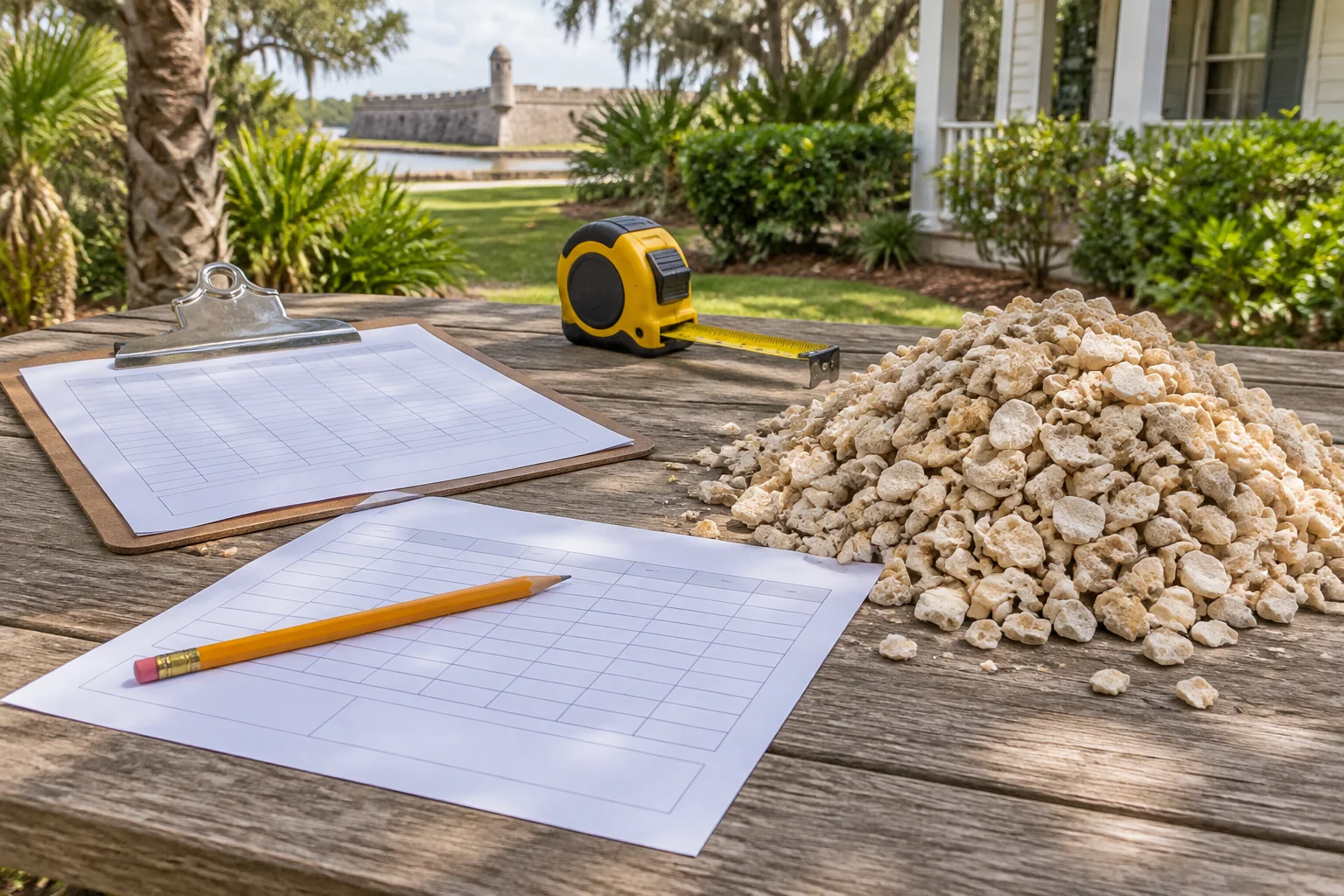
When reviewing a bulk coquina shell quote for St. Augustine, FL, start with the written breakdown rather than the total alone. Identify the material subtotal, the delivery entry, and any tax line. Then check which product, quantity, address, and delivery arrangement those entries describe.
A separate delivery line makes a charge easier to see. It does not, by itself, settle the charge's tax treatment. Florida's official guidance discusses both how the charge appears on the invoice and whether the purchaser can avoid it. Use that guidance to frame questions, not to predict how a particular order will be taxed.
Identify What Each Quoted Line Covers
Read material, delivery, and tax as separate parts of the written breakdown, while keeping the underlying purchase consistent. For product selection, intended use, volume calculations and delivery planning, see the bulk coquina shell buying guide. Use it alongside the coquina shell product page to prepare a clear material request before reviewing charges.
First, confirm the exact product description. The buying guide distinguishes loose coquina shell from consolidated shell rock. A shortened product name should not hide that difference. Keep the quoted quantity and its unit beside the description so that the material subtotal has a clear basis. Cubic yards measure volume; an amount without a unit needs clarification.
- Material subtotal: Check the product name and quoted quantity. Ask which material purchase this entry covers.
- Delivery: Record whether it is included, shown separately, or unclear. Preserve the seller's wording rather than replacing an included charge with a zero.
- Tax: Ask the seller to explain which listed charges are included in the amount used to calculate tax.
- Total: Confirm that it describes the same quantity, destination, and scope as the individual entries.
The Florida Department of Revenue's delivery-charge FAQ says delivery charges are generally subject to tax when imposed with the sale of a taxable item. It explains that the sales price of taxable tangible personal property, meaning physical goods, includes services that are part of the sale. This is general guidance, not a determination about your shell order.
A quote helps you review the proposed purchase. A final invoice records the charges being billed. Keep their roles distinct, and ask what remains subject to confirmation. If an estimate leaves a tax or delivery entry unanswered, mark it as unresolved in your notes. A blank field is not proof that a charge is included, excluded, or absent.
Ask What Optional Delivery Means for the Order
Ask whether a delivery charge can actually be avoided through a choice made by the purchaser, rather than relying on the word optional. The coquina shell quote comparison guide helps organize delivery terms, and the Tropical Yards contact page shows how to reach the supplier. Call +1 904 526 8345 to ask what arrangements apply to your request.
The Department of Revenue's FAQ describes two conditions together: the delivery charge is separately stated on an invoice or bill of sale, and the purchaser can avoid it through a decision or action solely on their part. The FAQ gives purchaser pickup and independently arranged transportation as examples. Those are examples in the state guidance, not statements that Tropical Yards offers either arrangement.
Rule 12A-1.045, Florida Administrative Code, Transportation Charges also states both conditions in subsection (4). Subsection (3) explains that when the seller agrees to deliver taxable goods and the purchaser cannot elect to avoid the transportation charge, that charge is subject to tax even if separately stated. The separate line alone therefore does not answer the question.
Ask a focused question: “When this estimate describes delivery as optional, what choice does that mean for this order, and can that choice avoid the delivery charge?” Keep the answer with the estimate. Do not assume that choosing another date, unloading point, or delivery description means the charge can be avoided. Those details need an explanation from the seller.
The rule also addresses other transportation arrangements. Subsection (5) discusses F.O.B. origin sales, where ownership passes at the starting point, and separately stated transportation charges. Do not infer those terms from a delivery line. If unfamiliar shipping language appears, ask the seller to explain it and consult the complete official rule rather than treating this general summary as an order-specific tax answer.
Use a Neutral Line-Item Example
Compare named entries without assigning a tax result to them. Keep the material description tied to the coquina shell listing, and use the quote-checking worksheet approach to mark anything that needs an answer. The table below is a reading aid, not a seller invoice.
Imagine an estimate with the labels Material subtotal, Delivery, Tax, and Total. No amounts are needed to practice the comparison. The task is to understand each label, match it to the agreed order, and ask about missing explanations. The labels do not establish which charges are taxable or how a final invoice will be prepared.
| Named Line | What to Compare | Question to Ask |
|---|---|---|
| Material subtotal | Product description, quantity, and unit | Does this cover the agreed material amount? |
| Delivery | Included or separate wording and agreed arrangement | What does this entry cover? |
| Tax | The seller's explanation of the calculation | Which listed charges were used to calculate tax? |
| Total | The complete purchase described by the document | Does this include all stated material and delivery charges? |
If the delivery entry says included, copy that wording into your comparison. Do not turn it into a statement that delivery is free. If delivery is separate, retain the entry alongside the material subtotal. Neither layout, standing alone, establishes tax treatment. Ask the seller to explain the breakdown rather than supplying an interpretation yourself.
If the total is unclear, request a revised or explained breakdown. Do not adjust an entry just to make the document appear consistent. The unresolved issue could concern quantity, delivery wording, or another order detail. Preserve the original response so that a later explanation can be read in context.
Compare the Estimate With the Final Invoice
Carry the same product, quantity, address, and delivery arrangement from the estimate into the invoice review. The bulk coquina shell quote checks explain how to preserve scope and revisions, while the shell buying guide connects those records to the material and delivery plan.
Keep the latest confirmed estimate beside the invoice. Also retain the messages that changed the order after the estimate was issued. A different quantity or unloading request should remain visible in the record. Otherwise, you may compare an older proposal with a newer purchase and mistake a documented change for an unexplained charge.
- Match the material. Compare the exact description, quantity, and unit. Flag any difference before comparing subtotals.
- Match the destination. Check the delivery address, proposed drop point, and access information used for the quote.
- Match the arrangement. Read the delivery wording on both documents and compare it with the seller's written explanation.
- Review changed entries. Ask the seller to identify which line changed and what order detail explains the change.
- Save the resolved version. Keep the explanation with the estimate and invoice rather than retaining only a total.
A quantity revision deserves its own check. Ask who approved the new amount and whether the updated document also reflects the intended delivery arrangement. Do not combine a material subtotal from one version with delivery terms from another. That combination may describe a purchase that was never offered as a whole.
Likewise, a changed address or drop point calls for confirmation. Give the seller the revised information and ask whether the earlier delivery terms still apply. This is a request to clarify the current order, not an assumption that a particular change will increase, reduce, or otherwise alter a charge.
If the tax line differs between documents, ask which underlying entries or terms changed and how the seller calculated the invoice. Refer to the official guidance when framing the question. Do not assume the earlier estimate fixes the final tax result, or that a different figure proves an error. Resolve the explanation before treating the documents as equivalent.
Prepare a Clear Tropical Yards Quote Request
Request a current written breakdown with enough detail to identify the purchase. Start with the Tropical Yards coquina shell page, and find business details on the Tropical Yards contact page. Call +1 904 526 8345 to ask about material, delivery, and tax entries. Ask the business to explain unclear lines rather than guessing what they mean.
Have the requested product, cubic-yard quantity, intended use, and delivery address ready. Include known access restrictions and the proposed unloading location. If the quantity still needs approval from your contractor, say so. Keeping an estimate visibly provisional is more useful than presenting an uncertain amount as the settled order.
A concise request could read: “Please quote bulk coquina shell for my project in St. Augustine, FL, using the attached quantity and delivery address. Please identify the material subtotal, explain how delivery appears in the breakdown, and explain the tax line. If any delivery choice is described as optional, please clarify what that means for this order. Please also identify anything that still needs confirmation before I approve the purchase.”
Ask how long the quote can be used if no validity period is stated. Keep current availability, scheduling, and quote validity as separate questions. A saved estimate does not answer every later ordering question. If your plan changes, send the revised details and request confirmation instead of relying on the earlier response.
Keep the responsibility boundary clear as well. Tropical Yards supplies coquina shell and provides dump trailer delivery. Customers handle preparation and installation themselves or engage their own contractors. A delivered-material total should not be mistaken for the cost of a finished driveway, path, or landscape bed.
Before confirming the order, retain the written breakdown and the answers that explain it. The goal is a record that ties each charge to the same purchase. Questions about the actual tax calculation belong with the seller; Florida's official sources provide the general delivery-charge framework, not a prediction for this specific invoice.
Frequently asked questions
Is a quote the same as a final invoice?
No. Use the quote to review the proposed purchase and the final invoice to review the charges being billed. Compare the product, quantity, address, and delivery arrangement across both documents. Keep later changes with the records, and ask the seller to explain any difference rather than assuming both documents describe an unchanged order.
Does a separate delivery line settle its tax treatment?
No. Florida's general guidance discusses both a separately stated charge and whether the purchaser can avoid it through a decision or action solely on their part. The rule also addresses other transportation arrangements. A separate line alone does not establish the result. Ask the seller to explain the order's terms and calculation.
What should I ask if delivery is listed as optional?
Ask what specific choice the word optional describes and whether that choice allows the purchaser to avoid the delivery charge. Request an explanation for the actual order, not a general label. Do not assume pickup or independently arranged transportation is available from Tropical Yards merely because the state guidance uses those examples.
Which details should match across a quote and invoice?
Compare the exact material description, quantity and unit, delivery address, unloading location, and agreed delivery arrangement. Review the material subtotal, delivery entry, tax line, and total against those details. If the order changed, keep the written revision and ask the seller to identify which entries reflect it.
How can I ask for a Tropical Yards quote?
Call Tropical Yards at +1 904 526 8345. Have your requested material, quantity, intended use, delivery address, access notes, and proposed drop location ready. Ask for a current breakdown that explains material, delivery, and tax entries. Identify uncertain details and request clarification before treating the response as a confirmed purchase.