 Tropical
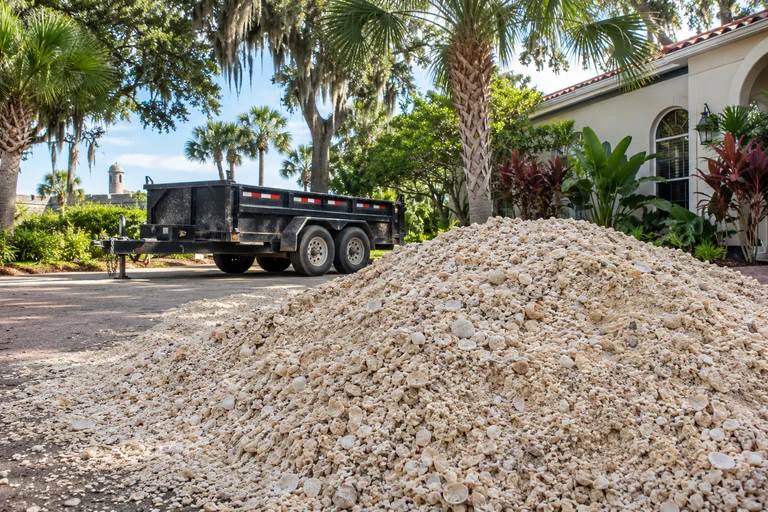
Buying bulk coquina shell in St. Augustine, FL starts with four decisions: confirm the material, define its use, calculate the volume, and arrange a suitable delivery location. Those decisions matter more than choosing a load size first. A decorative bed, a walking path, and a driveway can occupy the same area yet require different preparation and quantities.
If your search began with coquina rock for sale, clarify the product before requesting a quote. Loose landscape shell and consolidated shell rock are not interchangeable names for the same purchase. Tropical Yards supplies coquina shell and tropical plants, with dump trailer delivery. Customers handle installation themselves or hire their own contractors. Keep material selection, delivery arrangements, and installation responsibilities separate when planning the purchase.
1. Confirm Which Coquina Material You Are Buying
Buy loose coquina shell when that is the material your landscape plan requires, rather than assuming every coquina product is equivalent. Consolidated shell rock is a harder material, so confirm the exact product before comparing quantities or quotes.
Shell rock, also called coquina rock, forms from shell deposits that become cemented into rock and are processed into aggregate. Loose coquina shell consists of shell fragments rather than solid pieces of quarried rock. A contractor specifying one product may not accept the other as a substitute. Share any written material specification before placing an order.
Tropical Yards characterizes its coquina shell landscape material as containing “tiny, loosely consolidated marine shells,” with a warm cream-to-tan appearance. Common applications include driveways, pedestrian pathways, and landscape beds. These characteristics help establish what to discuss when requesting a quote, but the material supplied for your particular order still needs confirmation.
Use a short product checklist before comparing quantities or delivery totals:
- Product identity: Ask whether the quote is for loose coquina shell, shell rock, or another crushed-shell product.
- Intended use: Describe whether the material will serve as decorative cover, a pedestrian surface, or a vehicle surface.
- Appearance: Ask how to confirm the current material's color and texture before purchasing.
- Volume basis: Confirm that the quoted quantity is in cubic yards and clarify any unfamiliar unit.
- Order conditions: Ask about the current minimum, availability, and delivery arrangements for your address.
For an existing shell surface, describe what is already present. A close photograph of the old material and a wider photograph of the project may help explain whether you want a matching refresh or a different finish. Do not assume a product with a similar name will look identical beside an older installation.
Also separate the buying question from the design question. A supplier can discuss the product and delivery, but a driveway specification involving heavy vehicles needs more than a material name. If your contractor has already prepared a specification, share that wording before ordering. This avoids selecting a landscape finish when the project calls for a different base or structural aggregate.
2. Match The Shell To The Project Before Choosing Depth
Choose depth according to the surface's purpose and preparation, not a single coverage figure. Shell applications for beds, paths, and driveways involve different demands, and base preparation and expected traffic also affect the required section. Decide how the finished area will function before calculating volume.
UF/IFAS mulch guidance distinguishes shell from organic mulch: shell adds neither nutrients nor water storage to soil. Check that distinction before choosing shell for a planting bed.
For decorative landscape beds, a shell layer around 2 to 3 inches deep is a general planning starting point. That is not permission to bury plant bases or raise the entire bed without checking existing conditions. Measure the exposed ground you intend to cover, and leave suitable clearance around stems and trunks.
For a pedestrian path, think about the people and equipment using it. A route used occasionally to reach a garden bed is different from the main approach to an entrance. A loose layer and a compacted finished surface are also different specifications. Confirm the intended finished condition before using a depth in your order calculation.
For a residential driveway, a general starting point is at least 4 inches of compacted shell over a prepared base. That finished thickness differs from the loose material placed before compaction. This is buying context, not a complete pavement design. Existing ground, turning traffic, vehicle loads, and drainage need assessment by whoever is responsible for preparing the driveway.
Keep decorative and load-bearing areas separate on your sketch. A shell border beside a driveway does not necessarily need the same section as the wheel paths. Likewise, a planting bed beside a parking area should not automatically receive the parking area's depth. Separate measurements make it easier to calculate each use correctly without applying the deepest section everywhere.
Water movement deserves its own decision. Shell can provide a porous landscape surface, but that does not establish that an individual wet area can be fixed by adding shell. If water remains against a building, collects in a persistent low spot, or crosses the project in a concentrated stream, resolve that issue before selecting a finish layer. Ask an appropriate drainage professional rather than ordering extra shell as a substitute for assessment.
Finally, compare materials against your actual priorities. River rock can serve as a decorative accent, while harder aggregates may suit specifications that loose shell does not meet. Organic mulch contributes organic matter as it decomposes. Coquina shell offers a distinct coastal appearance, but a smooth, uniform walking surface or a heavy-load specification may lead to a different choice. Identify the required function before deciding on appearance alone.
3. Calculate Cubic Yards From Measured Area And Depth
Calculate shell volume by multiplying square feet by depth in feet, then dividing by 27. For cubic-yard quantity planning, convert every measurement to consistent units first. A 300-square-foot pathway at 3 inches deep requires about 2.78 cubic yards geometrically, before allowances or order conditions.
When your depth is measured in inches, the equivalent formula is cubic yards = square feet × depth in inches ÷ 324. The number 324 accounts for converting inches to feet and cubic feet to cubic yards. This gives a geometric volume for an even layer. It does not automatically include compaction, uneven ground, handling losses, or a supplier's order minimum.
Start with a sketch rather than a guessed total. Divide a large project into rectangles that you can measure with a tape. Calculate each rectangle's length times width, then add the areas. For curves, use smaller sections that approximate the shape and record where your measurements are uncertain. Avoid counting the same strip twice where two sections meet.
| Layer Depth | Coverage Per Cubic Yard | Volume For 300 Sq Ft | Volume For 800 Sq Ft |
|---|---|---|---|
| 2 inches | 162 sq ft | 1.85 cubic yards | 4.94 cubic yards |
| 3 inches | 108 sq ft | 2.78 cubic yards | 7.41 cubic yards |
| 4 inches | 81 sq ft | 3.70 cubic yards | 9.88 cubic yards |
| 6 inches | 54 sq ft | 5.56 cubic yards | 14.81 cubic yards |
A 300-square-foot pathway with a 3-inch layer requires 300 × 3 ÷ 324, or about 2.78 cubic yards before allowances. This does not mean that 2.78 cubic yards will necessarily be the available order quantity. Confirm the current minimum and ordering increments before making a purchase plan. Keep the calculated requirement separate from the quantity ultimately purchased.
For a mixed project, calculate each zone at its own depth. As an illustration, a 200-square-foot bed at 2 inches uses about 1.23 cubic yards. A separate 300-square-foot path at 3 inches uses about 2.78 cubic yards. Together, those geometric quantities total about 4.01 cubic yards before any allowance. Averaging the two depths without accounting for their different areas would obscure the calculation.
Compaction requires particular care. If your driveway plan specifies a compacted finished depth, a calculation using that depth describes the finished volume, not necessarily the loose volume to order. Ask your installer how the specified section translates into purchased material. Do not add a generic buffer and assume it covers every combination of base condition, compaction, and surface irregularity.
Use consistent units throughout. Feet for length and width, inches for depth, and cubic yards for the result form one clear calculation. A square yard measures area, not volume, so it cannot replace a cubic yard in the order. Write the units beside every number when sharing measurements with a supplier or contractor.
Keep the original measurements even after receiving an estimate. If the path becomes wider or another bed is added, update the affected zone instead of adding an arbitrary extra yard. A measurement sheet also makes a later refresh easier because you already know which areas were included in the initial delivery.
4. Compare The Complete Delivered Quote, Not Just The Yard Rate
Compare quotes using the same product, quantity, delivery address, and scope. A bulk coquina shell purchase involves both material and delivery arrangements. Request a current Tropical Yards project quote that identifies what is included rather than treating a unit rate as the complete delivered total.
The material rate is only one part of a bulk purchase. Your total also depends on the quantity ordered and the delivery arrangements for the address. Ask for a current quote rather than applying an old figure found in a search result or saved message. Make sure the quote states whether delivery is included or shown separately.
Quantity changes can affect more than the material subtotal. A larger project may require different load arrangements, and a small project still needs to satisfy the supplier's current order conditions. Ask how the proposed quantity will be delivered. Do not infer trailer capacity from its length or assume that every project can be completed with one trip.
Keep the scope clear when comparing suppliers. A delivered pile of shell is different from a completed driveway or finished planting bed. Tropical Yards supplies materials and offers dump trailer delivery. It does not provide installation, grading, landscape construction, or spreading labor. Budget separately for your own tools, labor, or independent contractor where those are needed.
If a contractor is buying on your behalf, agree on who calculates and approves the quantity. The person handling preparation may know whether the measured area needs a base layer, a finish layer, or a top-off only. Ask that person to identify which materials are included before comparing their estimate with a loose-shell delivery quote.
For a fair material comparison, use an equivalent finished task. Comparing one cubic yard of shell against one cubic yard of another product does not necessarily compare two completed projects. Different materials may call for different preparation, depths, borders, or upkeep. Begin with the required surface and the work needed to create it, then compare the total material and labor requirements.
Retain a written summary of the agreed order. It should identify the product, cubic yards, delivery address, delivery charge or included delivery terms, and any access conditions discussed. If the project changes before delivery, revisit both the quantity and the total. A quote based on one area and one drop location should not be assumed to cover an expanded project automatically.
5. Plan Dump Trailer Access And A Practical Drop Location
Confirm access and the proposed unloading point before scheduling delivery. Tropical Yards dump trailer delivery uses a 14-foot trailer, but access needs more than a length measurement. Disclose gate requirements and delivery restrictions, including restricted hours and known clearance concerns, before agreeing on the drop location.
The delivery corridor extends from St. Augustine, FL to Daytona Beach, FL, including areas in St. Johns, Flagler, and Volusia counties. That regional description is a starting point, not confirmation for every address. Provide the exact destination and ask the business to confirm coverage, route considerations, and scheduling for your order.
Choose a proposed drop point with both delivery and your later work in mind. A pile near the project may reduce manual transport, but it must also be somewhere the delivery operator can approve. Do not assume the trailer can reach a rear yard simply because a wheelbarrow can pass through the side gate.
- Describe the approach: Explain the driveway entrance, street approach, tight turns, and any gate that affects access.
- Share known restrictions: Mention delivery-hour rules, community entry procedures, overhead obstructions, and parking limitations.
- Identify the proposed drop: Provide photographs or a sketch showing where you want the shell placed and what surrounds that location.
- Explain ground concerns: Disclose soft areas, recent rain effects, slopes, or other conditions that may affect access and unloading.
- Plan your work route: Decide how you or your contractor will move shell from the approved pile to each project zone.
- Reconfirm before arrival: Make sure the agreed approach and unloading area remain available when the delivery is due.
For a gated property, resolve entry instructions before delivery day. Verify your own community's entry procedures and delivery windows rather than assuming the supplier can obtain entry on arrival. If someone must meet the delivery, agree on who that person will be and how they will be reached. Share any required instructions before the vehicle is dispatched.
Also think about what the pile will block. A convenient drop can become a problem if it prevents garage access, covers a route needed for moving plants, or interrupts other scheduled work. Coordinate the temporary storage location with everyone involved in the project. Delivery places the material at an agreed location; it does not distribute it across the measured areas.
6. Coordinate DIY Spreading, Plant Orders, And Project Timing
Have preparation and labor arrangements ready before shell arrives, and ask separately about combining plants with the order. Combined shell and plant deliveries may be possible, including hibiscus purchased with coquina shell. Confirm current plant availability and the load arrangement for your particular order before setting the project schedule.
For a DIY project, decide how the material will move from the delivery pile to its final location. The work plan may involve shoveling, wheelbarrow trips, spreading, and leveling. A vehicle surface may also involve equipment and base preparation that a decorative bed does not need. Arrange those tasks yourself or through your own contractor rather than expecting them to accompany the delivery.
Mark the project limits before spreading begins. Borders help contain loose shell along paths and beds. Confirm where those borders belong and how the shell will meet adjacent paving, lawn, and planting areas. A measured area is only useful if the installed limits match it closely enough to support the quantity calculation.
Resolve soft spots and other preparation questions before applying the finish. Do not place driveway shell over an unprepared base with unresolved depressions. Adding a uniform shell layer does not establish that the ground beneath it is ready for vehicles. Your installer should decide what preparation is needed for your property and intended loads.
When adding plants, coordinate planting positions with the shell layout. Keep shell away from plant stems and palm trunks rather than mounding it against them. Plan access for planting and watering so that a freshly spread bed does not have to be repeatedly disturbed. Shell is a ground cover, not a substitute for the plant's soil, irrigation, or care requirements.
Combined delivery can be worth discussing when both purchases are part of the same project, but confirm the actual arrangement. Ask about current plant availability, the shell quantity, and how the proposed combination fits the delivery plan. Do not assume that every plant selection and every shell order can share one load or that a combined order carries a particular discount.
For flowering accents, ask about currently available hibiscus varieties. For a boundary planting, discuss suitable privacy plants as a separate selection decision. Choose plants for their growing conditions and mature dimensions, not merely because their foliage contrasts with pale shell. Confirm availability before tying the entire project's schedule to a specific variety.
Finally, sequence the work realistically. Ground preparation, planting, borders, shell spreading, and any compaction should follow the plan developed for your project. Avoid treating a delivery appointment as the promised completion time for the landscape. Tropical Yards supplies and delivers the materials; the pace and execution of installation remain with you and your chosen workers.
7. Maintain The Surface And Plan Future Top-Off Purchases
Plan for redistribution, edge care, and periodic top-offs rather than assuming shell is maintenance-free. Replenishment needs vary with use and containment, so inspect the existing coquina shell surface before ordering another load. Buy according to current condition, not an assumed replacement date.
Loose material can move under feet and tires, especially where people turn or vehicles change direction. Before ordering more shell, inspect whether thin-looking areas reflect a true shortage or material that has shifted toward the edges. Raking displaced shell back into position may restore some areas without covering the whole project with a new layer.
Check borders at the same time. A broken or displaced edge can allow newly purchased material to spread beyond the intended area just as the original material did. Correct the containment problem before refreshing the surface. This keeps the next quantity estimate tied to the actual bed or path rather than repeatedly buying material to replace avoidable edge loss.
Remove accumulated leaves and other debris as part of routine care. Wind-blown seeds can still germinate in shell, so a shell layer does not eliminate the need to inspect and maintain the area. Avoid interpreting a clean new installation as a permanent weed-prevention guarantee. Include access for routine care when planning beds and pathways.
Base your top-off order on current measurements. If only a turning area or a short path section needs replenishment, calculate that zone rather than repeating the original full-project order. For example, a 200-square-foot area receiving an additional 1-inch layer represents about 0.62 cubic yard geometrically. That calculation is separate from the supplier's current minimum and from any preparation the damaged area needs.
Investigate recurring depressions instead of repeatedly hiding them. A place that becomes rutted again after redistribution may need attention to its underlying condition or use. Likewise, persistent water collection should prompt a drainage review rather than an automatic deeper shell layer. A supplier's material quote cannot determine the cause of a ground or drainage problem.
Keep a simple project record with the original area, intended depth, quantity purchased, and photographs after completion. Those details help you describe a future refresh and distinguish an expanded project from normal upkeep. They also provide a useful reference if a new contractor needs to understand what was installed.
When you are ready to buy bulk coquina shell, contact Tropical Yards with your measurements, proposed use, delivery address, and access information. Request current availability, order conditions, and a delivered quote. A clear product choice, a documented calculation, and an approved drop plan give the purchase a sound starting point while keeping installation responsibilities separate.
Frequently asked questions
Is coquina rock for sale the same as loose coquina shell?
Not necessarily. Loose coquina shell differs from consolidated shell rock, which may also be called coquina rock. Tropical Yards supplies loose shell aggregate for landscape projects. Before comparing quotes, confirm the exact material and explain whether your project needs decorative cover, a walking surface, or a specified vehicle-supporting section.
How much coquina shell covers 300 square feet at 3 inches deep?
An even 3-inch layer over 300 square feet has a geometric volume of about 2.78 cubic yards. Calculate it as 300 multiplied by 3, divided by 324. That result excludes compaction and other allowances. Confirm your intended depth, the supplier's current minimum, and available ordering increments before treating the calculation as an order quantity.
How deep should bulk coquina shell be for a driveway?
A general starting point for residential driveways is at least 4 inches of compacted shell over a prepared base. Loose delivery volume and compacted finished volume are not the same. Have your installer assess the ground, traffic, vehicle loads, and required preparation before calculating an order. A general depth recommendation is not a property-specific driveway design.
Does Tropical Yards spread or install delivered coquina shell?
No. Tropical Yards supplies coquina shell and offers dump trailer delivery, but it does not provide spreading, grading, installation, or landscape construction. You handle the work yourself or arrange an independent contractor. Confirm the approved unloading location and separately plan how the shell will move from the delivery pile into each project area.
What should I include when requesting a bulk coquina shell quote?
Provide the product you want, intended use, measured square footage, proposed depth, and delivery address. Include access details such as gates, restricted hours, tight approaches, and your proposed drop location. Ask for current availability, minimum order conditions, material charges, and delivery terms so you can compare the complete purchase rather than only a unit rate.
Can coquina shell and tropical plants share a delivery?
Combined plant and coquina shell deliveries may be possible. Ask Tropical Yards to confirm the arrangement for your specific shell quantity, plant selection, and address. Current plant availability and load planning still need confirmation. Combining purchases does not include planting or shell installation, and no particular discount should be assumed.