
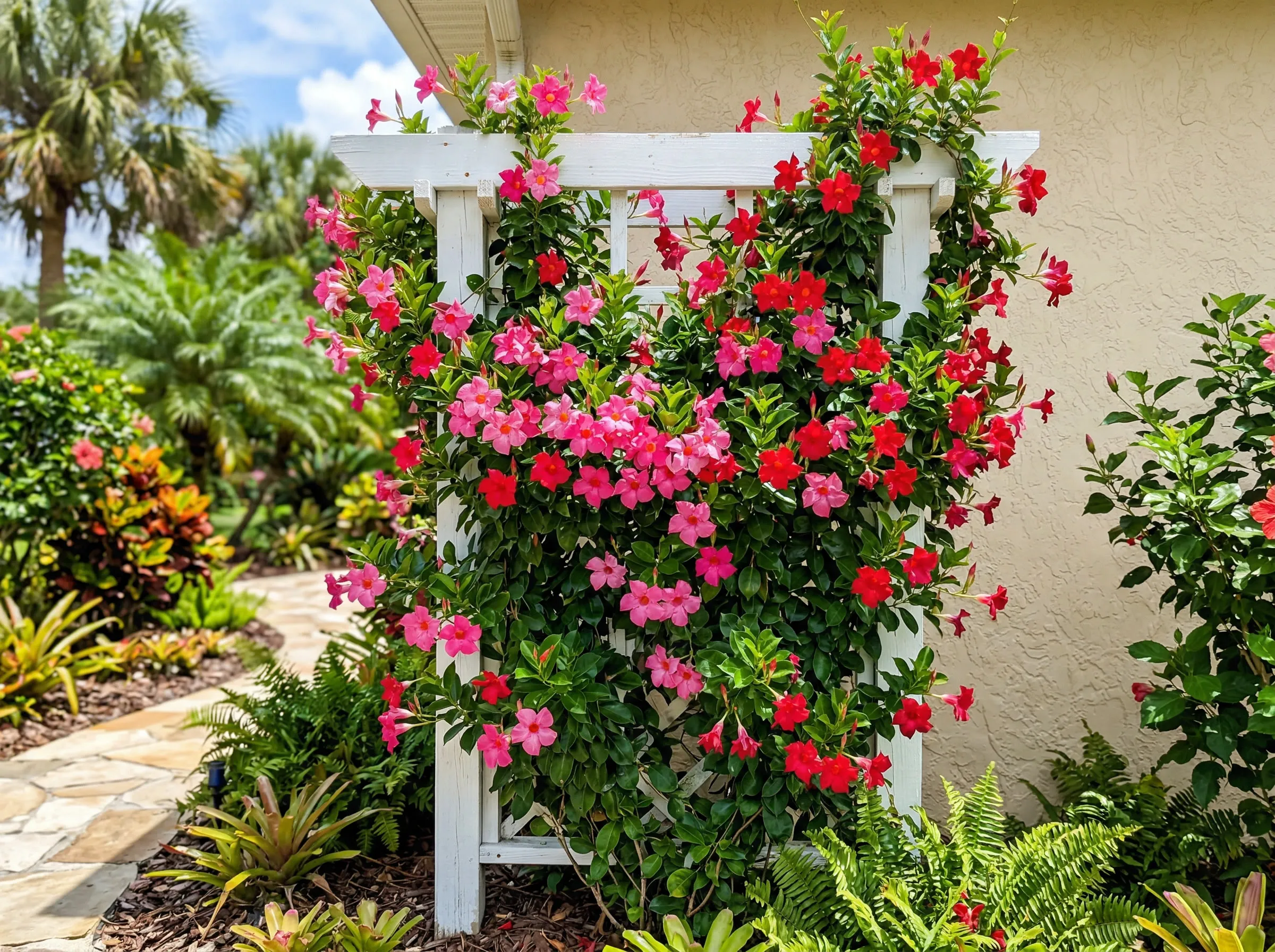
Choose a climbing mandevilla when you want stems to twine around an upright support. Consider a compact, bushier form when you want a smaller plant for a container, hanging basket, or mailbox setting. The distinction matters more than flower color when you are matching a plant to the space you have.
For a buyer in St. Augustine, FL, the best starting point is the actual plant being offered, not a general label. Confirm its growth habit, expected size, and care needs before ordering. For current plant availability or delivery questions, call Tropical Yards at +1 904 526 8345. Ask about the specific form you need rather than assuming that every mandevilla will climb or stay compact.
Match the Growth Habit to the Placement
A climbing form suits a usable upright support, while a compact form may better suit a container or smaller display. Use these tropical plant selection tips to define the space, then ask about the exact type through the tropical plant supply page.
According to UF/IFAS, climbing mandevilla twines as it grows. Twining means that its stems wrap around upright supports, such as poles, wires, or lattice. This is different from a plant that attaches itself directly to a broad wall.
Compact mandevillas grow upright with little twining, according to UF/IFAS. Their stems can creep over the edges of containers or hanging baskets. These smaller, bushier forms were once placed in the genus Dipladenia, but UF/IFAS now includes them in Mandevilla. A familiar name on a tag is therefore not enough to settle the growth-habit question.
Start with the effect you want. A tall trellis display calls for a different plant habit than a pot beside a chair. A mailbox planting also needs a clear goal: do you want stems growing around a support, or a more compact display near its base? The word “mailbox” alone does not identify the right plant.
Make a simple footprint sketch before shopping. The outline below is a planning aid, not a promise of plant size. Add your own measurements and mark the space that must remain open.
- Climbing form: Put the plant at the base of an upright trellis and check how much of the support you can easily reach.
- Compact form: Check the container footprint, room for stems and clearance at the walking edge.
Keep the plant outline separate from the pot or support outline. A nursery container shows the plant's current package, not its future spread. Leave the expected plant outline unfinished until the seller confirms the offered form.
Measure the Support and the Space Around It
Measure both the planting space and the structure the plant may use. For pots and baskets, consult the tropical container gardening guide; for fitting plants into nearby beds and paths, use the plant selection planning guide.
A useful measurement sheet separates what exists now from what the seller still needs to confirm. Record actual dimensions for your site. Do not fill in a mature height or spread by copying the size of a different mandevilla seen elsewhere.
- Trellis or other upright support: Record its height, width, and the arrangement of its upright pieces. Note whether you can reach the growing area for training and pruning. Photograph the support so the seller can understand its shape.
- Mailbox area: Measure the available planting footprint and mark the space needed to use the mailbox. Show nearby walking or access areas on the sketch. Decide which parts of the setting must stay clear.
- Container: Record the pot's width and depth, note its drainage openings, and measure the space around it. Include the area beyond the rim where compact mandevilla stems might extend.
- Hanging basket: Record the basket size, hanging location, and available space below and beside it. Note how you will reach it for watering and other care. Ask whether the specific offered plant suits that setup.
For climbing forms, the support needs to match the way the stems grow. The UF/IFAS guide to vines explains that twining vines twist around upright supports and may need help finding their way along fences or trellises. Do not assume that placing a plant beside a structure completes the training plan.
UF/IFAS also describes guiding new twining shoots sideways through a trellis to improve coverage. Consider whether you want that ongoing task before choosing a long climbing form. A large support can be visually appealing, but its upper reaches still need to fit your care plan.
Bring the measurements and photographs to the buying conversation. They make questions about expected growth more useful than asking only whether a plant is “small” or “large.”
Check Light, Drainage, and Winter Access
Check direct sun, drainage, and your winter plan before choosing either form. For the wider planting context, consult Best tropical plants by category, palms, hibiscus, bougainvillea, ferns, and privacy hedges, then use these container gardening ideas to consider a movable display.
UF/IFAS states that mandevilla needs full sun to flower well. It also notes that compact forms handle a little more shade than larger climbing varieties. Read those points together: greater shade tolerance does not mean that a compact mandevilla will flower equally well in deep shade.
Write down when direct sunlight reaches the proposed spot and when nearby walls, roofs, or trees shade it. A description such as “bright patio” leaves out useful detail. Give the seller your observations and ask how they fit the specific plant under discussion. Do not turn the source's full-sun guidance into an unsupported hourly guarantee.
Drainage matters for both forms. UF/IFAS says mandevilla tolerates a range of soils as long as the soil is well drained. Observe the proposed bed after rain and note any standing water. For a container, check that water has a way to leave the pot. These observations help identify questions; they do not establish that a problem site is suitable.
The source also calls for regular watering and fertilizing. Ask for care directions for the offered plant and your growing setup rather than adopting a fixed schedule from an unrelated container. Record wind exposure as another site condition to discuss, without assuming a tolerance that has not been confirmed.
Freezing temperatures can cause mandevilla to die back, according to UF/IFAS. The source suggests containers that can be brought indoors during winter in colder parts of Florida, or growing plants in the ground as annuals. Neither option promises freeze survival in St. Augustine, FL. If moving a pot is part of your plan, check the route and storage space before choosing the container and support.
Use a Buyer Confirmation Worksheet
Ask the seller to identify the specific offered plant and explain its expected growth before committing to an order. Review the tropical plant categories for purchasing context, with the contact page as secondary navigation for your inquiry.
Keep unknown answers blank. A blank field is more useful than an assumed cultivar name or a size copied from a general search result. The worksheet should connect a real plant to your measured site, not simply collect attractive descriptions.
- Identity and form: Record the name supplied by the seller and ask whether this particular plant is a long twining form or a more compact, bushier form. If the tag says Dipladenia, ask for clarification rather than treating the name alone as a complete answer.
- Expected dimensions: Separate its current size from its expected growth in your proposed setting. Ask what information supports the estimate. Do not enter a mature size until the offered plant has been identified.
- Support and placement: Share the trellis photograph or container measurements. Ask whether the plant's habit fits that setup and what training it may need. Record any unresolved mismatch.
- Care and winter plan: Describe the observed light, drainage, and access. Ask for plant-specific watering and fertilizer guidance, plus any details needed to assess your proposed winter arrangement.
- Purchase and delivery: Confirm current availability, the exact plant being quoted, and whether delivery is available for the address. Ask for current terms rather than assuming stock, price, or delivery coverage.
A plant with flowers today still needs to fit the job you want it to do. If the form remains unclear, request more information before treating the purchase as a trellis solution or compact container choice.
Tropical Yards supplies plants and offers delivery subject to confirmation. Planting, support setup, training, and ongoing care remain tasks for the buyer or a separately hired provider. A plant inquiry should not be treated as an installation booking.
Choose Provisionally, Then Confirm the Plant
Use your measurements to make a shortlist, then confirm the identity of the plant on offer. Compare the fit with the plant selection guide and revisit the container gardening guide if a movable pot better matches your care plan.
| Site and goal | Provisional choice | What to confirm | Pause when |
|---|---|---|---|
| Cover a reachable upright trellis | Long twining form | Growth habit, expected size, and training needs | The support or plant identity is unclear |
| Create a smaller patio display | Compact form | Expected spread and container suitability | Only the nursery pot size is known |
| Plant near a mailbox | Compact or climbing, depending on the goal | Available footprint and intended support | Growth would conflict with required access |
| Use a hanging basket | Compact form to discuss | Offered plant's habit and basket fit | Watering and care access are unresolved |
| Buy a plant labeled only mandevilla | Stop and confirm | Specific form and expected growth | The label is the only available information |
The table leaves room for different answers at the same type of site. A mailbox can support a climbing display or sit beside a compact planting. A container can hold a compact plant or be part of a climbing setup. The deciding factors are the actual growth habit, the usable space, and the care you can provide.
Do not use pruning as a substitute for resolving a major size mismatch. UF/IFAS describes pinching tips to encourage bushier growth, but that advice does not establish that a long climbing form will behave like a compact cultivar.
Before ordering, put the plant identity, site measurements, and unresolved questions together. Call +1 904 526 8345 to ask Tropical Yards about current mandevilla availability or delivery. Confirm the exact offered plant before relying on a form label, flower color, or photograph.
Frequently asked questions
How can I tell whether the mandevilla being offered is a climbing or compact form?
Ask the seller to identify the specific plant and confirm its growth habit. UF/IFAS describes climbing forms as having twining stems that wrap around upright supports. Compact forms grow upright with little twining and may creep over container edges. Do not rely only on the word mandevilla, a flower photograph, or the plant's current nursery size.
Do I need a trellis or other support for every mandevilla?
No. Compact mandevillas can suit containers or hanging baskets without serving as tall climbing displays. Long twining forms need an appropriate upright support when grown upward. Confirm the offered plant's habit before choosing a structure. UF/IFAS notes that twining vines may need help finding their way along a fence or trellis.
What should I measure before choosing a compact mandevilla for a container or mailbox?
Measure the container or planting footprint, then record the surrounding space that must remain clear. Include room beyond a container's rim and access around a mailbox. Ask the seller for the specific plant's expected dimensions. Its current pot size does not establish its eventual spread or prove that it will fit the location.
How much direct sun and drainage should I check at the planting site?
UF/IFAS says mandevilla needs full sun to flower well and well-drained soil. Compact forms tolerate a little more shade than larger climbing forms, but that is not a deep-shade recommendation. Record direct-light periods and observe the area after rain. Share those observations with the seller and ask whether the plant fits your growing conditions.
What should I ask the seller to confirm before ordering a specific mandevilla?
Confirm the plant's identity, climbing or compact habit, expected dimensions, support needs, and care guidance. Also ask about current availability and delivery for your address. Explain your winter plan because UF/IFAS describes dieback after freezing temperatures. Do not assume that either form is guaranteed to survive a freeze or that a named cultivar is currently stocked.