
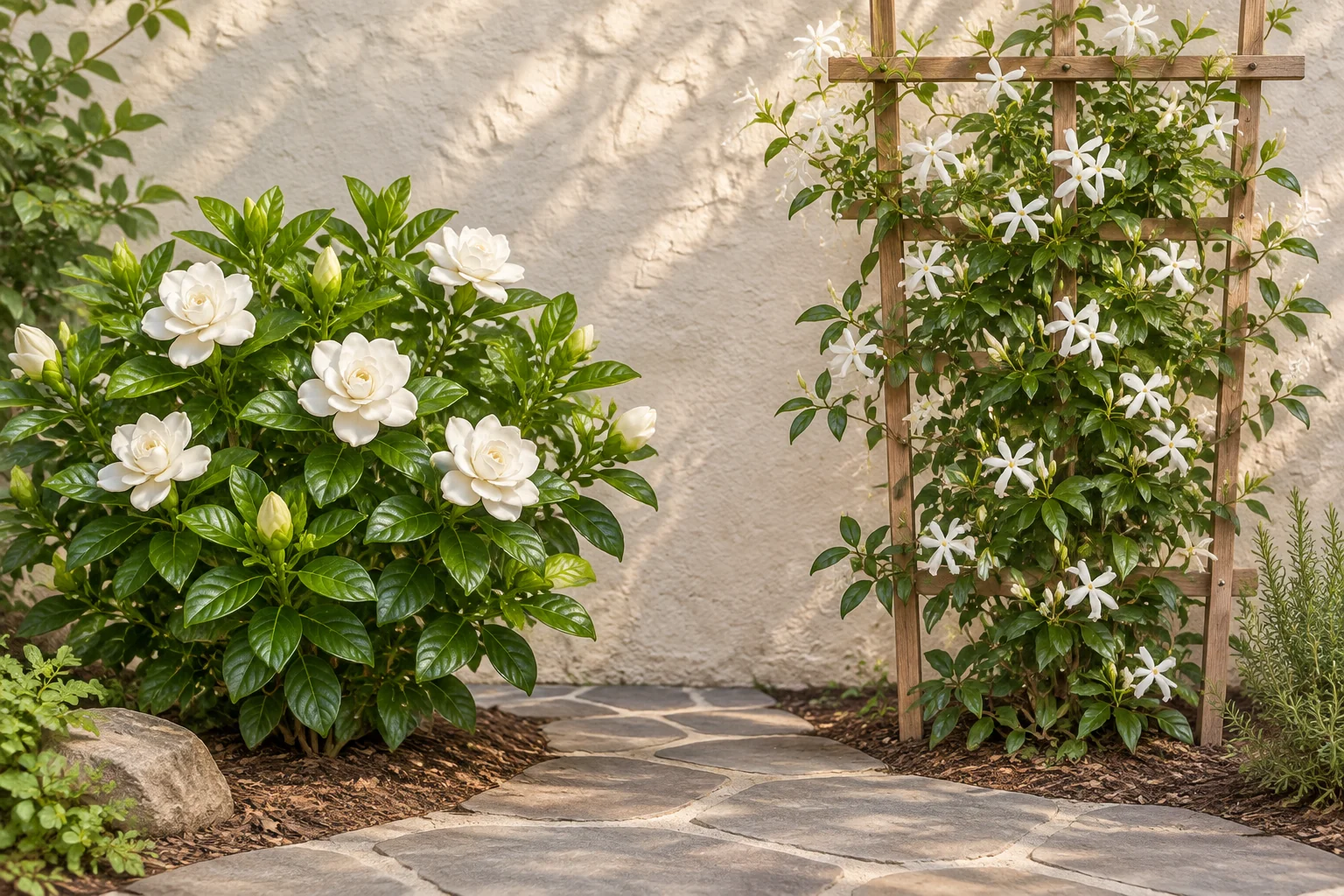
Gardenia and star jasmine can both bring fragrant flowers near a patio or path. The first choice, though, is about plant shape. Gardenia is an evergreen shrub. Star jasmine is an evergreen, twining vine. A space that suits one does not automatically suit the other, even when both appeal to you.
For a patio in St. Augustine, FL, start with the room available, the presence of an upright support, and the access you need to preserve. Then check the exact plant before ordering. Common names alone do not settle mature size, light needs, or winter suitability.
Place this comparison within your wider planting plan with Best tropical plants by category, palms, hibiscus, bougainvillea, ferns, and privacy hedges. Start with the broader landscape, then focus on whether you want a freestanding shrub or a twining vine.
Measure the Patio Edge Before Choosing a Plant
Choose the planting form that fits the space you can actually give it: a shrub needs a suitable footprint, while a climbing vine needs both planting room and an upright support. Use the plant selection tips to organize your measurements and growing conditions, then check the plant purchasing page before asking about a specific plant.
Measure the destination, not just the empty patch where a nursery pot could sit. Include the space beside the planting area and above it. A plant may fit at purchase yet be the wrong long-term shape for the path, chair, or doorway nearby. Record the clear space you want to keep rather than guessing from a photograph.
- Measure the available bed width and length beside the patio or path.
- Note overhead space, including anything that limits the intended plant height.
- Mark the walking route and the room needed to move chairs.
- Record whether a sturdy upright support already exists.
- Identify where you can reach the plant for training or pruning.
- Take photographs that show the whole setting, not only the planting hole.
For a gardenia, sketch the outline of a shrub within that space. For star jasmine, sketch the upright area you want the vine to occupy as well as its planting location. These are planning outlines, not mature-size claims. The exact dimensions must come from information for the plant you are considering.
If there is no support and you do not want to add one, that is a strong reason to focus on the shrub option. If the main goal is greenery on a trellis, investigate the vine instead. Neither choice should depend on reducing the clear route you need beside it.
Compare the Shrub and Vine Side by Side
Gardenia fits a shrub-shaped planting plan; star jasmine fits a plan for a twining vine on an upright structure. Keep that distinction central when reviewing the regional tropical landscaping guide and the plant sales information. Neither page replaces confirmation of the exact plant offered.
UF/IFAS describes gardenia and star jasmine as different growth forms. Gardenia, Gardenia jasminoides, is an evergreen shrub with glossy, dark green foliage. Star jasmine, Trachelospermum jasminoides, is a fast-growing, evergreen twining vine that can grow on structures such as trellises and arbors. Those botanical names identify the plants being compared here, not confirmed local inventory.
| Decision point | Gardenia | Star jasmine | Confirm before buying |
|---|---|---|---|
| Plant form | Evergreen shrub | Evergreen twining vine | Exact plant identity |
| Space planning | Plan for the selected shrub's mature outline | Plan planting room and upright coverage | Mature height and width |
| Upright structure | Not chosen to twine around a trellis | Stems twist around upright supports | Suitable support and training access |
| Winter question | Grafted types have a specific cold-hardiness caveat | UF/IFAS says it can be planted throughout Florida | Suitability for the property's exposure |
The climbing method matters. In its guide to vines, UF/IFAS explains that twining vines such as star jasmine twist their stems around upright supports. They may need help finding their way along a fence or trellis. Do not assume an empty vertical surface is already a suitable climbing arrangement.
UF/IFAS also advises periodic pruning to keep vines in bounds. If you choose star jasmine, include access for that work in the plan. Its upright form does not remove the need to manage its growth. If you prefer a shrub outline without vine training, compare gardenia selections that fit the measured space.
Set Realistic Fragrance and Flowering Expectations
Choose between these plants for their documented scent and flowering traits, but do not treat either as a promise of constant patio fragrance. Connect the choice to your daily use of the space with plant selection tips and the broader tropical planting guide.
According to UF/IFAS, gardenia flowers have a strong, sweet scent. It describes star jasmine flowers as strongly fragrant, sometimes sweet or vanilla-like. These descriptions help explain why both plants belong in this comparison. They do not establish which scent you will prefer or how strong either will seem from a particular chair.
For star jasmine, UF/IFAS says the blooms tend to be more fragrant at night. It also states that the plant blossoms in early spring and summer, with tiny white flowers shaped like pinwheels or stars. That makes evening use worth considering when you decide where a trellis would be most useful.
Do not turn those seasonal descriptions into a fixed flowering calendar for your property. Avoid planning around a fixed first bloom date or continuous flowers. Its gardenia passage also does not provide a bloom schedule for every cultivar. Ask about the flowering habit of the exact gardenia under consideration.
Separate the flowering experience from the year-round layout. Both plants are described as evergreen, so consider whether you want a shrub beside the patio or foliage trained on a support when flowers are absent. That choice remains relevant even if fragrance is the reason you started shopping.
If you can smell a flowering example before choosing, use that experience to judge your own preference. Still confirm its identity. A plant labeled only “jasmine” is not enough to establish that it is the star jasmine described here.
Check Light and Winter Exposure Before Ordering
Gardenia has documented light guidance and a specific warning about grafted plants; the exact star jasmine selection still needs a site-specific light and winter check. Review the plant selection guidance, then use the contact information to prepare a focused purchasing inquiry rather than assuming both plants suit the same spot.
According to the UF/IFAS gardenia guidance, gardenias can grow in full sun or partial shade in USDA Hardiness Zones 7b to 11b. Hardiness zones describe broad winter temperature ranges. This range is useful background, but it does not settle the suitability of every gardenia selection for every exposed patio edge.
The same source says gardenia cultivars vary from 2-15 feet tall. A cultivar is a named plant selection with particular traits. That height range shows why “gardenia” alone is not a size specification. It also provides no single mature width to apply to an unspecified plant. Ask for both dimensions before setting its final position.
For star jasmine, the source states that it can be planted throughout Florida. That broad statement is not a guarantee of winter performance at a specific property. Nor does the passage supply a light prescription for every proposed trellis location. Confirm both points for the exact plant instead of borrowing gardenia's light guidance.
Bring a simple record of the planting area's sun and shade at different times of day. Also describe whether the location is open or sheltered. These observations make your questions more useful without pretending that a short comparison can resolve every site condition.
Complete a Patio-Edge Decision Worksheet
Buy only after the plant's identity, mature dimensions, site needs, and support plan line up with your measurements. Use the plant purchasing information for context, and keep the contact page as secondary navigation while you prepare the details for a phone inquiry.
- Write the desired form. Choose a shrub outline beside the patio or a twining vine on an upright support. If neither fits clearly, revisit the layout.
- Record the usable space. Include bed dimensions, overhead limits, and the path or seating space that must stay clear.
- Resolve the support question. For star jasmine, identify the intended structure and how you will reach the stems for training and pruning.
- Confirm the exact plant. Ask for the gardenia cultivar or confirmation that the jasmine is Trachelospermum jasminoides. Request mature height and width.
- Resolve site questions. Describe the light and winter exposure. For gardenia, ask whether the plant is grafted and suitable for the proposed setting.
- Check the purchase details. Ask about current availability and delivery options without assuming a particular species, cultivar, or size is offered.
If star jasmine is the better match, plan for training from the start. UF/IFAS recommends weaving new shoots of twining vines sideways through a fence or trellis as they grow. UF/IFAS describes directing stems downward after they reach the top of their support. This helps address the tendency for climbing growth to leave a sparse base.
If gardenia is the better match, the next step is selecting a plant whose documented dimensions fit. Do not choose an unspecified gardenia because one small example looks right in its nursery pot. The source's broad height range makes cultivar confirmation especially important beside a narrow path.
For a plant availability or delivery inquiry, call Tropical Yards at +1 904 526 8345. Have your measurements, photographs, and plant identity questions ready. Tropical Yards supplies plants and offers delivery; planting, support construction, training, and other landscape work remain with you or your chosen contractor.
The final decision should be easy to state: the chosen plant fits the intended form, preserves access, and has no unresolved size or site question. If one of those points remains uncertain, pause the order and get the missing information first.
Frequently asked questions
Which plant is a twining vine, and what support does it need?
Star jasmine, Trachelospermum jasminoides, is the twining vine. UF/IFAS explains that its stems twist around upright supports and may need help finding their way along a fence or trellis. Plan the support before buying, and leave access for training and periodic pruning. Gardenia is an evergreen shrub, not the climbing option.
How much room should I reserve for a gardenia?
Confirm the cultivar before assigning a final space. UF/IFAS reports gardenia heights ranging from 2-15 feet across cultivars, not one size for every gardenia. That range does not provide a standard mature width. Measure your bed and clear walking route, then compare them with the selected plant's documented height and width.
When does UF/IFAS say star jasmine flowers?
UF/IFAS says star jasmine blossoms in early spring and summer. Its tiny white flowers resemble pinwheels or stars, and the blooms tend to be more fragrant at night. Treat this as seasonal guidance rather than a promise of exact flowering dates, continuous flowers, or a particular scent strength at your property.
What should a North Florida buyer ask about a grafted gardenia?
Ask whether the gardenia is grafted and whether that specific selection suits the proposed site. UF/IFAS warns that grafted varieties are less cold hardy and may not be suitable for North Florida. Confirm the cultivar and discuss winter exposure rather than relying only on a broad hardiness-zone range for gardenias.
How can I add fragrance near a path without blocking access?
Measure the planting area and mark the walking space that must remain clear. For gardenia, confirm the selected shrub's mature dimensions. For star jasmine, plan both its planting location and upright support, with room to reach the stems. Do not assume that a small nursery plant or a vertical layout eliminates future space needs.