
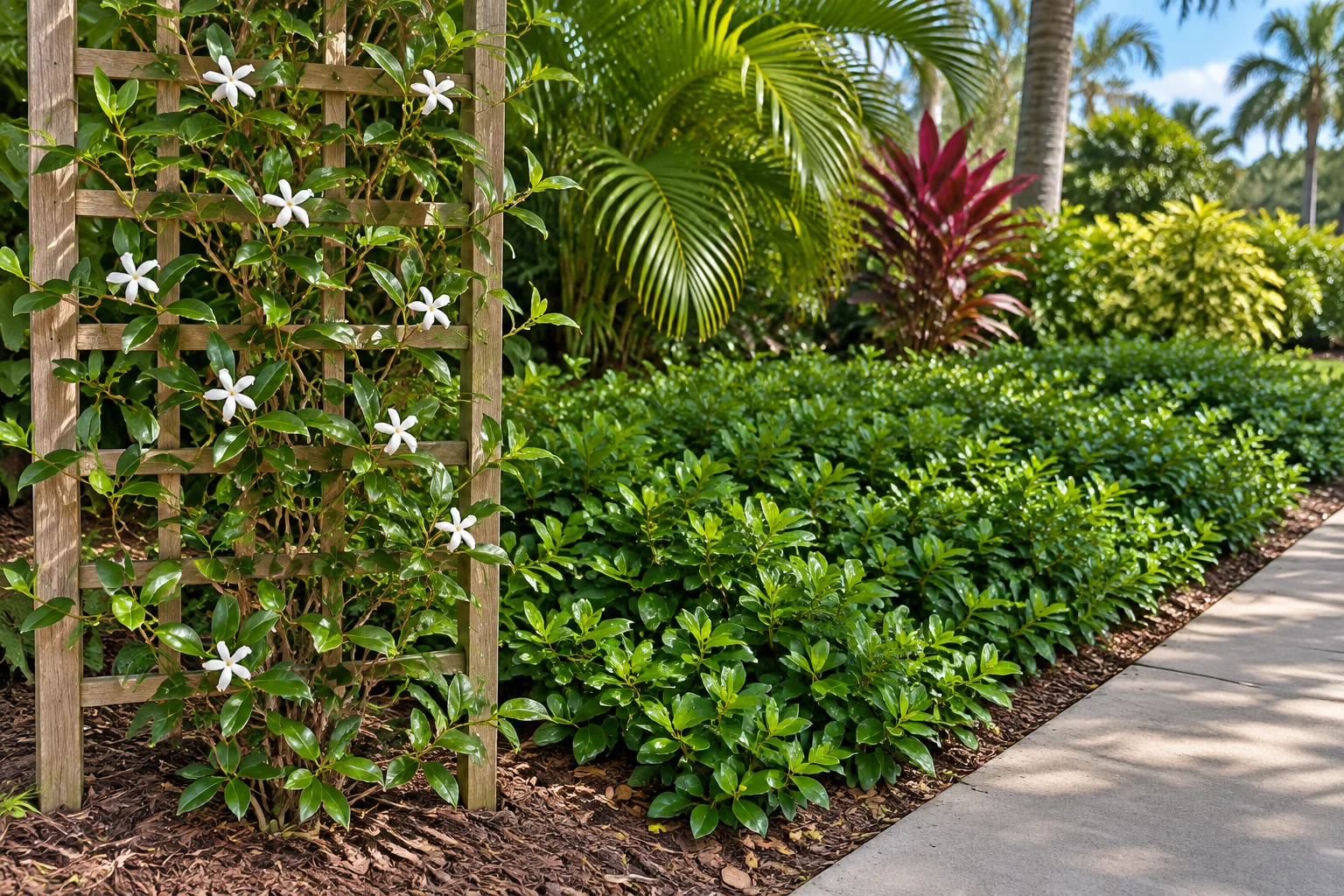
Choose star jasmine for a fragrant, twining vine on a support. Choose Asiatic jasmine for a low, spreading groundcover where people rarely walk. Their similar common names can cause confusion, but they describe two different plants with different landscape roles.
For a yard in St. Augustine, FL, start with the job you want the plant to do. A trellis beside a sitting area presents a different need from a broad bed beneath trees. Confirm the plant’s identity, map the space, and weigh scent against ground coverage before you order. Neither a familiar name nor an attractive nursery photo answers all those questions.
Confirm Which Jasmine You Are Buying
Confirm the plant’s identity before choosing care advice or placing an order. Use the landscape plant selection guide to organize your site questions, then use the Tropical Yards contact page as secondary navigation when you are ready to ask about a specific plant.
Star jasmine is Trachelospermum jasminoides. Asiatic jasmine is Trachelospermum asiaticum. These botanical names identify the plants more clearly than the word jasmine alone. UF/IFAS identifies star jasmine in its fragrance garden guidance and Asiatic jasmine in its groundcover guidance. Check the label against the plant you intended to buy rather than assuming all jasmine has the same growth habit.
The UF/IFAS Asiatic jasmine profile describes an evergreen, vine-like woody plant with small, leathery leaves. Its stems spread across the ground and form a dense, tangled blanket. It grows between 6 and 18 inches tall and at least 3 feet wide. Those dimensions describe a groundcover role, not the upright flowering feature many shoppers picture when they hear jasmine.
A listing for a broad plant category is not proof that a particular species or cultivar is currently available. Tropical Yards lists jasmine among its plant categories, but the exact type and current availability need phone confirmation. Keep that purchasing question separate from whether the plant would suit your yard.
Match the Plant to the Space It Must Fill
Choose according to the space: an upright support for a twining vine or a low bed for spreading cover. Use Best tropical plants by category, palms, hibiscus, bougainvillea, ferns, and privacy hedges to place that choice within the wider yard plan, and consult the Northeast Florida shade-plant guide when considering a shaded area.
Star jasmine needs something its stems can wrap around when used as a vertical feature. The UF/IFAS guide to vines explains that twining vines climb by twisting their stems around upright supports. They may need help finding their way along a fence or trellis. A blank wall and a suitable twining support are not the same planting setup.
Before shopping, make a simple sketch that shows the intended growing area and how you use the space around it. Include more than the planting spot itself:
- Mark the trellis, arbor, or other intended support for a vertical feature.
- Outline the full bed if you want low ground coverage.
- Show paths, gates, seating, and places you need to reach.
- Mark edges where spreading stems would need trimming.
- Note where people regularly cut across the proposed bed.
For Asiatic jasmine, the key question is whether you want a planted bed rather than a walking surface. Its low height does not make it a lawn that can take regular use. Keep the route to a gate, hose, or sitting area outside the groundcover where practical. If that is not possible, reconsider the layout before selecting the plant.
For star jasmine, think about future access to the support. UF/IFAS recommends periodic pruning for vines to keep them within bounds. A support you cannot readily reach creates a maintenance issue even if the vine suits the intended look. Choose a manageable feature rather than assuming fast growth will solve every design problem.
Choose Fragrance or Foliage With Realistic Expectations
Choose star jasmine when fragrance is a main goal, and choose Asiatic jasmine for its groundcover form rather than expected flowers. Keep those priorities in your plant selection checklist while reviewing the Tropical Yards plant categories; a category listing does not confirm the exact plant offered.
According to UF/IFAS, star jasmine is a fast-growing, evergreen, twining vine with strongly fragrant flowers. The scent is sometimes described as sweet or vanilla-like and tends to be stronger at night. Its small white flowers resemble pinwheels or stars, and the source places bloom in early spring and summer.
That makes star jasmine the better match between these two plants for someone seeking a scented vertical feature. Consider where you spend time outdoors and whether the support fits that area. Seasonal flowers are not a promise of constant scent, though. Base the decision on the whole plant and its upkeep, not only on a photograph taken during bloom.
Asiatic jasmine has small, fragrant, pinwheel-shaped yellow flowers, but UF/IFAS says it rarely blooms in Florida. Do not buy it expecting a regularly flowering carpet or dependable fragrance beside a patio. Its useful feature here is the low, spreading foliage described in the source, not an assumed display based on the jasmine name.
If scent is essential, write it down as a requirement before shopping. If covering a low bed matters more, note that instead. This simple distinction helps prevent a last-minute substitution that looks reasonable on a plant label but does not meet the original goal.
Check Traffic, Light, and Maintenance Before Choosing
Check how the area is used and how much trimming you will accept before choosing either plant. Review the shade-plant planning guide for broader planting choices, and use the contact page to support a phone inquiry about the exact plant under consideration.
Asiatic jasmine should be used in low-traffic areas because it does not withstand foot traffic well. UF/IFAS also says it grows well in both dense shade and full sun. That broad light tolerance can make it worth considering where turfgrass struggles, but it does not remove the need to check the bed’s boundaries, walking routes, and access needs.
Do not transfer that light guidance to star jasmine simply because the names are similar. The supplied fragrance source says star jasmine can be planted throughout Florida, but that is not a detailed light prescription for every site. Describe the actual sun and shade pattern when asking for advice about the confirmed plant.
For Asiatic jasmine, UF/IFAS recommends starting transplants in cleared, weed-free soil. Plants should be placed one and a half feet apart, and the source allows two growing seasons for complete coverage. Treat that as a planning expectation, not a guaranteed finish date. A new planting should not be judged against a photograph of a mature, filled-in bed.
Water needs also change with establishment. Asiatic jasmine prefers well-draining, moist soil when first planted. Once established, it is drought tolerant, and UF/IFAS says extra irrigation is rarely needed with regular rainfall. That does not mean a newly planted bed can be treated as established from the first day.
Low maintenance is not no maintenance. The source calls for occasional edge trimming and annual spring mowing and pruning to keep Asiatic jasmine attractive and controlled. It also warns that too much water, sun, or fertilizer can make it aggressive and unruly. More inputs are not automatically a way to create a better-looking bed.
Star jasmine brings a different task: managing growth on its support. UF/IFAS recommends weaving new shoots sideways through a trellis or fence and continuing as the vine grows. Once stems reach the top, they can be directed downward. Early training helps avoid a vine that races upward while leaving the lower part sparse.
Make the Choice, or Hold Until the Details Are Clear
Choose only when the plant name, intended role, and care needs line up. Use the plant sales page for broad category information and the Tropical Yards contact page as secondary navigation. If the identity or fit remains uncertain, hold the order and confirm those details first.
| Your Priority | Star Jasmine | Asiatic Jasmine | Next Step |
|---|---|---|---|
| A vertical feature | Twining vine for a suitable support | Described as a spreading groundcover | Map the support and pruning access. |
| Fragrant flowers | Strongly fragrant seasonal flowers | Rarely blooms in Florida | Choose for realistic bloom expectations. |
| A low planted bed | Not the vertical role sought here | 6–18 inches tall; poor foot-traffic tolerance | Keep regular walking routes outside the bed. |
| An unclear jasmine label | Identity not established | Identity not established | Hold and confirm before ordering. |
Bring a short set of notes to the buying conversation. Clear questions are more useful than asking for whichever jasmine is easiest to grow:
- State the botanical name you want confirmed.
- Describe whether the goal is vertical growth or low ground coverage.
- Share the area’s light pattern, walking routes, and boundaries.
- Explain whether fragrance is essential or simply a bonus.
- Ask about current availability and delivery for the confirmed plant.
Keep quantity questions separate from identity questions. A groundcover bed requires a different layout discussion from a vine on a support. Measure the proposed area and bring the sketch, but do not turn those measurements into an order until the plant and intended use are settled. Do not apply Asiatic jasmine spacing to star jasmine.
Call +1 904 526 8345 to ask Tropical Yards about the exact jasmine type, current availability, a current quote, and delivery coverage. Plant categories do not guarantee stock or a particular species. Plan separately for planting and ongoing care, and keep the buying decision tied to the role your yard actually needs.
Frequently asked questions
Are star jasmine and Asiatic jasmine the same plant?
No. Star jasmine is Trachelospermum jasminoides, while Asiatic jasmine is Trachelospermum asiaticum. Their similar common names do not mean they have the same landscape role. In this comparison, star jasmine is the twining vine for a support, while Asiatic jasmine is the low, spreading groundcover. Confirm the plant’s identity before ordering.
Which jasmine is described as a fragrant twining vine?
UF/IFAS describes star jasmine as a fast-growing, evergreen, twining vine with strongly fragrant white flowers. Its scent is sometimes described as sweet or vanilla-like and tends to be stronger at night. It can grow on supports such as trellises or arbors, but it needs training and periodic pruning.
Which jasmine is a low groundcover, and can people walk on it?
Asiatic jasmine is the low groundcover in this comparison. UF/IFAS describes it as growing between 6 and 18 inches tall and spreading at least 3 feet wide. It does not withstand foot traffic well, so reserve it for low-traffic beds rather than regular walking routes or an actively used lawn.
Should I expect Asiatic jasmine to flower often in Florida?
No. UF/IFAS says Asiatic jasmine rarely blooms in Florida, although its small yellow flowers are fragrant. Choose it for its spreading foliage and groundcover role, not for a dependable flower display or scent. Between these two plants, star jasmine better matches a goal of fragrant flowers on an upright support.
What plant name should I confirm with the seller before ordering?
Ask whether the plant is Trachelospermum jasminoides, star jasmine, or Trachelospermum asiaticum, Asiatic jasmine. If the label gives only a common name, ask the seller to establish the identity before proceeding. Also confirm the exact type and current availability. A broad jasmine category listing does not establish that either species is currently offered.