 Tropical
 2026-04-02
How to Protect Your Tropical Plants from Florida Freezes
How to Protect Your Tropical Plants from Florida Freezes
Florida's tropical plants face their biggest threat not in summer's heat and humidity, but during the brief, sharp freeze events that strike our state each winter. In northeast Florida — St. Augustine, Ponte Vedra, Palm Coast — Zone 9A and 9B gardeners can expect temperatures to drop below 32°F on average 5–15 nights per year, with occasional hard freezes dipping into the low 20s every few years. Knowing exactly when and how to protect your plants — and what to do after freeze damage occurs — is the difference between a thriving tropical landscape and a costly recovery project.
This guide covers historical freeze data for northeast Florida, a detailed preparation timeline, zone-specific advice, post-freeze recovery, cold-hardiness charts for 20+ plants, and the economics of protection versus replacement. For cold-hardy plant selections that minimize freeze risk, visit our cold-hardy tropical plants page.
Historical Freeze Data for Northeast Florida
Understanding the freeze history of your area is the foundation of smart cold-protection planning. Northeast Florida experiences significantly different winters than South Florida, and even within our region, a few miles inland can mean 5–8°F colder temperatures than coastal zones.
St. Augustine / Ponte Vedra (Zone 9B, coastal): Average of 3–8 frost nights per year. Hard freezes below 28°F occur in roughly 2–3 out of every 10 winters. The most damaging recent events include the December 2010 freeze (lows of 24°F in St. Augustine), the January 2018 "Bomb Cyclone" (lows of 20–22°F across St. Johns County), and January 2022 (multiple nights below 28°F). These events define the realistic worst-case scenario for protection planning.
Inland Zones (Zone 9A — western St. Johns, Flagler, and Putnam counties): Average of 10–20 frost nights per year. Hard freeze events below 25°F occur more frequently — approximately 4–5 out of 10 winters. Inland locations in our region are typically 5–10°F colder on clear, calm freeze nights than coastal areas. If you're more than 3–5 miles from the Atlantic or St. Johns River, plan your cold protection as if you're in Zone 9A regardless of what the general maps show.
The National Weather Service's historical climate data for Jacksonville and St. Augustine shows that the single coldest recorded temperature for the St. Augustine area is approximately 18°F, set during the January 1985 freeze — a once-in-a-generation event, but a useful worst-case benchmark for permanent cold-protection infrastructure decisions.
Preparation Timeline: 72, 48, and 24 Hours Before a Freeze
When a freeze is forecast, preparation should begin well in advance — not the afternoon of the cold night. Here's a practical hour-by-hour preparation framework:
72 Hours Before (When Freeze Watch Is Issued)
- Gather all frost protection supplies: frost cloth, burlap, old sheets, stakes, and clamps or clips to secure coverings.
- Identify which plants need protection based on the cold-hardiness chart below.
- Check that outdoor faucets and irrigation lines are functional — you may want to run irrigation before the freeze to warm the soil.
- Begin moving any containerized tropical plants — hibiscus, crotons, Mandevilla — indoors or to a garage/shed. Do this gradually; sudden moves from outdoors to a heated interior can shock plants.
- Water plants thoroughly. Moist soil holds heat far better than dry soil — this is one of the simplest and most effective cold-protection steps most homeowners skip.
48 Hours Before (When Freeze Warning Is Issued)
- Complete all container plant moves. Any plant rated below 30°F should be indoors or in a protected structure.
- Stake support structures around plants that will need covering — install the framework before the cold arrives so you're not working in the dark on a cold night.
- Apply a thick layer of mulch or coquina shell around the root zones of all in-ground tropical plants. A 3–4 inch layer over root zones significantly reduces soil temperature loss.
- Fill water containers (large buckets, garbage cans) that you can place near tender plants — water releases heat as it freezes, slightly warming the immediate microenvironment.
24 Hours Before (Evening Before the Freeze)
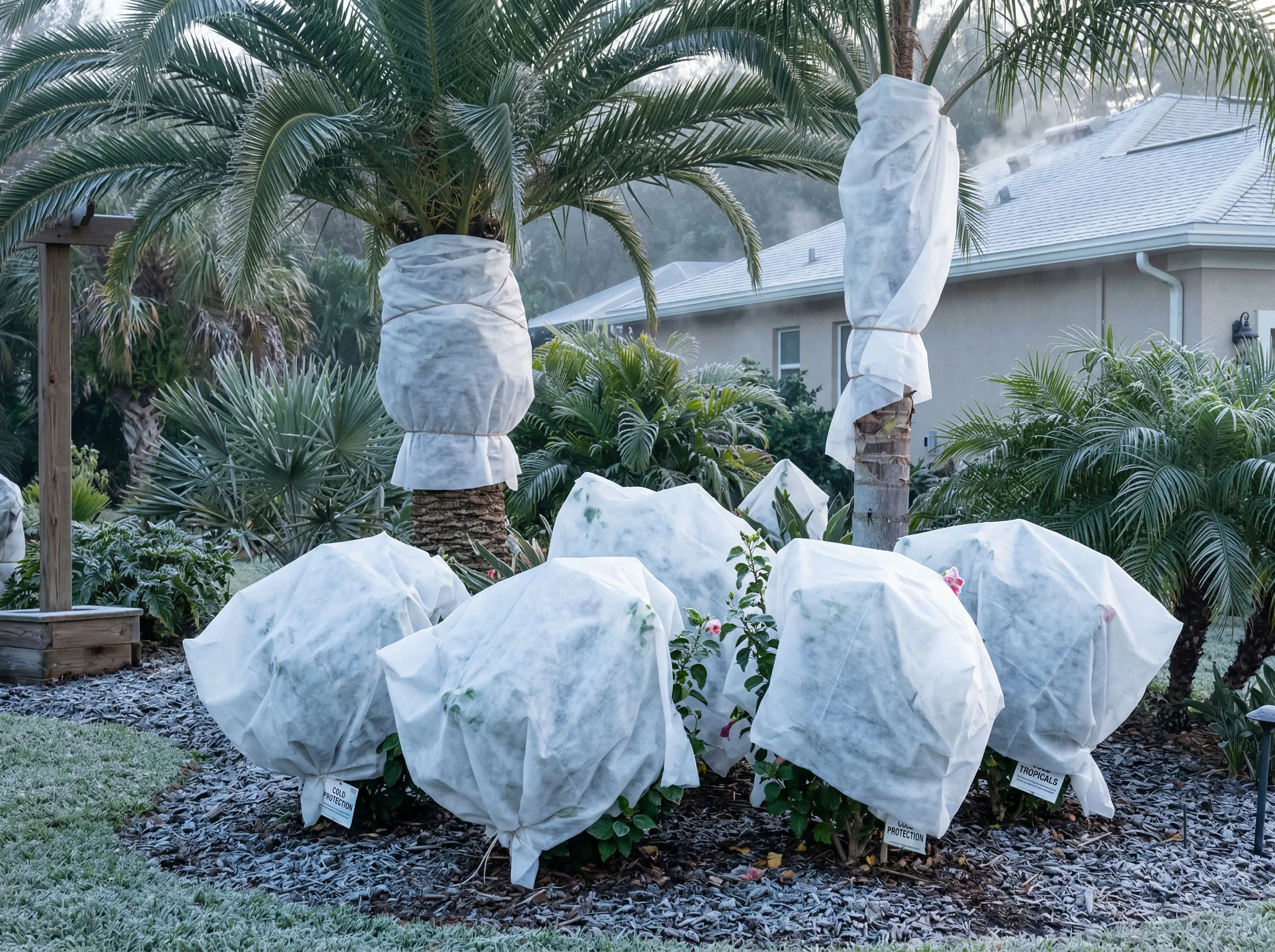
- Cover all frost-sensitive plants before sunset — not after dark. Once temperatures drop, covering cold leaves against cold cloth provides no benefit; you need to trap existing warmth under the cover.
- Use frost cloth or agricultural fleece (not plastic sheeting alone — plastic touching leaves accelerates cold damage). Drape covers all the way to the ground to trap soil heat.
- Secure covers against wind with stakes, bricks, or landscape staples — a blown-off cover at 2 AM on a 25°F night defeats the purpose entirely.
- Run any outdoor irrigation systems in "freeze mode" — a slow drip on sensitive plants can protect them through brief near-freezing conditions (this works for temperatures above 28°F; it is not effective during sustained hard freezes).
- String outdoor Christmas lights under frost cloth for additional warmth for most tender specimens.
Zone-Specific Advice: 9A vs. 9B
Zone 9B (coastal areas): In a typical winter, basic frost cloth protection is sufficient for most tropical plants. Focus your investment on protecting high-value specimens like large Bougainvillea, mature hibiscus, and established Mandevilla. You can generally plant most of the tropical species in our catalog with confidence that most winters won't cause significant damage.
Zone 9A (inland areas): Plan for harder freeze events as a regular occurrence. In Zone 9A, plants rated to 28°F are marginal — they'll survive most years but expect damage or loss in 3–4 out of 10 winters. Invest in more cold-hardy species as your permanent landscape base (Sabal Palm, Coontie, Agapanthus, Plumbago, Muhly Grass) and treat cold-sensitive tropicals (Croton, tropical Hibiscus, Mandevilla) as seasonal plants that you're prepared to protect aggressively or replace. Our cold-hardy tropical plants guide is specifically curated for inland Zone 9A gardeners.
Cold-Hardiness Chart: 20+ Tropical Plants
- Sabal Palm: 15°F — fully hardy in all NE Florida zones
- Windmill Palm: 5°F — most cold-hardy ornamental palm available
- Pindo/Jelly Palm: 12°F — excellent cold tolerance for a feather palm
- Coontie: 15°F — reliably hardy throughout Zone 9
- Agapanthus: 20°F — hardy in all NE Florida zones
- Plumbago: 25°F — usually survives, may die back and regrow
- Firebush: 28°F — top-kills below 28°F but resprouts from roots
- Liriope: 0°F — virtually indestructible in Florida winters
- Ornamental Grasses (Muhly, Fakahatchee): 20°F — very cold hardy
- Sylvester Date Palm: 20°F — hardy in Zone 9 with minimal protection
- European Fan Palm: 10°F — outstanding cold hardiness
- Queen Palm: 25°F — damaged below 25°F; marginal in Zone 9A
- Ixora: 30°F — dies back below 30°F; resprouts in Zone 9B
- Tropical Hibiscus: 28°F — protect below 32°F; recovers from root in Zone 9
- Bougainvillea: 28°F — top-kills in hard freezes; vigorous root resprouter
- Mandevilla: 30°F — protect below 40°F; dies to ground but may resprout
- Croton: 32°F — very cold sensitive; move indoors or replace
- Pygmy Date Palm: 28°F — marginal in Zone 9A; protect during freezes
- Bird of Paradise: 24°F — usually survives with damage, recovers well
- Heliconias: 28°F — tops die back; resprout vigorously in spring
- Banana (Musa spp.): 28°F — cut to ground after freeze; returns from corm
- Ginger (ornamental): 25°F — dies back but rhizomes survive to Zone 8B
Post-Freeze Recovery: What to Do After a Hard Freeze
The week after a hard freeze is not the time to make dramatic decisions. Florida freeze recovery follows predictable patterns that require patience above all.
Immediately after the freeze: Remove frost cloth covers once temperatures rise above 40°F. Assess surface damage but do not prune yet. Damaged leaves and stems, however ugly, provide some insulation for the plant's crown and roots if additional cold is forecast in the same week.
1–2 weeks after: Damage continues to become apparent as freeze-killed cells collapse. Brown, mushy foliage is dead; firm green tissue is alive. The key question is whether the growing point (the crown of the plant, the bud at the center of a palm, the root crown of a shrub) survived. Gently scratch the bark of a stem with your fingernail — green tissue beneath the bark is alive; brown, dry, or mushy tissue is dead.
4–8 weeks after: New growth emerging from the base or crown is definitive evidence of survival. Do not prune suspected-dead plants until you see clear signs of new growth or until 6–8 weeks have passed without any green signs. Many plants that look completely dead will push new growth from roots in March and April — patience prevents the mistake of removing plants that would have recovered.
When to prune after a freeze: Once new growth is visible, prune dead stems back to just above the lowest point of live growth. Make clean cuts with sterilized tools. Remove cut material from the garden to reduce fungal disease risk on exposed, damaged tissue.
When to Replace vs. Wait
Experienced Florida gardeners know the difference between "freeze-dead" and "freeze-dormant." Here are practical guidelines:
- Replace immediately if: the root crown is mushy and completely brown when dug, a palm's center bud is brown and pulls out with no resistance (the plant is dead), or the plant has been fully desiccated (dried out by freeze winds).
- Wait until April before replacing: Bougainvillea, Firebush, Hibiscus, Mandevilla, Banana, Ginger, and Heliconias — all of these commonly regrow vigorously from root systems even when all top growth is killed.
- Assess by mid-April: If no new growth has emerged from crown or roots by mid-April and the root system is brown when dug, the plant will not recover. Replace with species rated for your specific zone's realistic winter temperatures.
Building Permanent Cold Protection Structures
For high-value tropical specimens or Zone 9A gardeners who want to grow plants that are technically marginal for their zone, permanent cold-protection structures are a worthwhile investment:
- Cold frames: Low wooden or PVC-framed structures with removable polycarbonate tops. Excellent for protecting low-growing ground-level plants and cuttings.
- Shade/frost cloth pergola covers: PVC or metal frame structures over seating areas or plant beds that support draped frost cloth. These can protect an entire bed in minutes rather than wrapping individual plants.
- Windbreaks and microclimate creation: Strategic placement of cold-hardy plant masses (Sabal Palms, large shrubs, fences) on the north and northwest sides of tender plant areas can raise effective temperatures by 3–5°F by blocking cold north winds — often the difference between freeze damage and no damage.
Cost of Freeze Damage vs. Prevention
The economics strongly favor prevention. A frost cloth roll (10' × 50') costs $30–$50 and lasts 5–7 seasons with care. A quality 15-gallon tropical hibiscus or mature croton costs $80–$150 to replace. A large established bougainvillea or palm specimen can cost $300–$1,000+ to replace. Three minutes spent covering a plant on a cold night is a far better return on investment than sourcing, purchasing, delivering, and replanting a replacement. Document your landscape plantings with photos and record purchase prices — this documentation supports homeowner's insurance claims if a catastrophic freeze event causes widespread losses.
Frequently Asked Questions
What temperature kills tropical plants in Florida?
It depends on the species. Most true tropical plants begin showing damage below 32°F and can be killed by sustained temperatures of 28°F or below. Cold-hardy tropicals like Coontie, Windmill Palm, and Agapanthus survive temperatures well below 20°F. See the cold-hardiness chart above for specific species thresholds. Also check our full cold-hardy tropical plants guide for the best freeze-resistant options for Florida landscapes.
Should I water my plants before a freeze?
Yes. Watering plants thoroughly before a freeze is one of the most effective and overlooked protection strategies. Moist soil absorbs and releases more heat than dry soil, keeping root zone temperatures higher during cold nights. Water 24–48 hours before the freeze — not the day of, as wet leaves during a freeze can accelerate cold damage.
Can I use plastic sheeting to protect plants from frost?
Avoid plastic sheeting in direct contact with plant leaves. Plastic transmits cold directly to whatever it touches, and leaves pressed against plastic can freeze even when ambient temperature is only 30°F. Use frost cloth or agricultural fleece, which traps air as an insulating layer. If plastic is your only option, support it away from leaves with stakes so it forms a tent rather than direct contact cover.
How do I know if my palm was killed by a freeze?
Palms live or die based on survival of their single central growing point (the "bud"). Test survival by gently pulling on the youngest central fronds 4–6 weeks after a freeze. If they pull out easily and smell rotten, the bud is dead and the palm will not recover. If they resist pulling and the spear leaf at the center is still green or shows any resistance, the palm is alive and will recover, even if outer fronds are completely brown.
What are the best tropical plants for Zone 9A in northeast Florida?
Focus on plants with cold tolerance to 20°F or below: Sabal Palm, Windmill Palm, Pindo Palm, Coontie, Agapanthus, Liriope, Ornamental Grasses (Muhly, Fakahatchee), and Plumbago. These species handle Zone 9A winters without protection and form the reliable backbone of a beautiful tropical landscape. Layer in more cold-sensitive species (Ixora, Bougainvillea, Hibiscus) as secondary plants you're prepared to protect or replace periodically. Visit our St. Augustine, Ponte Vedra, and Palm Coast pages for locally relevant selections, or call 772-267-1611 for personalized recommendations.
Ready to Transform Your Yard?
Get the lowest prices on tropical plants and coquina shell in Northeast Florida.