 Tropical
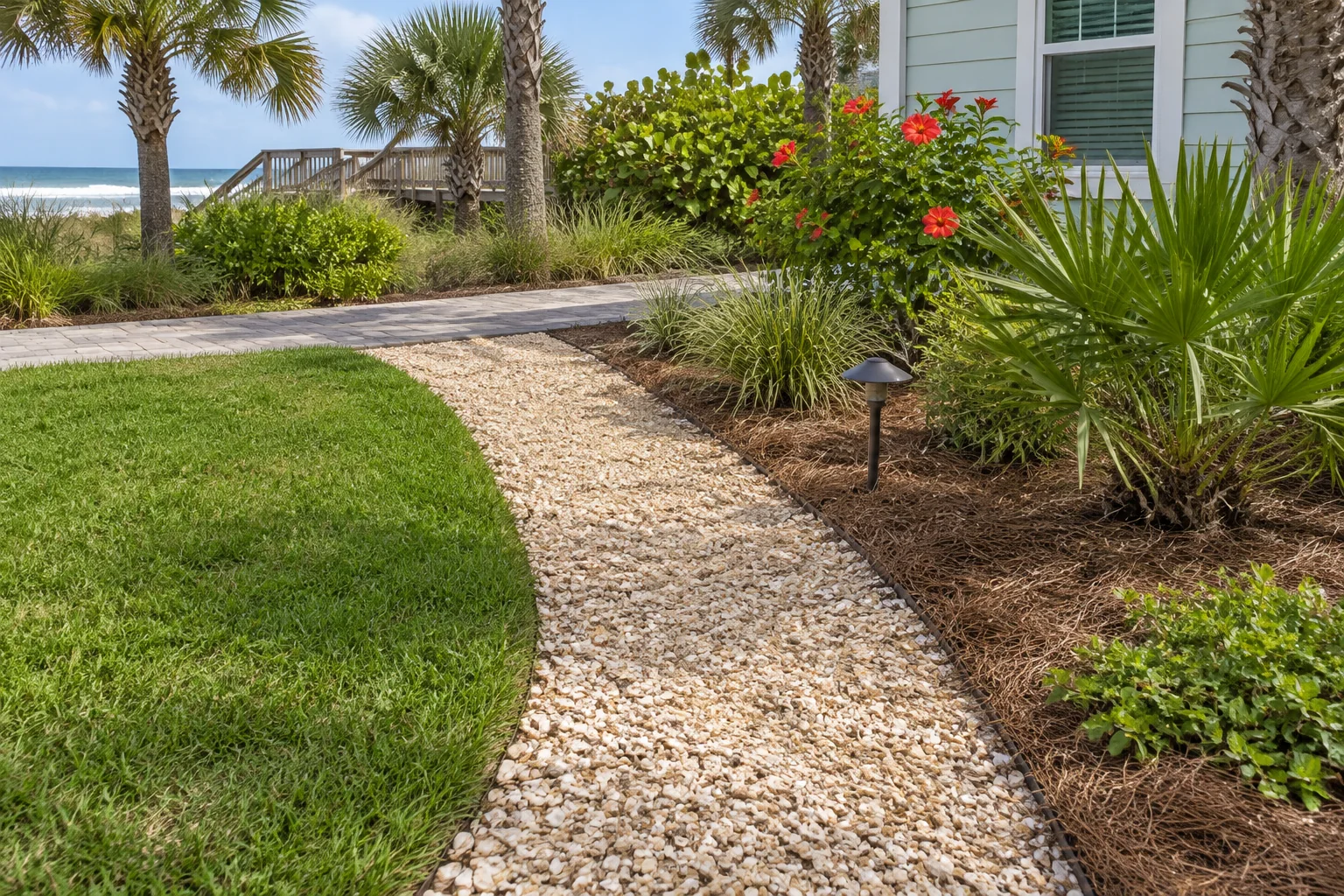
Bulk coquina shell edge planning in Flagler Beach, FL starts by identifying what sits on each side of the proposed surface. A boundary beside lawn raises different questions from one beside shrubs or an existing walk. Before choosing an edging product, record the adjoining use, maintenance access, and unresolved finished-level decisions. Ask your separately engaged installer to assess containment and how the surfaces should meet.
Use the bulk coquina shell buying guide to connect your boundary sketch with material confirmation, purchasing responsibilities, and delivery planning. This worksheet is an optional way to organize decisions, not an installation specification or a guarantee of performance.
Identify Each Physical Boundary Segment Once
Give each physical line one stable segment ID, separating exterior runs, shared boundaries and approved openings before adding linear feet. Coordinate this record with your bulk coquina shell buying plan and confirm the coquina shell material separately; boundary length is not shell volume.
For the hypothetical adjacent rectangles below, place A on the left and B on the right. Label lower corners P0, P1 and P2 from left to right, and upper corners P5, P4 and P3 from left to right. Exterior IDs connect those endpoints; D14 identifies the shared P1-to-P4 line.
- Exterior runs: Record E01, E12, E23, E34, E45 and E50 once each, with gross endpoint-to-endpoint lengths.
- Shared line: Keep D14 separate from the exterior, with its divider decision recorded as specified, omitted or unresolved.
- Opening O1: Mark its endpoints within E01, its width, and who confirmed that no edging is intended there. Do not infer an opening for access or drainage.
- Measurement basis: State whether each recorded length already excludes an opening. Retain unresolved decisions rather than entering zero.
Keep linear feet of boundary separate from square feet of covered ground and cubic yards of shell. Product-piece and connector ordering is another calculation, governed by the selected product’s actual lengths and instructions.
Beside lawn, retain access to inspect displaced shell. UF/IFAS mulch guidance notes that crushed shells displaced onto lawns can become a nuisance; a reconciled length does not establish containment performance.
Separate Shell Surfaces From Planting-Bed Decisions
Treat a shell surface beside plants as a boundary decision, not an automatic reason to cover the planting bed with shell. Review the supplied coquina shell material separately from the plant and material offerings at Tropical Yards. Material appearance does not establish suitability as mulch around plants.
UF/IFAS guidance on choosing and installing mulches recommends organic mulches for herbs, vegetables, shrubs, fruit trees, and other trees. It explains that organic mulch benefits soil, suppresses weeds, and moderates temperatures below the surface. As organic materials decompose, they can contribute nutrients and improve soil properties.
The same guidance specifically says gravel, rocks, and crushed shells do not contribute to soil nutrient content or water-holding capacity. They also do not provide the weed prevention or balanced soil temperatures associated with organic mulches. UF/IFAS does not recommend inorganic mulches for garden beds. Those distinctions matter when a proposed shell path meets an established planting area.
On the worksheet, identify whether the goal is a shell route beside a bed or shell placed within the bed itself. For the first, ask how the two materials will remain within their intended areas and how you will reach the plants. For the second, reconsider the mulch choice using the UF/IFAS guidance rather than assuming all ground covers serve the same purpose.
Plant selection also deserves its own decision. The Florida-Friendly Landscaping principles advise matching plants to soil, light, water, and climatic conditions. A coordinated appearance beside shell cannot replace those requirements. Record existing plants and any planned changes, but do not treat a material order as a planting assessment.
Leave unresolved plant-care questions on the worksheet for follow-up. There is no need to select both the shell boundary and the planting-bed treatment in one conversation.
Reconcile Adjacent Zones And One Shared Boundary
Add the individual perimeters, remove the shared line twice, then count a specified divider once and subtract an approved exterior opening once. Keep this boundary calculation separate from your bulk shell purchase planning and the cubic-yard quantity for loose coquina shell.
- Calculate both perimeters: Hypothetical rectangle A measures 12 ft by 8 ft, so 2 × (12 + 8) = 40 ft. B measures 6 ft by 8 ft, so 2 × (6 + 8) = 28 ft.
- Remove duplicate shared boundaries: The perimeter sum is 40 + 28 = 68 ft. Each rectangle includes the full 8 ft shared line. Exterior perimeter therefore equals 68 − 2 × 8 = 52 ft.
- Cross-check independently: Together the rectangles form an 18 ft by 8 ft outline. Its perimeter is 2 × (18 + 8) = 52 ft, matching the exterior reconciliation.
- Handle the divider separately: Add D14’s 8 ft once only if an internal divider is independently specified. Without that decision, do not add it or assume it is required.
- Apply the approved opening: For a separately approved 3 ft exterior opening O1, net exterior is 52 − 3 = 49 ft. With the specified divider, the total becomes 49 + 8 = 57 ft.
Those original totals are 49 ft exterior only or 57 ft including the divider. They are not interchangeable scopes. If E01 has already been measured as two solid runs excluding O1, add those runs without subtracting O1 again. The gross-length method above instead retains the full E01 measurement and deducts the opening once.
Update Only The Segments A Layout Change Affects
Revise the affected opening and its parent segment, retaining the previous dated total so a change cannot become a second deduction. Carry the current record into your bulk coquina shell order planning, while keeping Tropical Yards material and delivery arrangements separate from installation.
In this invented revision trail, the November 1, 2026 record retains O1 at 3 ft: exterior 49 ft, or 57 ft with D14. On November 2, 2026, O1 changes to 4 ft. E01 remains 12 ft gross, but its counted length changes from 12 − 3 = 9 ft to 12 − 4 = 8 ft.
| Segment ID | Measured length | Counting reason | Counted length |
|---|---|---|---|
| E01 | 12 ft gross | A lower edge; subtract O1 once | 8 ft |
| E12 | 6 ft | B lower edge | 6 ft |
| E23 | 8 ft | B outer side | 8 ft |
| E34 | 6 ft | B upper edge | 6 ft |
| E45 | 12 ft | A upper edge | 12 ft |
| E50 | 8 ft | A outer side | 8 ft |
| O1 | 4 ft | Already excluded within E01; informational row | 0 additional ft |
| D14 | 8 ft | Include only if specified | 8 ft if included |
| Independent check | 52 ft gross exterior | 52 − 4; optionally add 8; not another segment | 48 ft exterior; 56 ft with D14 |
The six exterior rows total 48 ft; adding the same specified 8 ft divider gives 56 ft. Both revised totals are exactly 1 ft below their originals. Retain the earlier record, revision date, opening confirmation and reason for change rather than overwriting the 49 ft and 57 ft totals.
Send measured lengths and unresolved layout choices to your independently engaged installer. Do not turn these totals into border heights, construction details, cutting allowances, product quantities or shell depth. Tropical Yards supplies materials and dump-trailer delivery, not installation, grading or spreading labor. Arrange that work yourself or separately through a contractor, and use actual product instructions for piece lengths and connectors.
Turn The Worksheet Into Separate Supply And Labor Requests
Prepare one request for material and delivery and a separate scope for installation work. Contact Tropical Yards for a current project quote and use the coquina shell product page to identify the material. The customer or a separately engaged installer handles preparation, edging, spreading, and other labor.
The boundary worksheet is most useful when it shows what has been decided and what remains open. A supplier can discuss the product and proposed delivery, but that conversation does not approve the edge construction. Likewise, an installer’s proposed layout does not confirm current material availability or delivery arrangements.
An optional handoff sequence can keep those conversations organized:
- Confirm the drawing: Share the labeled boundaries and identify any areas still excluded from the approved layout.
- Resolve installation questions: Ask your installer to address containment, finished levels, adjoining surfaces, and unresolved site concerns.
- Confirm quantity responsibility: Agree on who will calculate and approve the material requirement using the accepted project limits.
- Request supply terms: Give Tropical Yards the intended use, delivery address, material requirement, and proposed unloading information.
- Recheck changes: Update both the installation scope and material request if a boundary moves or the project expands.
Keep the proposed unloading point separate from the finished shell footprint. Tropical Yards offers dump-trailer delivery; the delivered material still needs to be moved and placed by you or your own workers. Ask the business to confirm access and the unloading arrangement rather than assuming the trailer can reach every boundary shown on the worksheet.
For an installer’s scope, request a clear description of which edges and adjoining surfaces are included. Keep photographs and unresolved questions with that description. This creates a shared reference without turning the homeowner worksheet into an engineering specification.
When the boundary decisions are ready, request current material availability, order conditions, delivery coverage, and a quote from Tropical Yards. Describe the shell use and provide the accepted measurements and access information. Keep supply and delivery separate from installation and maintenance so each party understands its responsibilities.
Frequently asked questions
Does every coquina shell boundary need the same edging?
Treat each boundary as a separate planning question rather than assuming one detail fits the whole perimeter. Label lawn, planting beds, existing paving, and junctions on your sketch. Ask your installer how containment, finished levels, and access should be addressed at each location before approving an edging choice or ordering material.
Is crushed shell a substitute for organic mulch around plants?
UF/IFAS does not recommend inorganic mulches, including crushed shells, for garden beds. Its guidance recommends organic mulches for many landscape plants because they benefit soil, suppress weeds, and moderate temperatures. Shell does not contribute nutrients or water-holding capacity to soil. Keep a shell surface and an adjoining planting-bed treatment as separate decisions.
What should a homeowner record beside a lawn edge?
Record the proposed shell limit, the existing grass boundary, and the route used for lawn care. Photograph any shell already displaced outside its intended area. UF/IFAS notes that displaced crushed shells can become a nuisance on lawns. Ask your installer about containment and leave space on the worksheet for inspection and upkeep responsibilities.
Can an edge worksheet determine finished levels?
No. A worksheet can identify existing surfaces, document questions, and show the proposed shell footprint, but it is not an installation specification. Ask your separately engaged installer to assess how the completed surfaces should meet. Keep unresolved ground or water concerns visible rather than assuming an edging product or additional shell resolves them.
Does Tropical Yards install edging or spread delivered shell?
No. Tropical Yards supplies coquina shell and plants and offers dump-trailer delivery. Customers perform installation themselves or engage their own installers. Request current material and delivery terms from the supplier, then arrange edging, preparation, spreading, and other labor separately. Confirm the proposed unloading location rather than treating delivery as placement throughout the project.