 Tropical
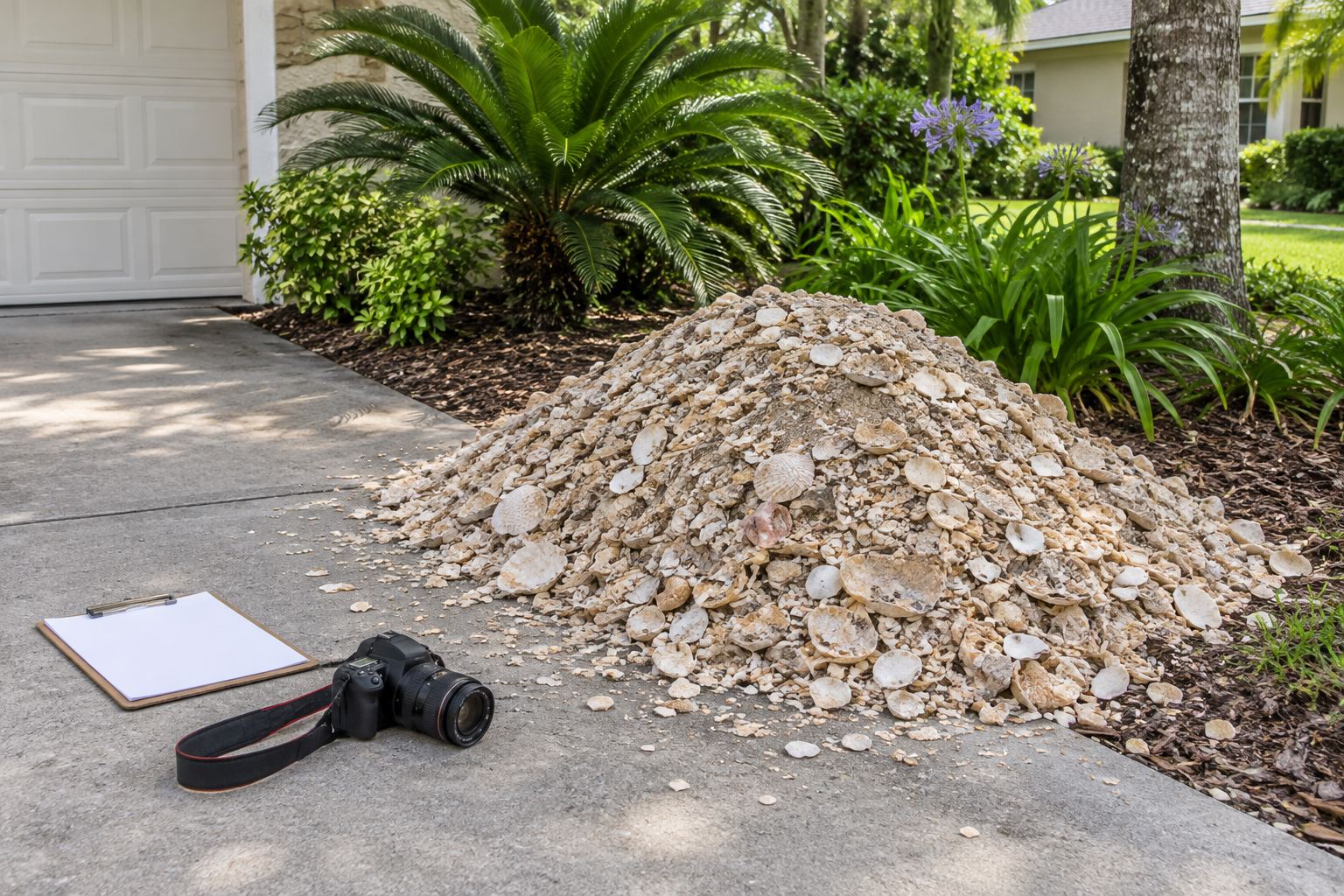
Before coquina shell is spread, moved, or mixed into a project, compare the delivery with the order details you and the supplier confirmed. A careful record can help you describe what arrived, identify questions while the material is still accessible, and give the supplier useful information if something appears different from the agreement. This guide is about documentation and communication, not a test of material quality or a substitute for supplier terms. For more information, see The Complete Guide to Coquina Shell in Northeast Florida: Pricing, Delivery & Applications.
Keep the comparison tied to what was actually agreed: the supplier’s stated product description, quantity, delivery details, and any other order information. Do not assume that a photograph, visual estimate, or homeowner measurement changes the supplier’s stated quantity or establishes an acceptance standard. If a detail is missing or unclear, ask the supplier how it should be interpreted before treating it as a discrepancy.
Make an order record before delivery
An inspection record starts with the order, not with the material in the driveway. Save the confirmation, estimate, invoice, written messages, or other documentation that records what the parties agreed. If the order was discussed by phone, you can make a dated note of the conversation and ask the supplier to confirm important details in writing. Treat your note as your own record of what you recall; if any wording is uncertain, mark it for clarification rather than presenting it as confirmed.
Separate confirmed terms from items still awaiting confirmation. For example, record the product name exactly as given, the quantity as stated by the supplier, and the delivery arrangement that was discussed. If a specification, quantity basis, charge, or timing is not stated, mark it as a question rather than filling in a number or assumption yourself. Tropical Yards supplies and delivers bulk coquina shell in the St. Augustine through Daytona Beach corridor; availability, quantities, specifications, current product and delivery charges, and scheduling must be confirmed directly.
- Save the order confirmation and any later changes in one place.
- Record the date of the order discussion and the names or business roles involved, without publishing personal information.
- Copy the supplier’s wording for product and quantity rather than translating it into a different unit or grade.
- Write down what is confirmed, what is pending, and who is expected to clarify each open item.
- Ask what information the supplier uses to identify the order at delivery, such as an order reference or customer name.
- Ask how the supplier wants a possible mismatch reported and what records would be useful. Do not assume a response deadline or remedy.
A simple order sheet can be a paper page or a digital note. If useful, leave labeled spaces for the order date, product wording, quantity wording, delivery address, discussed delivery timing, quoted charges, confirmation source, and questions still open. These are blank record fields, not a claim that every item is part of an order or that any particular term has been agreed. Put “not stated” or “to confirm” beside anything you do not know.
Include a version date if you edit the sheet. If a later message changes the order, you can keep the earlier wording and add the change with its date and source. For written messages, retain the message itself or a copy; for a phone discussion, you may note the date, the business role or name involved, the topic, and any action someone said they would take. If you are unsure whether a detail was agreed, ask the supplier to clarify it rather than treating your recollection as confirmation.
Before delivery, consider whether you have unanswered questions about the product name, quantity basis, specifications, charges, timing, or how the supplier identifies the order. Ask only about details that matter to your order, and record the answer and its source. You can also ask what records would be useful if the delivered order appears different from what you expected; do not assume a reporting deadline, resolution process, or remedy unless the supplier confirms it.
Clarify what “quantity” means
Quantity is only comparable when the supplier and homeowner are referring to the same stated basis. Do not infer a volume, weight, coverage area, depth, or number of loads from a general product name. Ask the supplier how the order quantity is expressed, how it will be reflected in the order record, and what the customer can reasonably observe at delivery. If the supplier uses a unit or description you do not understand, request an explanation in plain language and keep that explanation with the order.
What can you observe at delivery, and how does it compare with the supplier’s stated quantity? Rather than treating a visual impression as proof that a particular quantity is missing, record what you observed and ask the supplier how to compare it with the order quantity.
Before delivery, ask whether the order record will state a quantity and, if so, what basis the supplier uses. Ask whether there is a delivery document that identifies the order and whether it includes the same quantity description. If the paperwork uses different wording from the confirmation, do not silently choose one version. Save both, note the difference, and request clarification.
Prepare a clear place to observe and document
Before the delivery, ask the supplier where you can observe the unloading and what areas, if any, you should avoid. If you cannot safely observe a detail, could you note that limitation and ask the supplier how to obtain the relevant information?
What background details would help identify the delivery in photographs, such as the delivery location, surrounding ground, or a reference point? Where could you take pictures without interfering with the driver or unloading? Ask the supplier or driver about any site instructions, and whether there is another way to document the delivery if photographs are not practical.
If the intended drop area is not ready, what options can you discuss with the supplier before the vehicle arrives? Tropical Yards uses a 14-foot dump trailer for bulk coquina shell. Ask directly what access, placement, or site conditions to consider for your particular delivery. Will your driveway, gate, surface, overhead clearance, turning area, or proposed drop location accommodate the vehicle? The supplier can clarify its delivery arrangement; do photographs establish that a location is suitable?
At delivery: match the paperwork first
When delivery paperwork or an order identifier is available, compare it with the order record before treating the load as matched. Check the product wording, quantity as stated, destination or delivery location if shown, and any order reference. Read the document rather than relying only on a quick verbal description. If a field is blank, unclear, or different from the confirmation, ask what it means and record the explanation.
Do not assume that a delivery document is an inspection certificate or that signing a document has a particular legal effect. The meaning of paperwork, any requested acknowledgment, and any supplier terms depend on the actual document and applicable circumstances. If you are unsure what a signature represents, ask the supplier to explain before signing, and obtain professional advice if a legal question requires it. This guide does not establish an acceptance rule or a deadline.
Take a readable photograph of relevant paperwork if permitted, and retain the original or an electronic copy. Protect private details when sharing images. If the driver cannot provide a document or the document does not show an expected item, note what happened without accusing anyone of an error. Then ask the supplier which record should be used to verify the order.
Observe and photograph what is visible
Use photographs to support a factual account, not to claim more than the images show. A useful set may include an overall view of the delivered pile, a second angle that shows its placement, and close views of any feature you want to ask about. Include a reference point where practical. Avoid filters or edits that alter appearance, and avoid captions that state a conclusion before the supplier has reviewed the concern. Keep the original files when possible.
Write down when each image was taken and what it depicts. What label would help you identify the image later—for example, a date and a short description such as “overall delivery”? You can also leave a record field for the image name or location, without assuming a particular naming system is necessary. If conditions affect visibility, such as low light or an obstructed view, note that rather than presenting the image as a complete record. Can you take the photos from a safe place without interrupting unloading?
Describe observable facts in neutral language. “The pile is at the agreed drop area” is more useful than a broad judgment if the location is clear. “I see a difference between the product wording on the confirmation and the delivery document” identifies a question. “The quantity is definitely short” is not supported by appearance alone unless a reliable agreed measurement method establishes that conclusion. If you have a concern, say what you observed and ask the supplier how it should be checked.
For a concise record, consider noting the date and time, where the delivery was placed, what each photograph shows, and any visible condition that prompted a question. Which details are directly observable, and which remain uncertain? You might record “view partly blocked” or “lighting limited” where relevant, rather than treating the photograph as a full account. If you refer to order paperwork, what wording appears on each document? Keep the description to what you can see, and identify any comparison or measurement that still needs confirmation.
Before taking a close view, ask whether the feature can be photographed safely from your position. Is unloading still in progress, or would taking a photograph require you to move near equipment or the delivery area? If you cannot get a clear or safe view, note that limitation and ask how the concern can be reviewed. The purpose of the record is to show what was visible and what question you are raising, not to make an unsupported finding about product, placement, or quantity.
Comparison table: what to record and what not to infer
The table below is a recordkeeping aid. It does not create a supplier requirement, measurement standard, acceptance test, or remedy. Use it to keep order terms, observations, and unanswered questions distinct.
| Record item | What to compare | Useful record | Do not infer |
|---|---|---|---|
| Product description | The supplier’s order wording against available delivery paperwork and the delivered material as observed. | Save the confirmation, document any wording difference, and ask the supplier to clarify. | A visual impression establishes a precise product specification or grade. |
| Quantity | The quantity stated in the agreement and any quantity shown on the delivery record. | Copy the stated basis and units exactly; note if either record is silent or inconsistent. | Pile appearance, footprint, or a photo proves an amount or shortfall. |
| Order identity | Customer or order reference and delivery destination, when recorded. | Keep the order reference and note any mismatch for supplier review. | A matching location alone proves the load is the correct order. |
| Visible condition | What can be observed safely at the time of delivery. | Take unaltered, dated photographs and describe visible details neutrally. | A photograph establishes an unstated quality standard or performance. |
| Open question | The question against the supplier’s confirmed explanation or written terms. | Record when and how you asked, what information you provided, and the response. | A customary deadline, refund, replacement, or resolution policy. |
Keep observation separate from interpretation
Could you keep the order or agreement, what you observed, and what remains unresolved distinct in your delivery record? For example, you might note, “Order confirmation lists the quantity as stated in the attached document; delivery slip lists a different description,” and ask the supplier which records to compare. Rather than changing units yourself or declaring a precise shortage, could you attach the relevant documents and ask the supplier to clarify the difference?
If the material’s visible appearance raises a question, what specific feature can you describe without assuming a specification? You might note that an appearance differs from what you expected and ask whether it is consistent with the product ordered. Have the supplier’s product information or an appropriate professional assessment established any claims about origin, composition, suitability, durability, or performance?
Before using a scale, container, ruler, or calculation to assess the delivery, could you ask the supplier whether that method is appropriate and whether it is part of the agreed order? If a measurement was not agreed, how should you describe it—as your observation, rather than as proof of the supplier’s quantity or specification?
If something appears different, pause and ask
If a material or paperwork discrepancy seems possible, avoid spreading, blending, transferring, or otherwise altering the part you are concerned about until you have asked the supplier how to proceed. This is a practical recordkeeping suggestion, not a claim that the material must be held for a particular period or that the supplier has a specific resolution policy. If you are unsure whether pausing could create a safety or site-management concern, whom should you consult, and what information should you share with the supplier?
Contact the supplier promptly enough to describe the situation while your observations and records are fresh, but do not assume a formal reporting window. Ask the supplier whether it has a preferred process or timing. Provide the order reference, the exact wording that appears inconsistent, a concise description of what you observed, and the relevant photographs or paperwork. Ask what additional information it needs and whether you should leave the material undisturbed while the question is reviewed.
Keep your message specific and neutral. A clear note might say: “The confirmation describes the order as [copy wording]. The delivery document says [copy wording]. I have attached photographs of both. Please explain how you would like me to compare these records before the material is used.” Replace bracketed text with the exact source wording; do not add an unsupported estimate or accusation. Preserve your sent message and any response.
A practical sequence for documenting concerns
- Identify the order. Find the confirmation, order reference, and any written changes. Confirm that the documents refer to the delivery in question.
- Describe the mismatch. Quote the two differing entries or state exactly what visible feature prompted the question. Do not convert terms into a new unit.
- Preserve evidence. Save original photographs, paperwork, messages, and dated notes. Keep copies in a location you can retrieve.
- Avoid unnecessary alteration. Ask the supplier what to do before using or moving the material that is the subject of the question, where practical.
- Ask for the supplier’s process. Request clarification of the applicable order record, any relevant product information, and what next step the supplier recommends.
- Log the response. Record the date, communication method, response, and any actions agreed. If an answer is verbal, summarize it in a follow-up message and ask whether your summary is accurate.
- Close the record carefully. Note what was resolved, what remains open, and any follow-up promised. Do not mark a matter resolved merely because a message was sent.
Organize a simple delivery file
Choose a folder, envelope, or digital location for records related to the order. Would arranging them by date make it easier for you to find a particular document? A simple index might have fields such as date, record type, and a brief description; use whichever fields are helpful to you. Keep purchase documents, such as receipts, invoices, or contracts, together, and retain your own notes as well.
Possible records include an order confirmation, any changes to the order, an invoice or other transaction record, delivery paperwork, photographs, notes of conversations, questions to the supplier, and responses. Which of these do you have, and which relate to the issue or question you are documenting? If you send photographs or other information in a message, would keeping the original files and a copy or screenshot of the message help you recall what you sent? Keep originals and, when communicating with the business, consider providing copies. Avoid circulating payment details or other sensitive information unnecessarily.
A log could include optional fields such as date and time, event, source, evidence saved, question or requested resolution, and any promised action. For example, you might note when you contacted the supplier, what you asked, and what response or next step was discussed. You do not need to use a particular format; what would help you accurately remember the relevant dates and conversations? If you make a correction to an earlier note, add a dated correction rather than changing it in a way that could make it appear to have been written at an earlier time. What changed, and when did you make the correction?
Include only information relevant to the order, and store records where the people coordinating the project can access them if needed. Are there records another person involved in the project should receive, or sensitive details that should not be shared? Keeping copies of messages and notes of dates, conversations, and promised actions can help you refer back to what was discussed.
Questions to settle before placing an order
Many inspection questions are easier to address when the order is clear. Before committing, ask the supplier what product description will appear in the confirmation, how the quantity is stated, what delivery record may be available, and how to raise a question if paperwork or the load appears inconsistent. Ask which current charges and scheduling details apply to your order. Do not rely on an old quote, an assumed quantity, or a general statement as confirmation of current availability or terms.
If the intended use depends on a specific material characteristic, ask the supplier whether it can provide relevant product information. Then ask the landscape professional or other qualified professional responsible for the project whether that information answers the project’s needs. Tropical Yards supplies the material; customers or their landscapers handle installation. The supplier’s delivery information and a homeowner’s delivery record do not replace project-specific installation decisions.
- What exact product wording should I expect in the order confirmation?
- How is the agreed quantity expressed, and where will that description appear?
- What document, if any, will identify the delivery and its order details?
- What should I do if the confirmation, delivery record, or visible material seems inconsistent?
- How does the supplier prefer customers to report a question, and are there terms I should review?
- What site access information should I provide for the delivery arrangement?
- Which project questions should I direct to my landscaper or another qualified professional?
What photographs can and cannot do
If you have a question about a delivery, would photographs help the supplier review it? Ask what views or documents, if any, would be useful, and whether they can clarify your question about the order. Confirm quantities, specifications, and any order-resolution policy directly with the supplier.
What would you like the supplier to review: the placement of the delivery, a label or document, or another feature? Describe your concern in writing and ask whether an image is relevant to the agreed order. If your concern is about a document, ask which information the supplier needs to see.
Coordinate the record with the person installing
If a landscaper or other installer will handle the coquina shell, share the confirmed order details and delivery record with that person. Customers or their landscapers handle installation, so keep the handoff clear about which questions concern the supply and delivery and which concern the customer’s installation plans. Ask the installer what information they need to plan their work and whether they have project-specific questions for the supplier. A delivery comparison is not a substitute for asking the installer what information they need about the property or the project.
Agree on who will be present to observe the delivery and who will save the records. If the homeowner will not be present, decide in advance how the observer should record the paperwork and visible delivery without interfering with operations. Do not ask an installer or observer to certify a quantity or quality standard that was not agreed or that they cannot establish. If the installer notices a concern, ask them to describe what they saw and preserve their own dated observations. You might agree on simple blank fields for the record: date and time; name of observer; order reference, if any; documents received; and a short description of any question or concern. Leave a field blank when the information is not available rather than guessing.
Before the order is placed or the delivery is arranged, the customer and installer could agree on a simple record handoff. For example, ask: Who will keep the order details and any later written confirmations? Who should receive a supplier reply if a question comes up? Should the customer or installer forward that reply to the other, and by what method? These are coordination choices for the people involved, not assumptions about a supplier’s recordkeeping process. They can also decide whether the customer wants to retain copies of messages and order documents and who will gather them. A possible handoff note can be limited to names, preferred contact method, date shared, and documents or messages forwarded.
If order details change, consider labeling the newer note with its date and what it updates, while retaining the earlier version for reference. Ask each other: Which detail changed? Who confirmed it? Has the installer received the updated information? A record can simply identify the earlier note and the later one without drawing conclusions about why a change occurred. Do not assume an informal change is accepted; if availability, quantity, specifications, charges, or scheduling need confirmation, ask the supplier directly and keep the response with the relevant order records. For a blank change log, the participants might use fields such as date raised, detail to confirm, person contacted, response received, and person notified. Avoid filling in a confirmation field until a response has actually been received.
Where a project depends on a technical specification, the homeowner, supplier, and installer may each have different information. Write down the question, identify who can answer it, and keep the response with the relevant order records. The customer could ask the installer to identify unresolved product or delivery questions before use, then decide who will send those questions to the supplier and share the answer. Ask the supplier about supply or delivery details; ask the installer about the customer’s installation plans. Do not treat a casual conversation as written confirmation when a detail is important to the order or project. A practical question list might include: What exact detail needs an answer? Is it about the order, delivery, or installation plan? Who is being asked? When was the question sent? What response, if any, was received, and who has seen it? Keep the wording neutral and distinguish an open question from a confirmed detail.
Common recordkeeping pitfalls
- Relying on memory alone: Write down important conversations soon after they occur and request confirmation of material order details.
- Using inconsistent units: Copy the supplier’s stated quantity and unit exactly; ask before converting or comparing it with a personal estimate.
- Taking only a close-up: Include a contextual view when safe, and note where and when it was taken.
- Editing away context: Preserve original images and documents; add explanatory notes separately.
- Using a visual estimate as proof: Describe what you see, then ask the supplier how the agreed quantity can be checked.
- Assuming a response policy: Ask about the supplier’s current process rather than assuming a particular deadline, refund, replacement, or acceptance rule.
- Using the material before raising a question: Where practical, ask the supplier how to proceed before altering the part relevant to the concern.
- Mixing separate questions: Distinguish order identity, quantity, visible appearance, delivery access, and installation planning so each can be answered by the appropriate person.
When an issue needs a different professional
For questions about a contract, legal rights, or a disputed transaction, would an appropriate legal professional be the right person to consult? For questions about a project’s design, installation, drainage, load, site conditions, or suitability for an intended use, would the landscape professional responsible for the work be the right person to ask? Customers or their landscapers handle installation; confirm product and delivery details directly with the supplier.
Before delivery, what access or site details should you discuss with the supplier and the professional responsible for the project? Confirm delivery scheduling and any relevant order details directly with the supplier.
Takeaways for a useful delivery record
For your own notes, you could record the order date, the wording or reference shown on the order, and the details stated on any delivery paperwork. What quantity and specification were written down? Which details can you verify from the documents, and which remain unclear? If you take photographs, what do they show, and when were they taken? Keep observations separate from interpretations: for example, note the visible condition or location without presenting an assumption about cause or specification as a fact.
If a detail appears different from the order, you can write down the exact wording you are comparing and ask the supplier how it wants the question checked. What part of the order or paperwork are you asking about? What did you observe, and what information would help clarify the difference? Avoid assuming that an estimate is a confirmed quantity, specification, charge, delivery time, deadline, or remedy. Confirm current order details and any process directly. These are optional prompts for organizing your own account, not a statement of a supplier policy or a guaranteed resolution.
Before ordering, review the supplier’s current coquina shell service information and confirm the details for your particular order directly. For delivery planning, ask about the access and placement information the supplier needs. When you are ready to discuss current availability, quantity, delivery charges, scheduling, or an order question, use the Tropical Yards contact page as the next step.