 Tropical
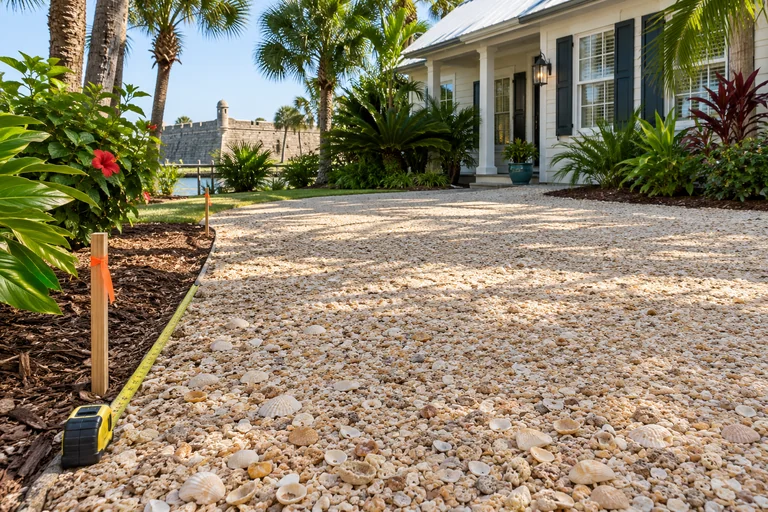
Planning a bulk coquina shell driveway in St. Augustine, FL, starts with more than choosing a coastal-looking surface. Before ordering, define where vehicles will travel, assess the existing base, agree on the finished depth, and decide where the delivery can safely unload. Those decisions connect the material estimate to the work that you or your contractor will complete.
Tropical Yards sells coquina shell and provides dump trailer delivery. It does not install driveways, grade property, compact materials, or provide landscape construction labor. Keep the supply order separate from the installation plan so that material, equipment, labor, and delivery responsibilities are clear before the shell arrives.
Decide Whether Coquina Shell Fits Your Driveway Use
Consider a cream-to-tan coquina shell driveway if you accept periodic surface upkeep. Include displaced material, tracking, and possible ruts in turning areas among the tradeoffs you weigh before choosing this aggregate surface.
Start with how the driveway actually functions. A straight residential approach has different demands from a parking court where drivers repeatedly turn their wheels. Note where cars enter, reverse, park, and turn around. Include any regular truck or RV use in the conversation with your contractor rather than treating all vehicle traffic as equivalent.
The material description also matters. Loose coquina shell is different from harder shell rock. Do not assume that an order described only as shell, crushed shell, or shell rock will deliver the same product. Tell the supplier that you are considering its loose coquina shell for a driveway, and confirm what material will be supplied.
- Appearance: Decide whether the natural cream-to-tan shell surface suits the house and driveway borders.
- Vehicle use: Record ordinary parking, frequent turning, and any recurring heavy loads.
- Walking needs: Consider the route between parked vehicles, the garage, and the front entrance.
- Upkeep: Be comfortable with returning displaced shell, checking edges, and adding material when needed.
A shell driveway is not a smooth slab. Shell can travel on tires and shoes and may feel uncomfortable under bare feet or heels. Consider those tradeoffs before selecting the material, particularly where the driveway doubles as the main pedestrian entrance.
Material identity, preparation, coverage, delivery, and maintenance all belong in the same buying decision. Use the complete coquina shell buying and application guidance to connect those choices before narrowing the order to a driveway quantity. The goal is a surface that matches your traffic and the upkeep you are prepared to handle, not simply a load that covers the measured footprint.
Set Base And Depth Requirements Before Ordering
Agree on the base condition and finished shell depth before converting measurements into an order. A general 4-to-6-inch driveway depth over a compacted base is a planning reference, but distinguish finished compacted depth from loose placement depth before estimating the material purchase.
EPA describes permeable pavement as a system that lets water reach underlying soil and gravel. Its examples include pervious concrete and interlocking pavers; it does not establish a coquina-shell driveway specification. Treat that guidance as background when discussing the complete surface and base with your contractor.
For base preparation, Tropical Yards cautions: “Do not install shell over an unprepared sandy base without first addressing any soft spots or depressions that could cause differential settling under vehicle weight.” Inspect the existing driveway before deciding that a fresh surface layer is sufficient.
Walk the area with your contractor and identify recurring ruts, soft patches, low spots, and failed edges. Record whether the project is a new driveway, an extension, or a refresh of an existing shell surface. Those are different scopes. A thin cosmetic addition should not be mistaken for rebuilding an inadequate base.
Ask the person doing the work to state the intended finished depth and how they will achieve it. A minimum of 4 inches of compacted shell is Tropical Yards' general residential guidance, not a design for every property. Heavy vehicles, poor ground conditions, and drainage concerns need a project-specific assessment.
Discuss edge restraint at the same time. Edging, timber borders, and concrete curbing are options for defining the driveway perimeter. Ask your contractor which approach suits the project and how it will meet existing surfaces. Include garage entrances, walkways, and the road connection in that discussion.
Drainage deserves its own check. Coquina shell is porous, but that does not establish how water will move through your driveway's underlying ground. If standing water is already a problem, have it assessed rather than assuming a shell surface will eliminate it. This planning step avoids turning a material purchase into an untested drainage solution.
Measure The Driveway And Distinguish Volume From Order Quantity
Measure the actual shell-covered area, then calculate volume using an agreed depth. Use the area-and-depth coverage formula alongside the driveway coverage examples to check the arithmetic. A calculated volume is a starting point, not automatically the final loose-material order.
Sketch the driveway before measuring it. Separate the main approach, parking spaces, widened entrance, and turnaround into areas you can calculate without counting the same space twice. For a rectangle, multiply length by width to find square feet. Add the separate areas to obtain the total proposed shell footprint.
Measure the intended finished boundaries, not just the wheel tracks. If the project includes widening an existing driveway, show the existing surface and the addition separately. That lets your contractor discuss whether both areas need the same preparation and material depth.
Volume formula: Square feet × depth in feet ÷ 27 = cubic yards. An equivalent version is square feet × depth in inches ÷ 324. The table below applies that arithmetic to simple rectangular examples. It contains no added allowance for compaction, handling, uneven ground, or waste.
| Driveway Area | Example Dimensions | Volume At 4 Inches | Volume At 6 Inches |
|---|---|---|---|
| 400 square feet | 10 × 40 feet | 4.94 cubic yards | 7.41 cubic yards |
| 800 square feet | 20 × 40 feet | 9.88 cubic yards | 14.81 cubic yards |
| 1,200 square feet | 20 × 60 feet | 14.81 cubic yards | 22.22 cubic yards |
For example, an 800-square-foot driveway at a uniform 4-inch depth has a geometric volume of about 9.88 cubic yards. If 4 inches is the desired finished compacted depth, do not assume that ordering exactly that loose volume will produce the finished result. Have your contractor explain the placement depth and order allowance, then confirm the proposed quantity with the supplier.
Keep allowances visible instead of combining several unexplained adjustments. Write down the measured area, target finished depth, loose placement assumptions, and any separately identified preparation material. This makes it easier to catch an estimate that includes an allowance twice or leaves one out.
For an existing shell driveway, measure the areas needing replenishment rather than automatically applying a full new-driveway depth everywhere. Your contractor should assess whether the surface only needs redistribution and topping off or whether underlying defects need repair first. Keep that refresh scope distinct from the volume needed for a new driveway.
Plan Dump Trailer Access And Drop Placement
Confirm access and unloading arrangements before scheduling bulk coquina shell delivery. Tropical Yards uses a 14-foot dump trailer for deliveries, but that equipment detail alone does not establish whether your entrance or proposed unloading location is suitable.
Give the supplier the full delivery address and explain the route from the street to the proposed drop. Describe gates, narrow entrances, tight turns, restricted delivery hours, and anything else that may limit access. If you are unsure how to describe a constraint, ask what measurements or photographs the supplier wants before confirming the delivery.
Do not use the trailer's stated length to infer its total working space, clearance needs, or load capacity. Ask the supplier to confirm the access requirements for the equipment serving your order. Likewise, do not assume the entire calculated driveway quantity can arrive in one load.
Choose a proposed drop location with the person who will spread the shell. A pile near the work may reduce material handling, but the location still needs the supplier's approval. Consider whether the pile would block vehicle access, the garage, or the route needed for moving material across the project.
Ask whether one unloading point or another agreed arrangement is available. Delivery should not be interpreted as spreading shell along the driveway, leveling it, or compacting it. If your contractor needs material placed in a particular sequence, resolve that request with the supplier before delivery day rather than relying on an assumption.
The published delivery area includes St. Augustine, FL, and the coastal corridor toward Daytona Beach, FL. Confirm coverage for your exact address, along with the current delivery quote and available schedule. For gated properties, provide entry instructions and community delivery restrictions early enough for the supplier to assess them.
Build A Clear Quote, Work Schedule, And Upkeep Plan
Request a current bulk shell and delivery quote using your measured area, agreed depth, proposed quantity, and access details. Budget separately for driveway preparation and ongoing surface care, with installation work arranged through your own contractor or completed yourself.
Keep the supplier's quote separate from your contractor's work estimate. The shell purchase and delivery are not the same as the complete driveway cost. You may also need preparation, edging, equipment, spreading, and compaction, depending on the agreed scope. Compare estimates using the same boundaries and finished-depth assumptions.
- Confirm the product: Specify loose coquina shell and discuss its suitability for the intended driveway use.
- Review the quantity: Provide the measured area and explain whether the estimate reflects loose placement or finished depth.
- Confirm order terms: Ask about the current minimum, available quantities, material quote, delivery charge, and any load arrangements.
- Agree on delivery: Confirm the address, access restrictions, unloading location, and schedule with the supplier.
- Assign the work: Identify who prepares the base, supplies equipment, spreads and compacts shell, and handles later maintenance.
Schedule delivery around readiness, not just an open date. Your contractor should have the preparation plan settled and the necessary labor and equipment arranged. If the drop would block the only parking or access route, work out how the property will function while the material is being moved.
Plan for maintenance without treating a published interval as a guarantee. Return displaced material, restore edges, and arrange topping off when needed. Actual needs depend on traffic and surface condition. Turning areas and driveway edges deserve attention because shell can migrate or develop irregularities there.
When the surface looks thin, distinguish material displacement from material shortage. Shell pushed toward the sides may need redistribution; recurring ruts may require assessment of the base rather than another cosmetic layer. Keep the original measurements and depth assumptions so future replenishment estimates have a useful starting point.
For your St. Augustine, FL, project, contact Tropical Yards for current coquina shell availability, a delivered quote, and confirmation of access and coverage. Arrange all preparation and installation work yourself or through your own contractor. A clear division of responsibilities helps the supply order support the driveway plan instead of leaving important decisions until the trailer arrives.
Frequently asked questions
How deep should coquina shell be for a driveway in St. Augustine, FL?
Tropical Yards recommends a minimum of 4 inches of compacted shell as general residential driveway guidance, with greater loose placement depth needed before compaction. Its general driveway range is 4 to 6 inches over a compacted base. Have your own contractor determine the appropriate preparation and finished depth for your ground conditions and vehicle use.
How much coquina shell does an 800-square-foot driveway need?
At a uniform 4-inch depth, the geometric volume is approximately 9.88 cubic yards: 800 multiplied by 4, divided by 324. That calculation does not include a loose-material compaction allowance or uneven ground. Confirm whether your stated depth is loose or finished compacted depth before your contractor and supplier review the final order quantity.
Does Tropical Yards install or compact coquina shell driveways?
No. Tropical Yards supplies coquina shell and provides dump trailer delivery. Customers or their own contractors handle base preparation, grading, edging, spreading, and compaction. Confirm the unloading arrangement separately from the installation work, and make sure your contractor has the necessary labor and equipment arranged before scheduling the material delivery.
What should I confirm before a bulk coquina shell delivery?
Confirm the exact address, delivery coverage, proposed quantity, current quote, access route, and unloading location. Tell the supplier about gates, narrow entrances, tight turns, and restricted delivery hours. The stated 14-foot dump trailer length is not enough to determine access suitability, working clearances, or how many loads your order will require.
Will a coquina shell driveway need maintenance?
Yes. Expect periodic raking, returning shell that has moved toward the edges, edge restoration, and topping off when needed. Turning areas can develop irregularities, and shell may track on tires or shoes. Inspect the surface condition rather than treating any published maintenance interval as a guarantee for your driveway.