 Tropical
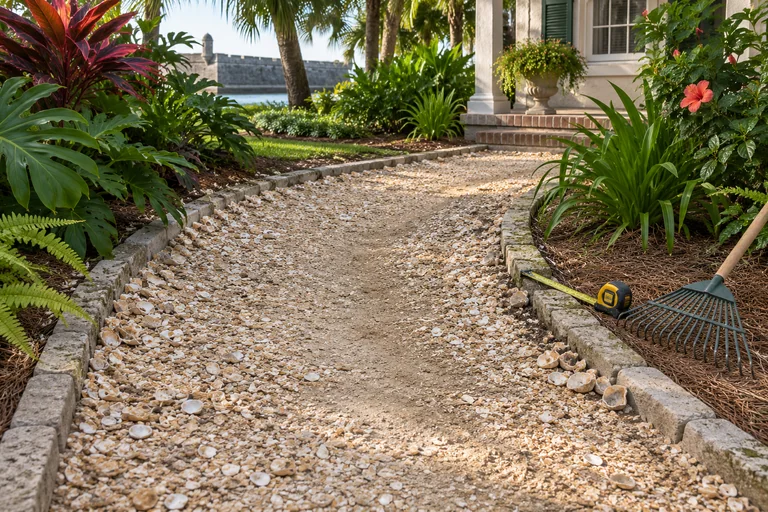
A coquina shell refresh should replace missing coverage, not simply add another layer everywhere. Before ordering bulk material for a property in St. Augustine, FL, check whether the existing shell needs redistribution, localized replenishment or a broader top-off. Those are different jobs, and they can require very different quantities.
For an existing surface, the key distinction is between its total intended depth and the additional shell needed now. Effective coquina shell maintenance and coverage planning combines periodic raking, edge restoration and replenishment where coverage has been lost. Measure what remains before calculating a bulk order, and separate routine surface maintenance from problems that require preparation or repair.
Tropical Yards supplies coquina shell and offers dump trailer delivery. Surface preparation, spreading, grading and compaction remain the responsibility of the customer or the customer's contractor.
Decide Whether The Shell Needs Raking, Patching Or A Refresh
Start by redistributing displaced shell and restoring edges before deciding how much fresh coquina shell to buy. This separates material that has moved from coverage that actually needs replenishment.
Shell does not decompose like bark mulch, but an existing surface can still become uneven. Foot traffic and vehicle tires can push material toward the edges. Gradual compaction can also reduce the apparent depth. A thin-looking center beside a thick outer ridge may therefore indicate movement rather than an overall shortage.
Remove loose leaves and other debris, then rake a representative section back into an even layer. If that restores adequate coverage without exposing adjacent areas, redistribution may be enough. If isolated sections remain thin, measure those sections separately instead of assuming the whole installation needs equal treatment.
- Raking only: Shell remains available within the original boundaries, and redistributing it restores a reasonably even surface.
- Localized replenishment: A few worn sections need additional material while most of the installation retains suitable coverage.
- Broad top-off: Thin coverage extends across much of the area after displaced material has been returned.
- Repair before replenishment: Recurring ruts, soft spots or failed edges suggest that adding shell alone may not address the underlying problem.
A top-off of roughly 1 to 1.5 inches can serve as a planning reference for an established installation, not an automatic depth for every surface. A lightly used bed and a driveway turning area should not receive identical treatment merely because they were originally installed together.
Use condition rather than a calendar deadline to make the decision. Traffic intensity and edge containment affect how quickly replenishment becomes necessary. An inspection is more useful than assuming every installation needs a full refresh after the same number of years.
Inspect Edges, Remaining Depth And Trouble Spots
Inspect the existing boundaries and remaining shell before choosing the refresh area or added depth. Account for edge migration and gradual compaction, then assess the surface according to its use as a driveway, pathway or planting bed.
UF/IFAS notes that displaced shells can become a lawn nuisance. Include the lawn edge in your inspection before deciding where additional shell belongs.
Walk the full perimeter rather than judging the project from its most visible section. Look for shell that has escaped into adjacent areas, edging that has moved, and thick accumulations beside thin sections. Where practical, restore the intended boundary before measuring. Otherwise, the refresh estimate may include ground that was never meant to receive shell.
Check the remaining layer at several representative points. Include a low-traffic section, a visibly worn section and a location near the edge. Record the differences on a simple sketch. The goal is not to produce an engineering survey, but to avoid treating one shallow spot as a reliable measurement for the entire property.
Separate appearance concerns from performance concerns. Leaves and other organic debris can make shell look neglected without indicating that the material is missing. In contrast, a depression that returns after raking deserves further investigation. Vehicle turning areas can develop ruts, and soft spots need attention before fresh material conceals them.
Also inspect transitions beside walks, driveway entrances, drains and planting areas. Adding shell raises the surface, so consider how the proposed layer will meet those features. Do not assume that more depth is harmless simply because the material is loose.
In planted beds, preserve clearance around stems and trunks rather than mounding shell against them. A refresh should restore the intended layer across the bed, not create progressively higher piles around established plants. Keep clear areas around plant bases out of the coverage estimate.
Measure Only The Additional Shell Needed
Calculate refresh volume from the area receiving new shell and the additional depth required, not from the installation's original full depth. Use the area-times-depth coverage calculation to estimate volume, then discuss the intended application and purchase quantity when ordering bulk coquina shell.
For measurements in square feet and inches, the formula is area × added depth ÷ 324 = cubic yards. The conversion works by dividing inches by 12 to obtain feet, then dividing cubic feet by 27 to obtain cubic yards.
Keep existing depth and added depth in separate columns on your worksheet. If a section already retains most of its intended coverage, calculating the entire original depth would count material that is still present. Conversely, a nearly bare patch should not automatically receive the same shallow top-off as the surrounding surface.
| Refresh Area | Added Depth | Calculated Volume |
|---|---|---|
| 400 square feet | 1 inch | 1.23 cubic yards |
| 600 square feet | 1.5 inches | 2.78 cubic yards |
| 1,000 square feet | 1 inch | 3.09 cubic yards |
These examples show geometric volume only. They do not prescribe a suitable depth for your property or include an allowance for compaction, handling or measurement uncertainty. Confirm the order quantity with the supplier after explaining the intended use and whether your depth refers to loose material or the finished layer.
When wear varies, calculate separate zones. For example, 500 square feet receiving 1 inch requires about 1.54 cubic yards. Another 100 square feet receiving 1.5 inches requires about 0.46 cubic yard. Together, the unadjusted requirement is approximately 2.01 cubic yards. Applying the deeper layer everywhere would overstate this particular plan.
For curved beds, break the sketch into manageable shapes and keep track of exclusions. Do not count a paved section, an equipment pad or another area that will remain uncovered. If the border is difficult to measure, identify that uncertainty rather than hiding it inside an unexplained extra quantity.
Keep allowances and rounding separate from the geometric calculation. Record each adjustment visibly so it is not added twice when you discuss the order. Ask Tropical Yards to confirm current minimums and available order increments before turning a calculated volume into a purchase.
Prepare The Existing Surface Before Delivery
Complete debris removal, redistribution and edge restoration before fresh shell arrives. Arrange necessary repairs independently, since Tropical Yards supplies materials and provides dump trailer delivery, not surface preparation or installation labor.
Preparation makes the quantity estimate more meaningful. If the project is measured before displaced shell is returned, you may order material to replace shell that was merely sitting outside the intended boundary. If a border repair changes the covered area, the earlier square footage may no longer describe the job.
Keep the work sequence straightforward, whether you are completing the refresh yourself or hiring your own contractor. The condition assessment should come first, followed by preparation, a final measurement check and delivery coordination.
- Clear the surface: Remove fallen leaves, fronds and loose debris so the remaining shell and worn sections are visible.
- Return displaced material: Rake usable shell back within the intended boundaries and reassess how much coverage is actually missing.
- Address problem areas: Arrange any needed edge, base or grading work through your own contractor before concealing those areas with fresh material.
- Recheck the estimate: Confirm the refresh footprint, added depths and exclusions after preparation changes the surface.
- Coordinate the drop: Discuss a proposed unloading location, access restrictions and the route for moving shell into place with Tropical Yards.
Do not assume an existing landscape fabric layer needs to be removed or replaced simply because you are topping off the shell. Planted beds and unplanted paths have different preparation needs. Exposed, damaged or tangled fabric is a separate issue to evaluate before spreading more material, rather than something to cover without inspection.
Plan how the delivered pile will reach each section. A convenient unloading location for the trailer may still leave substantial wheelbarrow or equipment work for the customer. Consider that handling distance when deciding whether to complete the refresh yourself or arrange outside labor.
Finally, separate material delivery from installation scheduling. Tropical Yards does not provide the preparation, spreading or compaction crew. Confirm your own tools, help and contractor arrangements rather than assuming those tasks are included with the bulk order.
Confirm The Bulk Order And Plan Future Checks
Request a current material-and-delivery quote using your measured refresh area, additional depths and access information. Confirm the quantity of coquina shell for delivery, then discuss your address, proposed unloading location and delivery requirements with Tropical Yards before scheduling.
Explain that this is an existing-surface refresh rather than a new installation. Share the calculated volume before allowances, the adjustment you are considering and any sections that require different depths. That gives the supplier a clearer basis for discussing quantity than a request to cover the whole yard.
Ask for confirmation of current availability, minimum order requirements, delivery coverage and the delivered quote for your address. Also confirm whether the proposed quantity will require more than one delivery. Do not infer load capacity from the trailer's length or assume that every order can be unloaded in a single visit.
Describe gates, restricted delivery hours, tight turns and any concerns about the proposed unloading area. Disclose community access requirements and clearance constraints before settling on a delivery arrangement. Let Tropical Yards assess the proposed access rather than treating a homeowner's estimate as approval.
After spreading, record where the new shell went and approximately how much each section received. Keep the area sketch, delivery quantity and a few reference photos. These records make the next inspection more useful because you can compare the same locations rather than relying on memory.
Continue basic maintenance by redistributing displaced shell, restoring edges and removing accumulated debris. Check high-traffic sections and inspect after major storms. Weeds can still appear, so fresh coverage should not be treated as a substitute for ongoing observation and removal.
A successful refresh restores useful coverage without needlessly increasing the entire surface height. For a project in St. Augustine, FL, the clearest ordering conversation starts with a prepared surface, separate measurements for uneven wear and an agreed delivery plan. Contact Tropical Yards for current coquina shell availability, a quote and delivery coverage, with installation labor arranged independently.
Frequently asked questions
How do I know whether to rake existing coquina shell or order more?
Rake displaced shell back within its intended boundaries before estimating a new order. If that restores even coverage, additional material may not be necessary. If thin sections remain, measure them separately. Recurring ruts, soft spots or failed edges should be assessed before a top-off hides the condition.
How much new shell should I plan for an established surface?
A top-off of roughly 1 to 1.5 inches can serve as a starting reference for an established surface, not a universal requirement. Check the remaining layer and intended use first. Calculate only the additional depth needed in each section, then discuss allowances and order requirements with Tropical Yards.
How many cubic yards are needed for a 600-square-foot refresh?
At an added depth of 1 inch, 600 square feet requires approximately 1.85 cubic yards. At 1.5 inches, it requires approximately 2.78 cubic yards. These are geometric volumes before allowances or rounding. Confirm the appropriate depth, current minimum order and final purchase quantity before scheduling delivery.
Should all the old coquina shell be removed before refreshing it?
Not automatically. Existing shell can often remain while raking, edge restoration and periodic replenishment restore coverage. Remove loose debris and assess the remaining material first. If the surface has recurring settling, damaged fabric or another preparation problem, have your own contractor evaluate that issue separately before adding fresh shell.
Does Tropical Yards spread or compact shell after delivering it?
No. Tropical Yards supplies coquina shell and provides dump trailer delivery, not installation labor. Customers or their independently hired contractors handle preparation, spreading, grading and compaction. Before ordering, confirm current availability, quantity requirements, delivery coverage, access arrangements and the proposed drop location, along with your own labor and equipment plans.